Siloxane is an easily overlooked but highly destructive impurity in landfill gas, biogas and industrial waste gas treatment processes. Even at low concentrations, this silicone-containing organic compound can cause serious damage to treatment equipment, resulting in reduced system efficiency, soaring maintenance costs, and even unplanned downtime. Activated carbon, with its excellent adsorption properties, has become the most widely used and cost-effective solution for siloxane removal. In this paper, we will combine the practical experience of the industry, detailed disassembly of how to scientifically select the activated carbon used for siloxane removal, to solve the poor adsorption effect encountered in the selection of enterprises, the replacement of frequent, high cost and other core pains, to help enterprises to achieve high efficiency, low-cost removal of siloxane.


Siloxane is a class of volatile organic silicon compounds (VOSiCs), mainly divided into cyclic and linear structure, of which cyclic siloxanes (D3, D4, D5, D6, etc.) and linear siloxanes (L2, L3, etc.) are the most common in industrial waste gas and biogas. Different structures of siloxane molecular size differences, such as L2, D3 belongs to the small molecule siloxane, while D5, D6 belongs to the large molecule siloxane, this molecular size differences, directly affect the subsequent adsorption effect of the activated carbon – the small molecule siloxane is more likely to be adsorbed by the micropore, the large molecule siloxane needs to rely on the pore to achieve diffusion and adsorption.
During the landfill process, the decomposition of silicone-containing products such as cosmetics, lubricants, sealants, etc. in domestic waste will release a large amount of siloxane, which is the main source of siloxane in landfill gas.
The biogas produced by anaerobic digestion in sewage treatment plants and organic waste treatment processes will also contain a certain amount of siloxane. Among them, sludge biogas has relatively high siloxane content, while biogas from anaerobic digestion of agricultural waste contains low or almost no siloxane.
Industries such as cosmetic production, silicone manufacturing, and paint processing directly emit siloxane-containing exhaust gases during production, and the concentration of siloxane in such exhaust gases is relatively stable, but the composition is more complex.
Even ppm-level siloxane, long-term accumulation will cause irreversible damage to the equipment, which is one of the most prominent difficulties – low concentration is easy to ignore the characteristics, but the long-term effect of the destructive.
Biogas, landfill gas usually contains methane (CH₄), carbon dioxide (CO₂), hydrogen sulfide (H₂S) and other impurities, which compete with siloxane for the adsorption sites of the activated carbon, which directly affects the removal of siloxane and increases the difficulty of treatment.
Humid environment will allow water molecules to occupy the adsorption pores of activated carbon, significantly reducing its adsorption capacity of siloxane, which is one of the key reasons why the actual removal effect does not meet the standards of many enterprises after selection.
Siloxane into the turbine, engine, heat exchanger and other equipment, will cause equipment wear, clogging, especially in the combustion process, siloxane will be converted to glassy silicon dioxide (SiO₂), deposited on the inner wall of the equipment and the surface of key components, resulting in equipment performance degradation.
Silicon dioxide deposits are hard and difficult to remove, reducing the heat transfer efficiency of the equipment, accelerating wear and tear of components, shortening the service life of the equipment, and increasing the frequency and cost of maintenance.
Clogging and wear and tear of the equipment will cause the efficiency of the entire treatment system to drop, and even cause unplanned downtime, bringing direct production losses to the enterprise, while increasing the risk of environmental compliance – untreated siloxane emissions will cause air pollution and violate environmental emission standards.
Activated carbon has a high specific surface area of 1000-1620 m²/g and adjustable pore structure, which provides sufficient adsorption sites to efficiently adsorb different types of siloxanes to meet the removal needs of different scenarios.
Compared with membrane separation and condensation method, activated carbon adsorption method has lower initial investment and operation cost, and simple operation without complex equipment modification, which is suitable for large-scale popularization and application, especially for small and medium-sized enterprises.
It can be adapted to different concentrations and types of siloxane gas, whether it is landfill gas, biogas or industrial waste gas, it can realize stable removal, and it can adapt to the complex environment of gas composition, so there is no need to select a separate type for different scenarios.
After years of industry verification, activated carbon adsorption method in biogas, landfill gas siloxane removal in stable performance, the removal rate of up to 95% or more, is currently one of the most reliable siloxane removal technology, do not need to worry about the risk of immature technology.
The core of siloxane removal by activated carbon is physical adsorption, i.e. relying on the van der Waals force between the surface of activated carbon and siloxane molecules to adsorb siloxane molecules in the pores of activated carbon, thus realizing gas purification. The key to this process is the pore structure and surface properties of activated carbon:
The pores of activated carbon are divided into micropores (<2 nm), mesopores (2-50 nm) and macropores (>50 nm), forming a complete multi-stage pore system – the micropores are mainly responsible for capturing small siloxanes (e.g., L2, D3), while mesopores are used for adsorption of large molecules (e.g., D5, D6), and at the same time, provide diffusion channels for siloxane molecules, ensuring that the gas can be rapidly purified. At the same time, it provides diffusion channels for siloxane molecules to ensure that the gas can reach the internal adsorption sites quickly, while the macropores mainly play the role of gas transmission to enhance the adsorption efficiency.
The larger the specific surface area and pore volume, the more adsorption sites the activated carbon has, and the higher the adsorption capacity, which is one of the core indexes determining the adsorption performance of the activated carbon, but it is not the higher the better, and the key lies in the effective utilization of the pore space – if the pore space can’t match the siloxane molecules, then even the higher specific surface area can’t be put into use.
Siloxane belongs to hydrophobic substances, while the surface of activated carbon has non-polar characteristics, the hydrophobic interaction between the two can effectively avoid the competition of water molecules adsorption, especially in humid gases, the advantage of hydrophobic activated carbon is more obvious, and can maintain stable adsorption performance.
For gases with complex composition (such as industrial waste gas containing H₂S, VOCs), the adsorption effect of ordinary activated carbon will be affected, and then impregnated activated carbon is needed. This type of activated carbon through chemical modification (such as impregnation of potassium hydroxide KOH, amines, etc.) can not only enhance the adsorption selectivity of siloxane, but also through the catalytic effect to realize the hydrolysis of siloxane, which can further enhance the removal effect, and at the same time, reduce the adsorption failure brought about by the polymerization of siloxane.
Activated carbon produced by different raw materials and different processes has significant differences in pore structure and adsorption performance, and the adapted siloxane scenarios are also different. Currently, activated carbon used for siloxane removal is mainly divided into three types, which are compared as follows:
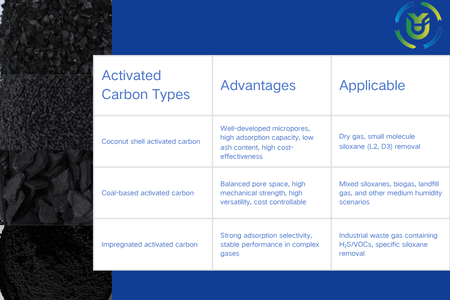
Coconut shell activated carbon is the more widely used type in siloxane removal, and its core features are developed microporous structure, strong adsorption capacity, and low ash content. Due to the high percentage of micropores, it has excellent adsorption effect on small molecule siloxanes (L2, D3), and is suitable for siloxane removal from dry gas streams (e.g., some industrial exhaust gases).
Advantage: high specific surface area, large adsorption capacity, renewable raw materials, environmentally friendly and cost-effective; Disadvantage: low percentage of mesopores, poor adsorption effect on large molecules of siloxane (D5, D6), and the adsorption performance will be significantly reduced in the high humidity environment.
The core advantage of coal-based activated carbon is a balanced pore structure, with a moderate proportion of micropores and mesopores, and high mechanical strength. This balanced pore structure makes it adaptable to mixed siloxane streams (e.g., D4, D5 coexisting biogas), and can adapt to the gas environment of medium humidity, which is currently the mainstream choice for biogas and landfill gas siloxane removal.
Advantages: strong versatility, high mechanical strength, not easy to be pulverized, suitable for large-scale, high-flow rate gas treatment scenarios, and relatively controllable cost; Disadvantages: adsorption capacity of small molecule siloxane is slightly lower than that of coconut shell activated carbon, and the ash content is higher than that of coconut shell activated carbon.
Impregnated activated carbon is a special activated carbon obtained through chemical modification, and its core feature is strong adsorption selectivity, which can preferentially adsorb siloxane in complex gas environments. It is mainly used in industrial exhaust gases containing interfering substances such as H₂S, VOCs, or in scenarios where specific types of siloxanes need to be removed.
Advantages: stable performance in complex gas matrices, can effectively improve siloxane removal rate and reduce adsorption failure, while inhibiting siloxane polymerization; Disadvantages: higher cost, need to be customized according to specific siloxane types and gas composition, less versatile.
|
Activated Carbon Types |
Core Advantages |
Applicable |
|
Coconut shell activated carbon |
Well-developed micropores, high adsorption capacity, low ash content, high cost-effectiveness |
Dry gas, small molecule siloxane (L2, D3) removal |
|
Coal-based activated carbon |
Balanced pore space, high mechanical strength, high versatility, cost controllable |
Mixed siloxanes, biogas, landfill gas, and other medium humidity scenarios |
|
Impregnated activated carbon |
Strong adsorption selectivity, stable performance in complex gases |
Industrial waste gas containing H₂S/VOCs, specific siloxane removal |
Adsorption capacity refers to the total amount of siloxane that can be adsorbed by activated carbon, which directly determines the service life and replacement frequency of activated carbon, and the core focus on two indicators:
It refers to the amount of siloxane that can be adsorbed per unit mass of activated carbon from the beginning of adsorption until the siloxane breaks through the adsorption layer (i.e., the siloxane is detected at the outlet), which is a key indicator for judging the actual service life of activated carbon, and directly determines the replacement frequency.
The adsorption capacity in the laboratory environment is usually higher than the actual working condition, because there are impurities, humidity and other disturbing factors in the actual gas, the selection should be combined with the site conditions, leaving a certain margin to avoid frequent replacement due to insufficient capacity.
Currently, the actual working capacity of commercial siloxane removal activated carbon is usually between 1% and 1.5% (siloxane mass/activated carbon mass).
Pore size distribution is centered on “matching siloxane molecule size”: small siloxanes (L2, D3) require micropores (<2 nm) for adsorption, while large siloxanes (D5, D6) require mesopores (2-50 nm) for diffusion and adsorption. If the pore size does not match the siloxane molecules, the adsorption effect will be poor even if the specific surface area is high.
For example, to deal with mixed siloxanes dominated by D4 and D5, coal-based activated carbon with balanced micropores and mesopores should be selected; to deal with small-molecule siloxanes dominated by D3, coconut shell activated carbon with well-developed micropores can be selected.
Specific surface area (BET) is an important index to measure the adsorption capacity of activated carbon, but the saying of “the higher the better” is not valid – the key lies in the effective utilization rate of pores. If the pore size is too large or too small to match the siloxane molecules, even a high BET will not work.
For siloxane removal, the optimal range of specific surface area of activated carbon is 1000-1600 m²/g. Activated carbon in this range can provide sufficient adsorption sites, but also ensure a reasonable pore size for efficient adsorption.
In high flow rate gas treatment system, activated carbon will be impacted by gas flow and friction of particles, if the hardness and mechanical strength are insufficient, it is easy to be pulverized and crushed, and the dust generated will block the pipeline of the equipment, increase the pressure drop of the system, and reduce the adsorption efficiency at the same time.
When selecting the type, we need to pay attention to the wear rate and compressive strength of the activated carbon, and give priority to the products with high hardness and not easy to be pulverized (such as coal-based activated carbon), which are especially suitable for landfill gas, biogas and other high-flow gas treatment scenarios, and can extend the service life of the activated carbon, and reduce the maintenance cost.
Gases such as biogas and landfill gas usually contain high humidity, and water molecules will compete with siloxane for the adsorption pores of the activated carbon, leading to a decrease in adsorption capacity and a shorter service life. Therefore, the hydrophobicity and moisture content of the activated carbon used for siloxane removal are critical.
When selecting activated carbon, hydrophobic activated carbon should be preferred, as its surface can effectively repel water molecules and avoid the adsorption sites being occupied by water; at the same time, the moisture content of activated carbon should be controlled at a lower level, so as to avoid affecting the adsorption effect due to the moisture itself. Generally speaking, the adsorption performance of activated carbon is best when the relative humidity is lower than 30%, if the gas humidity is more than 30%, it is recommended to carry out pre-demoisturization treatment first.
The particle size and shape of activated carbon will affect the gas contact time and system pressure drop, and should be considered in combination with the type of equipment and treatment flow rate:
The shape of activated carbon is divided into columnar (pellets) and spherical (pellets), the specific surface area of columnar activated carbon is larger, the contact is more adequate, but the pressure drop is higher; spherical activated carbon has good fluidity, lower pressure drop, suitable for large flow gas treatment, and more convenient to replace.
The smaller the particles, the larger the contact area, the better the adsorption effect, but the higher the pressure drop; the larger the particles, the lower the pressure drop, but the adsorption effect will be slightly reduced. Usually, the size of activated carbon particles for siloxane removal is 2-4 mm, which can achieve a balance between adsorption effect and pressure drop.
Other components in the gas will directly affect the adsorption effect of activated carbon: methane (CH₄), carbon dioxide (CO₂) and other major components have a small impact on adsorption, but will occupy part of the space, reducing the effective adsorption sites; hydrogen sulfide (H₂S), VOCs and other impurities will compete for adsorption sites with siloxane, which will lead to early failure of the activated carbon.
If the gas contains H₂S, VOCs, it is recommended to choose the impregnated activated carbon, or increase the pre-treatment link before the activated carbon adsorption to remove the interfering impurities.
The adsorption performance of activated carbon is negatively correlated with temperature, low temperature environment (20-40℃) can enhance the adsorption effect, and high temperature will lead to the increase of kinetic energy of siloxane molecules, which is easy to be desorbed from the pores of activated carbon, and reduce the adsorption capacity. Therefore, the temperature of the adsorption system should be controlled below 40℃.
The higher the pressure, the higher the concentration of siloxane molecules in the gas, the higher the probability of contact with the surface of activated carbon, and the adsorption capacity will be enhanced accordingly. For high pressure scenarios such as biogas purification, the adsorption effect of activated carbon will be superior.
As mentioned earlier, humidity is a key factor affecting the adsorption of siloxanes by activated carbon. When the relative humidity of the gas exceeds 30%, water molecules will occupy the micropores and mesopores of the activated carbon in large quantities, leading to a significant decrease in siloxane adsorption capacity. Therefore, for high humidity gases (e.g., biogas, landfill gas), it is recommended to add pre-humidification equipment to control the humidity below 30% or choose hydrophobic activated carbon.
Empty bed contact time (EBCT) refers to the residence time of the gas in the activated carbon bed, which directly determines the adsorption effect of siloxane – insufficient residence time, siloxane molecules can not be sufficiently adsorbed, and will directly break through the adsorption layer; residence time is too long, which will increase the pressure drop of the system and reduce the treatment efficiency.
The minimum EBCT for siloxane removal is 0.5 seconds, and it is recommended to control it between 0.5-1 seconds; at the same time, the gas flow rate should be controlled at 0.1-0.3 m/s, to avoid that the flow rate is too fast, resulting in insufficient contact time, or that the flow rate is too slow, resulting in inefficient operation of the system. In addition, the height of the activated carbon bed should be ≥1m to ensure sufficient contact time.
The penetration curve is the core curve describing the adsorption process of activated carbon, with time as the horizontal axis and outlet siloxane concentration as the vertical axis. The inflection point of the curve (i.e. the exit siloxane concentration reaches the emission standard) is the penetration point, and the time from the beginning of adsorption to the penetration point is the actual service life of the activated carbon. The shorter the mass transfer zone in the curve, the higher the utilization rate of activated carbon and the better the adsorption effect.
The service life of activated carbon is mainly affected by four factors: siloxane concentration, gas flow rate, adsorption capacity of activated carbon, and operating conditions (temperature, humidity, impurity content). The estimation formula can be simplified as follows: service life (days) = (mass of activated carbon × actual adsorption capacity) ÷ (gas flow × siloxane concentration).
Bed volume (m³) = (gas flow rate (m³/h) × empty bed contact time (EBCT, sec)) ÷ 3600, the bed volume directly determines the filling amount of activated carbon, which is the basis for calculating the consumption. 2.
Activated carbon mass (kg) = bed volume (m³) × activated carbon packing density (kg/m³); Note: The packing density of commercial siloxane-removed activated carbon is usually 1.0-1.2 kg/m³, which can be adjusted according to specific product parameters.
Note: The stacking density of commercial siloxane removal activated carbon is usually 1.0-1.2 kg/m³, which can be adjusted according to specific product parameters.
The treatment scale of a biogas plant is 100 m³/h, and the concentration of siloxane in biogas is 50 ppm. Coal-based activated carbon with a stacking density of 1.2 kg/m³ is selected, the empty bed contact time (EBCT) is 0.6 seconds, and the actual adsorption capacity of the activated carbon is 1% (mass of siloxane/mass of activated carbon), and the calculation process is as follows:
In actual application, the bed volume and activated carbon dosage should be adjusted according to the working condition on site, and the replacement cycle of activated carbon in biogas plants is usually 1-6 months.
The iodine value is an index to measure the adsorption of small molecule substances (e.g. iodine) by activated carbon, which is not directly related to the adsorption performance of siloxane. Blindly pursuing a high iodine value may lead to wrong selection and fail to achieve the expected removal effect.
Without considering the high humidity characteristics of biogas, landfill gas, the selection of ordinary hydrophilic activated carbon, resulting in a significant decline in adsorption capacity, frequent replacement of activated carbon, increasing operation and maintenance costs.
The actual siloxane concentration is higher than the test value, leading to early penetration of activated carbon, which is not replaced in time, triggering environmental risks and even facing environmental penalties.
Relying only on laboratory data selection, without considering the site gas composition, humidity and other interfering factors, resulting in the activated carbon and the actual working conditions do not match, poor adsorption effect.
The pore structure and adsorption capacity of low-priced activated carbon are unstable, and the difference between batches is large. Although the initial cost is low, it is replaced frequently, and the long-term operation and maintenance cost is higher, and it may face environmental protection penalties due to substandard adsorption effect.
After selection, the actual performance of activated carbon should be verified through testing to avoid product quality problems affecting the removal effect of siloxane. The test is divided into laboratory test and on-site test, the core focus on the following points:
Under the ideal conditions of temperature, humidity and gas composition control, the adsorption capacity and penetration time of activated carbon are tested, which are mainly used for screening candidate products and understanding the basic performance of activated carbon, so as to provide reference for subsequent selection.
Build a small activated carbon adsorption device under actual working conditions and test it using on-site gas samples to verify the performance of activated carbon in the actual environment, which is a key part of selection to avoid the disconnection between laboratory data and actual working conditions (it is recommended to test it according to ASTM D5160 standard).
During the pilot test, the following three points should be noted: first, use the same amount of activated carbon and bed structure as the actual system; second, use the real gas on site to ensure that the test conditions are consistent with the actual working conditions; third, continuously monitor the penetration time, adsorption capacity, system pressure drop and other indicators, to ensure that the data are accurate.
The time from the start of adsorption to the exit siloxane concentration reaching the standard (penetration point) directly determines the service life of the activated carbon, and is one of the core indexes for evaluating the performance of activated carbon.
The actual amount of siloxane adsorbed per unit mass of activated carbon needs to be compared with the parameters provided by the supplier to verify whether the product quality meets the standard and avoid purchasing inferior products.
Pressure drop changes during system operation. If the pressure drop rises rapidly, it indicates that the activated carbon may be pulverized or clogged, and should be adjusted or replaced in time to ensure stable operation of the system.
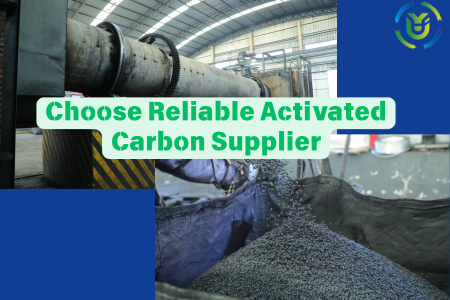
Priority should be given to suppliers with ISO and other relevant certificates to ensure that the product quality meets the industry standard; at the same time, the supplier should have a perfect quality control system and be able to provide batch-to-batch performance test reports to ensure the consistency of the performance of the activated carbon. In addition, the supplier should be able to provide third-party test reports to verify the adsorption capacity, pore structure and other key indicators.
The performance of activated carbon is closely related to the quality of raw materials, and the supplier should have stable raw material sources (e.g. coconut shells, high-quality coal) to avoid unstable performance of activated carbon due to fluctuation of raw materials. Suppliers can be required to provide raw material procurement certificates and quality inspection reports to ensure that the quality of raw materials meets the standards.
The supplier shall have professional knowledge in the field of siloxane removal and be able to provide customized activated carbon solutions according to the specific working conditions of the enterprise (gas composition, siloxane type, humidity, etc.); meanwhile, it can provide timely technical support to solve the problems of poor adsorption effect, abnormal pressure drop and other problems that occur in the course of operation.
Priority shall be given to suppliers with experience in biogas, landfill gas and industrial waste gas siloxane removal projects, and suppliers can be requested to provide relevant cases and customer testimonials to understand the performance of their products in actual application. Suppliers with rich industry experience can better cope with complex working conditions and provide more reliable products and services.
The total life cycle cost includes: activated carbon procurement cost, replacement cost, operation and maintenance cost (labor, equipment loss), and disposal cost of waste activated carbon (saturated activated carbon is a hazardous waste and requires professional disposal). Low-priced activated carbon may have low procurement cost, but with frequent replacement and high O&M cost, the whole life cycle cost is higher.
The price of different types of activated carbon varies greatly: coconut shell activated carbon is moderately priced and has a moderate replacement frequency; coal-based activated carbon is less expensive and has a moderate replacement frequency; impregnated activated carbon is more expensive but has a lower replacement frequency. When selecting the type of activated carbon, it is necessary to combine the adsorption capacity and replacement cycle to calculate the cost of activated carbon consumption per unit of time, rather than simply looking at the unit price.
Although the upfront investment of high-quality activated carbon is higher, it can reduce the frequency of replacement, lower the wear and tear of the equipment, and avoid unplanned shutdowns, so the long-term operation and maintenance cost savings are much higher than the additional investment in the early stage. For example, by choosing high-performance activated carbon, the replacement cycle can be extended from 1 month to 3 months, which not only reduces labor and activated carbon procurement costs, but also avoids production losses caused by downtime.
Q1: Does humidity affect the adsorption of siloxane by activated carbon?
A1: Yes. High humidity will cause water molecules to occupy the adsorption pores of activated carbon, significantly reducing the adsorption capacity of siloxane. It is recommended to control the gas humidity below 30% or use hydrophobic activated carbon.
Q2: How often does the activated carbon need to be replaced?
A2: When the detected concentration of siloxane at the outlet reaches the emission standard (penetration point), it needs to be replaced in time; it is also possible to plan the replacement time in advance according to the service life calculated in advance, so as to avoid exceeding the environmental protection standard.
Q3: Must I use impregnated activated carbon to remove siloxane?
A3: Not necessarily. Only when the gas contains H₂S, VOCs and other interfering substances, or when it is necessary to remove a specific type of siloxane, then it is necessary to use impregnated activated carbon; for ordinary biogas and landfill gas, it is sufficient to use coconut shell or coal-based activated carbon.
Q4:What is the ideal specific surface area of activated carbon for siloxane removal?
A4:The ideal range is 1000-1600 m²/g. The key lies in matching the pore size with siloxane molecules rather than simply pursuing a high specific surface area.
The core of selecting activated carbon for siloxane removal is to “match the working conditions and take into account the cost and performance” – firstly, we should clarify the type of siloxane in the gas, concentration, humidity and other working conditions, and then combine the pore structure, adsorption capacity, mechanical strength and other indexes of activated carbon to select the right type of activated carbon. At the same time, choose a reliable supplier and verify the performance through on-site testing to avoid falling into the selection misunderstanding.