📖 Contents
For fish enthusiasts, an aquarium is not only a container for viewing beautiful scenery, but also a home for fish, aquatic plants and other aquatic organisms. Clean and safe water quality is the core of maintaining the health and stability of this tiny aquatic ecosystem – deteriorating water quality not only leads to muddy water and odour, but also breeds harmful toxins that can threaten the lives of fish and shrimps. Among the many aquarium filtration materials, activated carbon, with its strong adsorption capacity, has become an indispensable core filtration medium in freshwater and saltwater aquariums. In this article, we will explain in detail how to choose the right activated carbon for your aquarium, avoid common misunderstandings, and teach you how to optimise water quality and guard the health of aquatic organisms through the scientific selection of activated carbon, whether you are a novice or a veteran player, you can find practical reference content.
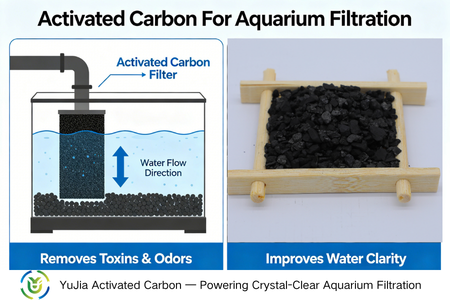


Water quality is the ‘lifeline’ of aquarium ecology, once the water quality problems, the whole aquarium system may face collapse. Many novice fish farmers will encounter such trouble: aquarium water body suddenly yellow, emit unpleasant odour, or fish and shrimp inexplicably appear vitality decline, rotting fins and other problems, which are mostly related to the impurities and toxins in the water.
Common water quality problems in the aquarium are mainly three types: one is the smell, mostly from fish and shrimp feces, residual bait rotting organic waste; the second is the discolouration of the water, the most common is the sinking wood, olive leaves release of tannins caused by the yellowing of the water; the third is the harmful toxins, including chlorine in the water, chloramines, and organic pollutants in the water body breeding, and so on. Activated carbon is a powerful tool for solving these problems.
Activated carbon is one of the core filtration media in both freshwater and saltwater aquariums. It can quickly remove harmful impurities in the water through unique adsorption, improve water transparency, make the water cleaner and safer, and provide a stable living environment for fish, shrimp and aquatic plants. Simply put, activated carbon is like the ‘purifier’ of the aquarium, silently adsorbing the ‘rubbish’ in the water, guarding the balance of the entire aquatic ecology, and its role is difficult to replace other filtration materials. Research shows that activated carbon has a strong adsorption capacity for organic matter within the molecular weight range of 500-1000, which can effectively improve the purity of aquarium water.
Many people’s cognition of activated carbon stays in ‘can adsorb impurities’, but in fact its core principle and characteristics determine its effect in aquarium filtration. Activated carbon is a kind of porous carbon material after special activation treatment, with extremely developed pore structure – 1 gram of high-quality activated carbon’s pore area can reach more than 1,000 square metres, and this huge surface area is the source of its adsorption capacity.
There is a key concept that needs to be distinguished here: the function of activated carbon is ‘adsorption’ (not ‘absorption’). Adsorption means that the impurity molecules in the water are firmly adsorbed on the pore surface of the activated carbon through molecular force, just like dust sticking on a sponge, and will not enter the inside of the activated carbon; whereas absorption is the penetration of substances into the inside of another substance, and there is a fundamental difference between the two. In aquarium filtration, when the water flows through the activated carbon, the impurity molecules in the water will be firmly ‘grasped’ by its pores, so as to be separated from the water body to achieve the purpose of water purification.
Chlorine and chloramine: Chlorine and chloramine added to tap water are for sterilisation, but they are toxic to fish and shrimp, activated carbon can quickly adsorb and remove them to avoid fish and shrimp poisoning;
Organic compounds: organic waste produced by the decay of fish and shrimp faeces and residual bait can lead to deterioration of water quality, activated carbon can adsorb these organic impurities and reduce water pollution;
Tannins: tannins released by aquascape materials such as sunken wood and elemi leaves will make the water body yellow and affect the ornamental effect, activated carbon can adsorb tannins and restore the clarity of the water body;
Odour and dissolved pollutants: dissolved pollutants such as odour and trace heavy metals in the water body can also be effectively adsorbed by activated carbon to make the water cleaner and odourless.
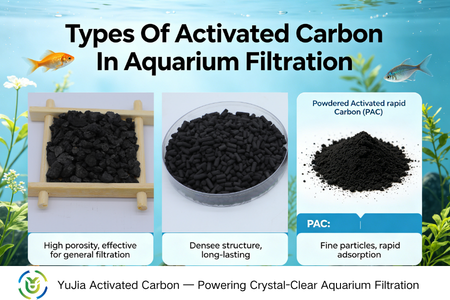
Granular Activated Carbon (GAC): This is the most common and widely used type of activated carbon, which is in the form of irregular particles with well-developed pores and large adsorption capacity. It has the advantage of long service life, suitable for long-term continuous use, suitable for most of the aquarium filtration systems (such as external filter bucket, top filter, bottom filter, etc.), and is the first choice for home aquariums. Granular activated carbon is usually made of high-quality coconut shells, walnut shells and other raw materials, with high mechanical strength, not easy to be de-powdered, and can play a stable role in long-term filtration.
Powdered activated carbon (PAC): it is in the form of fine powder, with a larger surface area than granular activated carbon, and the adsorption speed is very fast, which is suitable for short-term emergency use. For example, if the aquarium suddenly has a serious odour, the water body is rapidly yellowing, or the water quality is turbid after a water change, the use of powdered activated carbon can quickly improve the water quality. However, its disadvantage is that it has a short lifespan and needs to be replaced frequently, and it is easy to clog the filter cotton, so it is not suitable for long-term continuous use. Powdered activated carbon is made of high-quality charcoal, refined by a special process, with strong adsorption capacity, but it is necessary to pay attention to the way of use to avoid clogging the filtration system.
Column/extruded activated carbon: it is in the form of uniform column or sphere, with high density and low resistance to water flow, which is suitable for high-flow filtration system. It has stable adsorption performance and is not easy to be pulverised. It is suitable for large-scale aquariums or commercial aquarium systems, and it can achieve high efficiency filtration while ensuring smooth water flow. Columnar activated carbon is mostly made of anthracite or charcoal, processed by advanced technology, with high mechanical strength, easy to regenerate, and suitable for high-flow filtration scenarios.
| Activated Carbon Types | Core Advantages | Applicable Scenarios |
| Granular Activated Carbon (GAC) | Long life and high adsorption capacity | Household routine filtration, most aquariums |
| Powdered Activated Carbon (PAC) | Fast adsorption speed | Short-term emergency, rapid water quality improvement |
| Column/Extruded Activated Carbon | Low resistance to water flow, stable performance | Large aquariums, high-flow filtration systems |
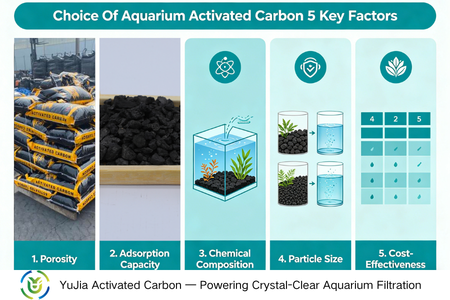
Coconut shell as raw material, made after activation treatment, pore fine and developed, strong adsorption capacity, high purity, not easy to release harmful substances, is the first choice for aquarium activated carbon (high-end models are mostly coconut shell raw materials). It has developed microporous structure, large specific surface area, significant effect on the adsorption of organic matter and toxins in the water, and pH stability, will not easily affect the water quality of the aquarium, suitable for most of the aquariums, but also the quality of the raw material choice for water purification activated carbon.
Coal as raw material, low price, pore structure is coarse, adsorption capacity is medium, suitable for the filtration effect is not demanding, the pursuit of cost-effective ordinary family aquarium. However, it is necessary to pay attention to the selection of coal activated carbon with high purity to avoid excessive impurities affecting water quality. The advantage of coal-based activated carbon is low cost, suitable for batch use, but need to strictly control the purity to avoid excessive ash.
Wood-based activated carbon is a weak adsorption capacity with fewer applications. It is only suitable for certain specific scenarios (e.g. targeted adsorption of certain organic impurities), and is generally not recommended for use in home aquariums. The pore structure of wood-based activated carbon is relatively sparse, with limited adsorption capacity, which is more suitable for specific areas such as industrial wastewater treatment, and is less commonly used in aquarium scenarios.
Iodine value is the key index to measure the adsorption capacity of activated carbon, the unit is mg/g. Simply put: the higher the iodine value is, the higher the adsorption capacity of activated carbon is, and the better the filtration effect is. The recommended range of iodine value of activated carbon for aquarium is 800-1200mg/g. Activated carbon lower than 800mg/g has a weak adsorption capacity, which is difficult to meet the demand of aquarium filtration; activated carbon higher than 1,200mg/g has a high price, which is not cost-effective for an ordinary home aquarium and may over-adsorb the beneficial substances in the water.
It should be noted that the stronger the adsorption capacity is not the better, and it is necessary to balance the performance and safety: excessive adsorption may take away the beneficial trace elements in the water (e.g., nutrients needed by aquatic plants), especially in aquariums, and it is necessary to control the adsorption strength of activated carbon. In addition to iodine value, carbon tetrachloride adsorption value and methylene blue adsorption value can also reflect the adsorption capacity of activated carbon, of which the iodine value mainly reflects the adsorption capacity of liquid substances, which is the core reference index of aquarium activated carbon.
Ash is an impurity component in activated carbon, the higher the ash content, the lower the purity of the activated carbon, which may release harmful substances into the water, leading to fluctuations in the pH value of the water, water turbidity, and seriously harming fish and shrimp. Therefore, the ash content of activated carbon for aquariums should be controlled below 8%, the lower the ash content, the higher the purity and the safer it is to use.
Many low-priced low-quality activated carbon, ash content exceeds the standard, into the aquarium will lead to white water, pH value suddenly change, especially sensitive fish and shrimp (such as seven-coloured fairy fish, crystal shrimp), it is very easy to get sick or even death. When purchasing, check the ash index in the product description, and try to choose products in sealed packages to avoid the activated carbon adsorbing impurities in the air and reducing the adsorption performance.
The particle size of activated carbon affects the filtration efficiency and water flow rate, and needs to be matched with your own filtration system:
Fine granular activated carbon (1-3mm ): fast adsorption speed, but high water flow resistance, easy to block the filter cotton, suitable for small flow filtration systems (such as small external filter bucket);
Coarse granular activated carbon (3-5mm ): small water flow resistance, not easy to be blocked, slightly slower adsorption speed, but longer service life, suitable for large flow filtration systems (such as bottom filter, large top filter).
If the particles are too small, it will lead to poor water flow and overloading of the filtration system; if the particles are too large, the water flow speed is too fast, and the impurities will flow through before they can be adsorbed, and the filtration effect will be greatly reduced. Therefore, the selection should be based on the flow rate of the filtration system, matching the appropriate particle size, to ensure adsorption efficiency and smooth water flow. The particle size distribution of activated carbon will also affect the filtration effect, generally 8-30 mesh particle size range is more suitable for aquarium filtration scenarios.
Aquarium organisms (especially fishes and shrimps) are very sensitive to the pH value of the water body, most ornamental fishes are suitable to live in neutral or weakly acidic water with pH value of 6.5-7.5, and the pH value of the aquarium needs to be kept stable. Poor quality activated carbon, on the other hand, may release acidic or alkaline substances into the water, leading to drastic fluctuations in water pH, upsetting the water balance and triggering stress reactions in fish and shrimp.
When choosing activated carbon, priority should be given to pH-stable (neutral) products, avoiding industrial-grade activated carbon that has not been purified – industrial activated carbon may contain acidic and alkaline impurities, which can seriously affect water quality and even lead to the death of fish and shrimp after being put into the aquarium. High-quality aquarium activated carbon pH value is usually between 5-10, can be well adapted to the aquarium water environment, will not cause significant fluctuations.
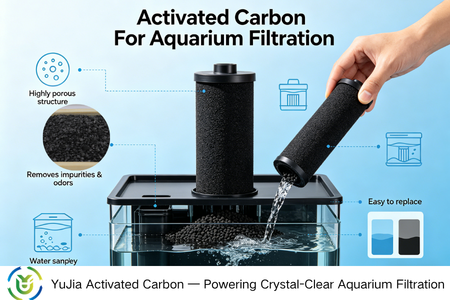
Different types of aquariums (freshwater, seawater, aquascape, etc.) have different water quality and filtration needs, and the selection of activated carbon needs to be targeted to achieve the best filtration effect, while protecting aquarium organisms:
The core needs of freshwater aquariums are to improve water clarity, remove odours and chlorine, and the requirements for activated carbon are relatively mild. Recommended choice: coconut shell or coal granular activated carbon (GAC), iodine value 800-1000mg/g, ash content ≤8%, particle size 2-4mm, suitable for conventional filtration system.
Focus on the adsorption capacity and pH stability of activated carbon, no need to pursue too high iodine value, avoid excessive adsorption of beneficial substances in the water, and take into account the effect and cost-effectiveness. For common freshwater fish, such as peacock fish, zebra fish, etc., choose medium quality coconut shell granular activated carbon can meet the demand.
The water quality of saltwater aquarium is more sensitive, the fish and shrimp (such as clown fish, coral) have very high requirements for water purity, and the seawater environment is easy to breed algae, so the requirements for activated carbon are more stringent. Recommended choice: high purity coconut shell granular activated carbon (GAC), iodine value 1000-1200mg/g, ash ≤ 5%, and must be phosphorus-free activated carbon.
Phosphorus-free is the key – if the activated carbon in the seawater aquarium contains phosphorus, it will lead to algae outbreaks, destroying the coral and fish and shrimp; at the same time, high purity can avoid the release of impurities and protect the stability of seawater quality. The activated carbon in seawater aquariums should be replaced regularly to ensure the adsorption effect and avoid water quality deterioration due to adsorption saturation.
The special feature of aquascape is that aquatic plants need to absorb nutrients (e.g. nitrate, phosphate) from the water to grow, and the adsorption effect of activated carbon will take away some of the nutrients, so the choice of activated carbon for aquascape needs to be extra cautious, and even can be limited or avoided according to the situation.
If the aquarium has problems such as yellowing of the water body, odour and so on, it is recommended to use activated carbon: low adsorption strength of wood or low iodine value of coconut shell activated carbon (iodine value of 800mg/g or less), and take it out in time after the short-term use (1-2 weeks), so as to avoid the long-term use of activated carbon that will lead to the loss of aquatic plant nutrients and poor growth. At the same time, avoid the use of powdered activated carbon to prevent clogging of aquatic grass leaves and affecting photosynthesis.
Commercial aquaculture (e.g., ornamental fish breeding, batch feeding) has a large aquarium system with high volume and high flow rate, and the demand for activated carbon is ‘high efficiency, batch, and cost-effective’. Recommended choice: column/extruded activated carbon or bulk granular activated carbon (GAC), iodine value 900-1000mg/g, ash content ≤8%, particle size 3-5mm, suitable for high flow rate filtration system.
Focus on: balance between cost and performance, choose products that can be supplied in bulk and have stable quality, and also need to be replaced in bulk periodically to ensure filtration effect and avoid affecting the breeding efficiency due to water quality problems. In commercial aquaculture, the regenerability of activated carbon can also be used as a reference factor to reduce the cost of long-term use.
Although many people choose the right activated carbon, but because of improper use, not only did not achieve the filtration effect, but also harmed the aquarium organisms. The following 4 common misunderstandings must be avoided:
The use of industrial-grade activated carbon: industrial activated carbon has not been purified for aquariums, high ash, impurities, may contain toxic substances, put into the aquarium will contaminate the water, resulting in the death of fish and shrimp. Be sure to choose clearly marked ‘aquarium-specific’ activated carbon, to avoid the cheap purchase of industrial-grade products – there are fake activated carbon on the market, most of which are not activated charcoal material pretending to be such carbon almost no adsorption properties, the colour of the white, feel hard, you need to pay attention to differentiate when you buy! Be careful to distinguish them when purchasing them.
Unscheduled replacement of activated carbon: The adsorption capacity of activated carbon is limited, generally after 2-4 weeks of use, the pores will be filled with impurities and the adsorption capacity will decline, and even release the adsorbed impurities, leading to deterioration of water quality. Many newbies mistakenly think that activated carbon can be used for a long time until the water body has problems before replacement, this is very wrong, need to be strictly in accordance with the cycle of 2-4 weeks of replacement (can be shortened to 1-2 weeks when the water quality is seriously polluted).
Excessive use of activated carbon in aquarium: As mentioned before, activated carbon will adsorb the nutrients needed by aquatic plants, and excessive use of activated carbon will lead to yellowing and wilting of aquatic plants, especially for newbies, do not place activated carbon in the tank for a long period of time for the sake of pursuing the ‘ultimate clarity’, but use it for a short period of time according to the need.
Mismatch between the size of activated carbon and the filtration system: too small particles will clog the filter cotton, too large particles will affect the adsorption effect; too little activated carbon will fail to achieve the filtration purpose, and too much activated carbon will cause the water flow to be unsatisfactory. According to the volume of the aquarium and the flow of the filtration system, we need to reasonably choose the size of the particles and dosage (generally 50-100g of activated carbon per 100 litres of water).
Follow the order of ‘mechanical filtration → chemical filtration → biological filtration’, and put activated carbon after filter cotton (mechanical filtration) and before biological filter materials (such as ceramic rings and biochemical cotton). This can first remove large particles of impurities in the water (such as residual bait, faeces) through the filter cotton, to avoid impurities blocking the pores of the activated carbon, affecting the adsorption effect; at the same time, to avoid the activated carbon powder into the biofilter material, destroying the nitrifying bacterial community.
Under normal circumstances, replace the activated carbon every 2-4 weeks; if the aquarium water quality is seriously polluted (e.g., a large number of fish and shrimp deaths, excessive residual bait), it can be shortened to 1-2 weeks to replace. When replacing, it is recommended not to replace all the activated carbon at once, but to keep 1/3 of the old activated carbon to help the new activated carbon to quickly establish the adsorption balance and reduce the fluctuation of water quality.
Newly purchased activated carbon will have a small amount of dust and impurities on the surface, which will cause turbidity when put directly into the aquarium. Before use, rinse the aquarium 2-3 times with clean water until the water is clear and free of dust before placing it into the filtration system to avoid contamination of the water by dust.
According to the size of the aquarium, the amount of activated carbon should be reasonably controlled, generally 50-100g of activated carbon should be used for every 100 litres of water. Too much activated carbon will lead to poor water flow, while too little activated carbon will fail to achieve the desired filtration effect. For small aquariums (≤ 50 litres), the dosage can be appropriately reduced to avoid excessive adsorption.
Take two transparent cups and fill them with equal amount of turbid aquarium water (or clear water with a small amount of red ink dripped into them), put an appropriate amount of activated carbon into one cup to be tested, and use the other one as a control, and let it stand for 10-20 minutes. If the water quality of the cup with activated carbon becomes clearer, it means that its adsorption capacity is better; if the water quality does not change significantly, or even becomes more turbid, it means that the quality of activated carbon is poorer or has been adsorbed saturated. This method makes use of the decolourisation ability of activated carbon, the stronger the decolourisation effect, the better the adsorption performance.
Take a small amount of activated carbon, put it into a cup with water, soak it for 24 hours, and then use pH test paper to detect the pH value of the water. If the pH value is between 6.5-7.5 (neutral), it means that the activated carbon is pH stable and suitable for aquarium use; if the pH value is obviously acidic or alkaline, it means that the activated carbon contains impurities and is not suitable for use.
If activated carbon is purchased in bulk (e.g. for commercial breeding), it can be sent to the laboratory for testing of iodine value, ash content, purity and other indexes to ensure that the activated carbon meets the special standards for aquariums – iodine value of ≥800mg/g, ash content of ≤8%, and pH neutrality, which are the basic requirements for activated carbon for aquariums. In addition, the specific surface area and strength of activated carbon can also be tested to judge its quality comprehensively.
First, look at the volume, under the same weight, good activated carbon pore developed, larger volume, feel lighter; the second is to see the bubble, activated carbon into the water, if the production of small bubbles, the duration of a long time, indicating that its pore developed, adsorption capacity, and vice versa, the quality of the poorer.
For ordinary home users, choose a reliable supplier in order to buy quality-guaranteed aquarium activated carbon; for commercial farming or aquarium business, choose a high-quality supplier, but also to ensure the stability of supply, cost-effective, specific attention can be paid to the following four points:
Choose suppliers with perfect quality control system to ensure consistent quality of each batch of activated carbon and avoid batch differences (e.g. unstable iodine value and ash content). Suppliers can be asked to provide product test reports to check key indicators such as iodine value, ash content, pH value, etc. to ensure compliance with aquarium-specific standards.
Priority should be given to suppliers with relevant certificates such as ISO, NSF, etc. The production process of such suppliers is more standardised and the quality of products is more guaranteed, especially when exporting or purchasing in bulk, the certification is an important reference basis. Certified products can effectively avoid purchasing poor quality or industrial grade activated carbon.
If there are special needs (e.g. customised particle size, iodine value, packaging), you can choose suppliers that provide OEM/ODM customisation services to meet the individual needs of your own aquarium system or brand (e.g. aquarium merchants can customise their own brand of activated carbon).
For commercial farming, aquarium businesses and other users who need to purchase in bulk, we need to pay attention to the supplier’s ability to supply, delivery cycle and price advantage, choose suppliers that can provide stable supply and cost-effective, and at the same time, we can negotiate preferential policies for bulk purchasing to reduce the procurement cost. In addition, you can also pay attention to the supplier’s after-sales service, such as quality problems of the return policy.
The key to choosing the right activated carbon for your aquarium is ‘suitability’ – suitable for your aquarium type and filtration system, and at the same time taking into account the quality and cost-effectiveness. To sum up, novice aquarists can choose high-purity coconut shell granular activated carbon (GAC), iodine value of 800-1000mg/g, ash ≤ 8%, pH neutral, according to the cycle of 2-4 weeks of replacement, can meet the filtration needs of most of the aquariums; marine aquariums need to choose non-phosphorus models, aquatic plant tanks need to control the frequency of use and the amount of use, to avoid the loss of nutrients.