Activated carbon has become an indispensable core material with its excellent adsorption performance in many fields such as environmental protection, industrial purification and food processing. Among them, powdered activated carbon and granular activated carbon are the two most widely used categories. Although they belong to the same family of activated carbon, they are suitable for different scenarios due to differences in form and performance. Many enterprises and practitioners are easily confused when choosing whether to prioritise powdered or granular activated carbon. This article will comprehensively analyse the core differences between the two from the definition, characteristics, applications, differences in comparison and other dimensions, combined with the industry trends in 2026, to provide you with a scientific reference for selection, helping to accurately match demand and reduce operating costs.
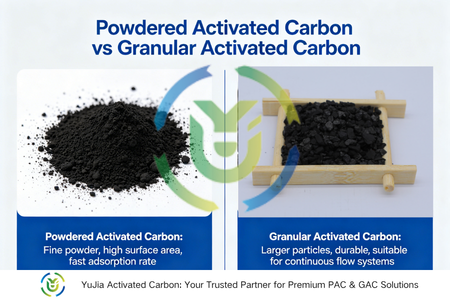


Activated carbon is a kind of carbon material with extremely high specific surface area and developed pore structure after physical or chemical activation treatment, and its core role is to capture all kinds of pollutants in gases and liquids through adsorption, which is widely used in environmental protection, food, medicine and other fields.
The adsorption capacity of activated carbon originates from its unique porous structure – micropores, mesopores and macropores formed during the activation process, which can lock the pollutant molecules in the pores through physical adsorption (van der Waals force) and chemical adsorption (surface functional group reaction) to achieve the purpose of purification and purification. This characteristic makes it an ‘efficient adsorbent’ to deal with all kinds of pollutants, which is also the core reason why it is widely used in the field of environmental protection.
The raw materials used in the production of activated carbon are mostly natural substances rich in carbon, which are mainly divided into three categories: coal (anthracite, lignite), coconut shells, and wood (wood chips, bamboo chips). Among them, coal-based activated carbon occupies about 60% of the domestic activated carbon market by virtue of its cost advantage. Coconut shell and wood-based activated carbon are mostly used in high-end purification scenarios due to their more developed pore structure and are growing at a faster rate, making them an important driving force for the industry’s growth. Powdered activated carbon and granular activated carbon made from different raw materials may also have slightly different adsorption performance and application scenarios.
In addition to powdered activated carbon and granular activated carbon, there are other types of activated carbon, such as extruded activated carbon (EAC), but powdered activated carbon and granular activated carbon are the two most commonly used in industrial and environmental protection fields. Extruded activated carbon (EAC) is mostly in the form of columns and is mainly used in specific gas purification and water treatment scenarios. This article focuses on the comparative analysis of powdered activated carbon and granular activated carbon.
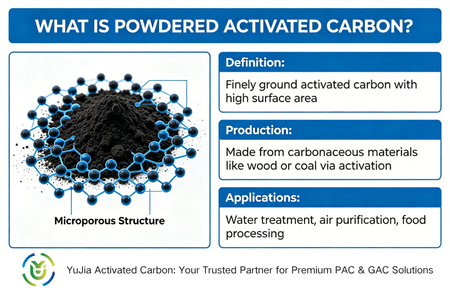
Powdered activated carbon is made by crushing activated carbon raw materials into fine powder directly after carbonisation and activation, and its core defining standard is particle size <0.18mm (80 mesh), and the particle size of some high-end products can reach 200-300 mesh, which belongs to the micron-level powder, with strong dispersibility, and it can be in contact with the medium to be treated quickly and fully.
High specific surface area: the fine powder form allows it to have a larger specific surface area, usually up to 1000-1500 ㎡ / g, the internal microporous ratio is higher, can provide more adsorption sites, adsorption capacity is greater;
Fast adsorption speed: the contact area between the powder and the fluid (water, gas) is very large, and the adsorption reaction can be effective in minutes, so pollutants can be captured quickly without prolonged contact;
Short contact time: no need for complex equipment, just simple stirring to achieve full contact, high processing efficiency, suitable for emergency scenarios;
Flexible delivery: the dosage can be flexibly adjusted according to the concentration of pollutants to meet the treatment needs of different pollution levels.
The characteristics of powdered activated carbon determine that it is more suitable for ‘emergency treatment’ and ‘flexible purification’ scenarios, and the core applications are concentrated in the following fields:
Wastewater treatment: Removal of high-concentration organic pollutants and heavy metals in industrial wastewater (chemical industry, printing and dyeing, papermaking, etc.), especially suitable for the treatment of wastewater with complex composition and large fluctuation in concentration, and can be used as a pre-treatment or deep treatment unit to make up for the deficiencies of conventional processes;
– Emergency pollution management: when the water plant encounters sudden pollution such as water source odour, pesticide residue, algal metabolites, etc., powdered activated carbon can be quickly injected to quickly adsorb the pollutants within 10-30 minutes to avoid the spread of pollution and protect the safety of drinking water;
Decolouration of food and beverage: decolourisation, deodorisation and purification of sucrose, fruit juice, edible oil, etc. It can quickly remove the pigment and odour in them without affecting the taste and quality of the products;
Other scenarios: rubbish leachate treatment, industrial waste gas emergency adsorption (special dispersion equipment is required), etc.
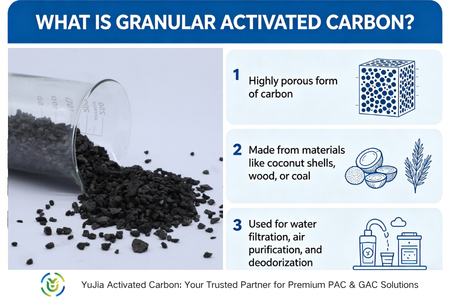
Granular activated carbon is a granular product made from raw materials of activated carbon after carbonisation and activation, adding binder and extrusion, and then sieving, and its core defining criterion is that the particle size is more than 0.2 mm, and the common particle sizes are divided into large particles (4-8 mesh), medium particles (8-30 mesh), and small particles (30-60 mesh), and different particle sizes are suitable for different scenarios.
Large particle size, stable structure: the particle form makes it have good mechanical strength, not easy to break, can be stably filled in the filtration equipment, suitable for continuous operation system.
Reusable and renewable: after adsorption saturation, the adsorption performance can be restored through thermal reactivation, etc. It can be reused for 3-5 times, which greatly reduces the long-term operation cost.
Suitable for continuous systems: It can be filled in fixed beds, filter columns and other equipment to achieve continuous filtration and purification of fluids without the need for frequent dosage and convenient operation.
Continuous and stable adsorption: Although the adsorption speed is slow, the adsorption effect is long-lasting, which can remove low concentration pollutants stably for a long time, and the purification effect is more stable.
Drinking water filtration: long-term filtration of municipal water plants, household water purifiers, industrial water purification equipment, can stably remove odour, residual chlorine, organics, etc. in water to ensure the safety of drinking water, of which medium granular activated carbon is mostly used in ordinary water purifiers, and small granular activated carbon is suitable for precision filtration.
Air purification: industrial VOCs treatment, indoor air purification, waste gas treatment, through the fixed-bed adsorption system, to remove harmful gases, odours in the air, is one of the core materials for VOCs treatment, with the increase in air pollution prevention and control, the demand continues to climb.
Fixed bed filtration system: deep treatment of industrial wastewater (polishing stage), continuous purification of gases, can operate stably for a long time and reduce the pressure of subsequent treatment.
Other scenes: precious metal recovery, solvent recovery, flue gas desulphurisation and denitrification.
Powdered activated carbon: particle size <0.18mm (80 mesh), in the form of fine powder, strong dispersion, no fixed form, need to be fully mixed with the medium after use.
Granular activated carbon: particle size > 0.2 mm, granular (or columnar, spherical), stable structure, can be directly filled in the filter equipment, without mixing, different particle size granular activated carbon in the resistance, flux also have differences.
Influence: The powder form of powdered activated carbon leads to its difficult separation after treatment, and additional precipitation and filtration processes are required; the granular form of granular activated carbon is easy to be retained in the filter, and the operation is more convenient and less abrasive to the equipment.
Powdered activated carbon: the adsorption speed is very fast, and the effect can be achieved in minutes, which can quickly cope with high concentration and sudden pollution, and belongs to the adsorbent of ‘fast and sudden type’, but the adsorption lasts for a short period of time.
Granular activated carbon: the adsorption speed is slower, and it takes hours or even days to achieve the ideal adsorption effect, which belongs to the ‘long-lasting and stable’ adsorbent, but the adsorption effect is lasting, and it can steadily remove the low-concentration pollutants for a long period of time.
Powdered activated carbon: powdered after use, mixed evenly with the treatment medium (water, gas), difficult to separate completely, easy to carry residual particles, the need for supporting sedimentation tanks, filtration machines and other equipment to increase the treatment process.
Granular activated carbon: the particle form is stable, can be directly filled in the fixed bed, filter column, fluid penetration particles layer can be completed adsorption, after use can be directly taken out of the equipment regeneration, separation difficulty is low, without additional processes.
Powdered activated carbon: low initial investment, no need for complex equipment, low cost of a single injection, but belongs to the one-time use, can not be regenerated, long-term frequent injection will lead to high operating costs; the current price of low-end powdered activated carbon is about 3,500 yuan / tonne, the price of high-end purification of special products up to 15,000 yuan / tonne.
Granular activated carbon: the initial investment is high, need to purchase fixed bed, filter column and other supporting equipment, the initial loading cost is high, but can be regenerated and reused, long-term operating costs are lower, more suitable for long-term stable operation of the scene.
Powdered activated carbon: Due to the small particle size, the cost of recycling and regeneration is extremely high, and it is usually used for one-time use in practical applications, and is directly discarded after adsorption saturation, and the discarded powder needs to be disposed of afterwards, which puts a little more pressure on environmental protection.
Granular activated carbon: regular shape, high mechanical strength, adsorption saturation can be regenerated through high temperature to restore adsorption performance, can be reused 3-5 times, 2026 regeneration of activated carbon utilisation rate is expected to increase to more than 35%, which can not only reduce the cost, but also reduce the generation of waste.
|
Contrasting dimensions |
Powdered activated carbon |
Granular activated carbon |
|
Particle size and morphology |
<0.18mm (80 mesh), fine powder form |
>0.2mm, granular (or columnar, spherical) |
|
Adsorption rate and efficiency |
Minute effect, rapid adsorption, short duration |
Hourly/daily effect, long-lasting adsorption, stable and efficient |
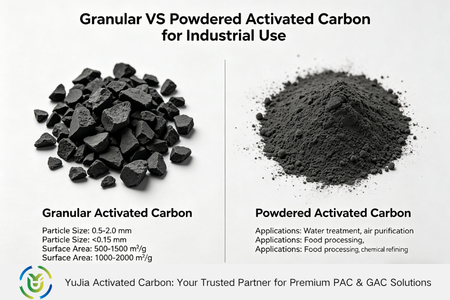
Powdered activated carbon: suitable for emergency impact injection, such as seasonal pollution, sudden water pollution (algae outbreaks, pesticide spills), as well as industrial wastewater removal of high-concentration pollutants, the demand for activated carbon in the field of municipal water supply in 2026 amounted to 205,000 tonnes, and powdered activated carbon plays an important role in emergency treatment.
Granular activated carbon: suitable for long-term fixed-bed filtration, such as conventional purification in municipal waterworks, household water purifiers, industrial pure water preparation, can remove residual chlorine, odour and organic matter in water stably for a long period of time, and is the core long-lasting purification material in the field of water treatment.
Powdered activated carbon: It is mainly used in the primary treatment of industrial wastewater, removing high concentration of organic pollutants and heavy metals, as well as the treatment of complex wastewater such as rubbish leachate, etc. The dosage can be flexibly adjusted to match the fluctuation of pollutant concentration.
Granular activated carbon: It is mainly used for the deep treatment of wastewater (polishing stage), removing low concentration residual pollutants that are difficult to be removed by the conventional process, ensuring that the wastewater meets the emission standards, and it is especially suitable for the enterprises with higher emission requirements.
Powdered activated carbon: limited application, only suitable for emergency gas adsorption, need to be matched with special dispersion equipment, difficult to achieve continuous treatment.
Granular activated carbon: the preferred material in this field, suitable for fixed-bed air purification system, used in industrial VOCs treatment, indoor air purification, waste gas desulphurisation and denitrification, etc. In 2024, the consumption of activated carbon in the field of industrial waste gas treatment has reached 326,000 tonnes, and the demand will continue to climb in 2026. Granular activated carbon has become the core choice in this field by virtue of its renewable advantages.
Powdered activated carbon: mainly used for decolourisation, deodorisation and purification of liquid products, such as decolourisation of sucrose, de-adulteration of fruit juices and purification of edible oils, to enhance the quality of products by virtue of the advantage of rapid adsorption.
Granular activated carbon: mainly used for continuous filtration of food processing water, such as purification of drinking water and production water, to ensure the purity of production water and to meet the needs of long-term continuous production.
Advantages: fast adsorption speed, quick response to sudden pollution; flexible placement, suitable for different pollution concentrations; low initial investment, no need for complex equipment; high specific surface area, high adsorption capacity, capable of handling high concentrations of pollutants.
Disadvantages: non-renewable, high long-term operation cost; powder form is difficult to separate, need additional supporting processing equipment; there is dust pollution, handling difficulty, certain requirements on the operating environment; abandoned after use, environmental protection pressure is slightly larger.
Advantages: renewable, reusable, low long-term operating costs; stable form, easy to separate and operate, no dust pollution; suitable for continuous operation system, suitable for long-term stable purification needs; high mechanical strength, low wear and tear on equipment, can be adapted to different particle size needs.
Disadvantages: slow adsorption speed, unable to cope with sudden high concentration of pollution; high investment in the early stage, the need to purchase supporting filtration equipment; high initial loading costs, and regeneration of professional equipment and processes, the threshold of the early investment is higher; particle size is large, and the adsorption efficiency of fine pollutants is slightly lower than that of powdered activated carbon.
The core of selection is ‘matching demand’, no need to pursue ‘better’, just combine their own processing scenarios, budgets, system design, refer to the following 5 points, you can accurately select the type to avoid stepping on pits:
Application type: if it is batch treatment, emergency treatment (such as sudden pollution), give priority to powder activated carbon; if it is continuous treatment, long-term purification (such as daily drinking water filtration), give priority to granular activated carbon.
Adsorption speed demand: if you need to remove pollutants quickly and cope with emergencies, choose powder activated carbon; if you don’t need emergency treatment and pursue long-term stable purification, choose granular activated carbon.
Budget and Life Cycle Cost: If the budget is limited and the treatment is short-term or intermittent, choose powder activated carbon; if you focus on long-term cost-effectiveness and can afford the initial investment in equipment, choose granular activated carbon (regeneration advantages can significantly reduce long-term costs).
System design: If there is no complex filtration equipment on site, and the subsequent separation process is acceptable, choose powder activated carbon; if there are fixed beds, filter columns and other equipment, or a continuous filtration system can be built, choose granular activated carbon.
Environmental protection and disposal requirements: If the local requirements for waste disposal are strict and you want to reduce environmental pressure, choose renewable granular activated carbon; if waste disposal is convenient and the treatment cycle is short, choose powder activated carbon.
In 2026, the activated carbon industry will enter a new development cycle, the global market size is expected to increase to 9.26 billion U.S. dollars, and the domestic market size will exceed 18 billion yuan, of which the demand in the field of water treatment and air purification will continue to rise and become the core driving force of market growth. In the future, the activated carbon industry will develop in the direction of high-end, green and refinement, the demand for customised products (according to pore size and raw materials) will increase, the utilisation rate of regenerated activated carbon will continue to improve, and the application of granular activated carbon in long-term purification scenarios will be further expanded by virtue of the advantages of regeneration; and the powdered activated carbon will continue to play an irreplaceable role in emergency treatment and high-concentration pollution management. Powdered activated carbon will continue to play an irreplaceable role in emergency treatment and high concentration pollution control.
Customised selection: according to the type and concentration of pollutants, choose powdered activated carbon/granular activated carbon with appropriate pore size and raw materials, such as coconut shell-based activated carbon with better adsorption performance, which is suitable for high-end purification scenarios, and coal-based activated carbon with lower cost, which is suitable for regular purification needs;
Focus on supplier quality: Priority should be given to suppliers with complete qualifications and stable product quality to ensure that the particle size, specific surface area and adsorption performance of powdered activated carbon/granular activated carbon meets the requirements, so as to avoid affecting the purification effect due to product quality problems;
Considering both environmental protection and cost: If conditions permit, give priority to the choice of renewable granular activated carbon, which can not only reduce long-term operating costs, but also respond to the green environmental protection policy, in line with the development trend of the industry;
Adjustment in combination with actual scenarios: if there are emergency treatment and long-term purification needs in the same project, the combination mode of ‘powder activated carbon + granular activated carbon’ can be adopted to take into account the rapid response and long-term stability and improve the purification effect.
Powdered activated carbon and granular activated carbon are not ‘who is better and who is worse’, but ‘who is more suitable’. Powdered activated carbon wins with ‘fast’, which is the ideal choice for emergency treatment, high-concentration pollution treatment and flexible purification, and its core advantage lies in fast adsorption and low upfront investment; granular activated carbon excels with ‘long’, which is the preferred choice for long-term stable purification, cost optimisation and continuous operation. Granular activated carbon is the first choice for long-term stable purification, cost optimisation and continuous operation, and its core advantage lies in its renewability and long-lasting stability.
In the actual selection, we need to combine our own treatment scenarios, adsorption needs, budget costs and system design, and make clear the core demand – whether to pursue ‘fast emergency’ or ‘long-term stability’; whether to control the upfront investment “Whether to control the initial investment or optimise the long-term cost. With the continuous development of the activated carbon industry in 2026, customisation and greening have become the trend, and choosing powdered activated carbon or granular activated carbon that suits your needs is the only way to achieve the goal of high efficiency, economy and environmental protection, and to give full play to the maximum adsorption value of activated carbon.
The core difference lies in the particle size and physical form: powdered activated carbon is a powder with a particle size <0.18mm, fast adsorption, single-use, low upfront cost; granular activated carbon is a particle with a particle size >0.2mm, stable adsorption, renewable, low long-term cost, and the two have significant differences in the application scenarios and operation methods.
Not necessarily, depending on the application scenario. Powdered activated carbon is more effective in rapid adsorption, emergency treatment, and high-concentration pollution treatment; granular activated carbon is more effective in long-term stable purification, continuous operation, and low-concentration pollution treatment, and both are suitable for different needs without absolute advantages or disadvantages.
Yes in some cases, no in others. Granular activated carbon is suitable for in-depth treatment of wastewater (polishing stage), but it cannot replace powder activated carbon to cope with sudden high concentration of pollution; if wastewater treatment is mainly for long-term stable purification, granular activated carbon can be used; if there is a need for emergency treatment, it is still necessary to use powder activated carbon.
In the long run, granular activated carbon is more cost-effective. Although granular activated carbon has high equipment and loading costs, it can be regenerated and reused 3-5 times, which significantly reduces long-term operating costs. Powdered activated carbon is a single-use product, which is frequently dosed over a long period of time and has high operating costs.
There are 4 core points:
① treatment type (emergency/long-term, batch/continuous);
② adsorption speed requirement;
③ budget (preliminary/long-term);
④ system design (with or without filtration equipment).
Powdered activated carbon is preferred for emergency, granular activated carbon is preferred for long term, and a combination of both can be used for complex scenarios.
Yes. Coconut shell-based powdered activated carbon has more developed pores and better adsorption performance, which is suitable for high-end purification scenarios; coal-based powdered activated carbon has lower cost, which is suitable for regular purification needs; and wood-based powdered activated carbon is more outstanding in food decolouration scenarios.
It is mainly affected by the regeneration process (e.g. high temperature regeneration temperature and time), the original quality of granular activated carbon, and the type of adsorbed pollutants, etc. After regeneration in accordance with the specifications, high-quality granular activated carbon can regain more than 80% of the adsorption performance, and can be used repeatedly for 3-5 times.