In the production process of textile, printing and dyeing, chemical industry and other industries, decolorization of dyestuff wastewater is a key link in environmental protection and product quality improvement. Activated carbon has become the preferred material for dye decolorization due to its excellent adsorption performance and wide range of application. However, there are many kinds of activated carbon on the market, and the difference in the decolorization effect of different materials and specifications of activated carbon is significant. Choosing the wrong product will not only lead to substandard decolorization, but also increase the production cost and environmental protection risk. In this article, we will provide you with a comprehensive guide to selecting activated carbon for dye decolorization from the aspects of dye characteristics, activated carbon’s functioning principle, and core factors of selection, so as to help enterprises efficiently solve the problem of decolorization and take into account both environmental protection and benefits.
Commonly used in the textile industry, with strong water solubility, complex molecular structure, medium difficulty in decolorization, and high requirements on the adsorption capacity and pore size distribution of activated carbon.
Mostly used in wool and silk dyeing, anionic, good water solubility, need to choose activated carbon with cationic groups on the surface to enhance the adsorption effect.
Commonly used in acrylic fiber, paper dyeing, molecules with positive charge, suitable for the selection of activated carbon with negatively charged surface, the adsorption process can be enhanced through the charge attraction adsorption.
Strong water solubility, high molecular weight, difficult to be adsorbed by conventional activated carbon, need to prioritize the choice of activated carbon with well-developed mesopores.
Poor water solubility, mostly in the form of particles, the surface activity and pore size of activated carbon are more demanding.
The larger the dye molecule is, the more difficult it is to enter into the pores of activated carbon, so large molecule dyes need to choose activated carbon with developed medium and large pores.
Dyes that are highly soluble in water have a strong binding force with water, and require activated carbon to have a stronger adsorption capacity in order to separate them from water.
Cationic dyes and anionic dyes need to adsorb opposite to the surface charge of activated carbon in order to enhance the adsorption efficiency.
Chemically stable dyestuffs are not easy to desorb after adsorption, which can enhance the service life of activated carbon, while on the contrary, activated carbon needs to be replaced frequently.
The molecular structure, charge and solubility of different dyestuffs are different, and the adsorption effect of activated carbon depends on the pore size, surface charge and other characteristics. Only when the two are matched accurately can we achieve the ideal decoloration effect, and avoid the waste of cost caused by blind selection.
The molecular structure, charge and solubility of different dyes are different, and the adsorption effect of activated carbon depends on the pore size, surface charge and surface chemical properties. For example, large molecule direct dyes need activated carbon with well-developed mesopores to accommodate their molecules, while cationic dyes need negatively charged activated carbon to realize efficient adsorption through charge attraction. If you ignore the characteristics of dyestuffs and blindly choose activated carbon, it will lead to low decolorization rate and high consumption of activated carbon, which will increase the operation cost of enterprises.
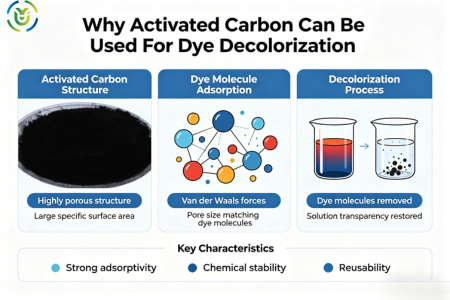
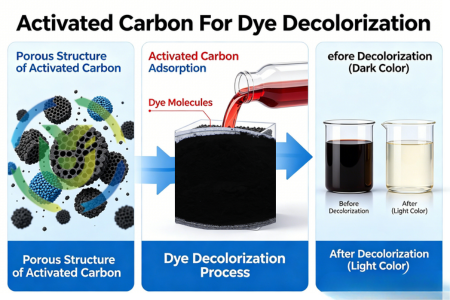
The adsorption of dyes by activated carbon is divided into physical adsorption and chemical adsorption. Physical adsorption relies on the van der Waals force of the pores of activated carbon to adsorb the dye molecules in the pores; chemical adsorption further enhances the adsorption effect and durability through the chemical reaction between the functional groups on the surface of activated carbon and the dye molecules to form a stable bond.
The pore structure of activated carbon (microporous, mesoporous and macroporous) determines the size of the dye molecules that can be adsorbed. Microporous is suitable for small molecules of dyes, mesoporous is the core pore size for dye decoloration, and macroporous plays the role of a channel, which helps the dye molecules to enter into the internal pore space quickly. The richer the surface functional groups (e.g. hydroxyl group, carboxyl group), the stronger the binding ability with dye molecules, and the more prominent the adsorption selectivity.
At present, the mainstream treatment methods for dye decolorization include coagulation, membrane separation, oxidation and activated carbon adsorption, in which activated carbon treatment has significant advantages: coagulation method is easy to produce sludge, and the subsequent treatment is difficult; membrane separation method has high cost of equipment and is easy to be clogged; oxidation method is highly selective to the type of dyes, and it may produce toxic byproducts.
Activated carbon, on the other hand, is simple to operate, moderate in cost, and can treat a wide range of dye wastewater, with a decolorization rate of more than 90%, and at the same time remove COD and other pollutants, realizing a multi-purpose solution.
|
Treatment method |
Core Advantages |
Applicable Scenarios |
|
Activated carbon adsorption |
Simple operation, moderate cost, high decolorization rate (up to 90%), simultaneous removal of COD, applicable to a wide range of dyestuffs. |
Decolorization of dye wastewater in most industries such as textile, printing and dyeing, chemical industry, etc. |
|
Coagulation |
Low treatment cost, convenient operation, good removal effect for suspended dyes. |
Pre-treatment of low concentration and suspended dyestuff wastewater. |
|
Membrane separation |
High decolorization precision, dye recovery, no secondary pollution. |
High-end scenarios that require high decolorization accuracy and recovery of dyes. |
|
Oxidation |
Good effect on difficult adsorption of dyes, fast decolorization speed |
Deep decolorization of difficult to adsorb dyes (e.g. some fluorescent dyes). |
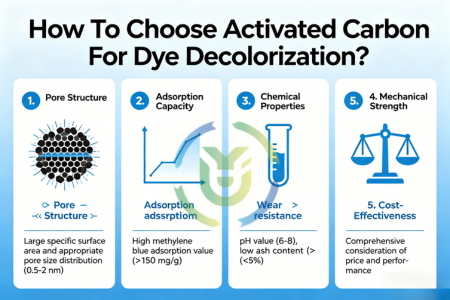
The pore size of activated carbon is divided into microporous (less than 2nm), mesoporous (2-50nm), macroporous (more than 50nm), different pore sizes have different roles, and the core of dyestuff decoloration is to match the pore size with the size of dyestuff molecules.
Microporous (less than 2nm) mainly adsorb small molecule dyestuff, organic matter, but its pore size is small, the adsorption capacity of large molecule dyestuff is weak, it can’t meet the decolorization demand of large molecule dyestuff such as direct dyestuff and reactive dyestuff.
Mesopore (2-50nm) is the core pore size for dye decolorization, which can accommodate most of the dye molecules (especially large molecule direct dyes and reactive dyes), the more developed the mesopore is, the higher the decolorization efficiency is, and it is the preferred type of pore size for decolorization of most of the dye wastewater.
Macropore (larger than 50nm) itself has a weak ability to adsorb dye molecules, and mainly plays the role of “channel”, allowing dye molecules to quickly enter the micropores and mesopores inside the activated carbon to enhance the overall adsorption speed.
Core principle: the larger the dye molecules are, the more necessary it is to choose activated carbon with well-developed mesopores; for small molecule dyes, activated carbon with both micropores and mesopores can be chosen.
Coal-based activated carbon has strong adsorption capacity and moderate cost, with both microporous and mesoporous, suitable for treating medium molecular dye wastewater, and it is the most widely used type in industrial dye decolorization, which can balance the effect and cost.
Coconut shell activated carbon has extremely developed microporous, suitable for adsorption of small molecular dyes, but less mesoporous, less effective in decolorization of large molecular dyes (e.g. direct dyes), with relatively high price, suitable for small molecular dyestuffs with high decolorization precision requirements.
Wooden activated carbon has the most developed mesopores and large adsorption capacity, especially suitable for decolorization of large molecule dyes (direct dyes, reactive dyes), with high cost performance, and it is the preferred raw material type of activated carbon for most of the dyestuff wastewater.
Specific surface area refers to the total surface area per unit mass of activated carbon, usually expressed by BET value, which is directly related to the adsorption capacity: the larger the specific surface area is, the more adsorption sites the activated carbon has, the higher the adsorption capacity is, and the better the decoloration effect is.
The specific surface area of activated carbon for dye decolorization is usually between 800-1500m²/g, and the specific selection should be combined with the concentration of dyes: for high concentration of dye wastewater, select the activated carbon with higher specific surface area (1200-1500m²/g); for low concentration of dye wastewater, select the activated carbon with 800-1200m²/g, and take into account the effect and cost.
Iodine value mainly reflects the number of micropores of activated carbon, the higher the iodine value is, the more developed the micropores are, which is suitable for measuring the adsorption capacity of small molecule dyes, but has little reference significance for the decolorization effect of large molecule dyes.
Molasses value directly reflects the number of mesopores of activated carbon, the higher the molasses value is, the more developed the mesopores are, the stronger the adsorption capacity of large molecule dyes is, which is the core reference index of dye decolorization.
Most industrial dyes have a macromolecular structure and require activated carbon with developed mesopores to achieve efficient adsorption, while the molasses value directly reflects the number of mesopores, so when choosing activated carbon for dye decolorization, priority should be given to the molasses value rather than purely pursuing a high iodine value. For example, the molasses value of wood-based activated carbon is usually higher than that of coal-based and coconut shell activated carbon, so its dye decolorization effect is better.
Powdered activated carbon (PAC) has small particle size (100-200 mesh), large specific surface area, fast adsorption speed, suitable for batch processing, emergency decolorization scenarios, simple operation, low cost, but the subsequent separation is difficult, and needs to be matched with filtration equipment.
Granular activated carbon (GAC) has a large particle size (1-5mm), slower adsorption speed, but can be repeatedly regenerated, suitable for continuous filtration system (fixed bed, moving bed), convenient subsequent treatment, suitable for long-term, stable dye decolorization treatment.
If the enterprise adopts batch treatment process (e.g. batch reactor), powdered activated carbon is preferred; if continuous filtration process is adopted, granular activated carbon is chosen. In addition, powdered activated carbon is suitable for short-term and emergency decolorization, while granular activated carbon is suitable for long-term and stable decolorization treatment.
The surface chemistry of activated carbon (e.g. surface charge, functional groups) and wastewater pH will directly affect its adsorption effect on dyes, especially ionic dyes (acidic and basic dyes).
Different dyes exist in different forms at different pH values, and the adsorption effect varies significantly. For example, acidic dyes adsorb better under acidic conditions, and basic dyes adsorb more stably under alkaline environment, so it is necessary to adjust the pH value of wastewater according to the type of dyes or choose suitable activated carbon.
The hydroxyl group, carboxyl group and other functional groups on the surface of activated carbon can enhance the chemical binding ability with dye molecules and improve the adsorption selectivity. For difficult to adsorb dyes, surface modified and impregnated activated carbon can be selected to optimize the adsorption effect by loading metal ions and so on.
Adsorption capacity refers to the amount of dye that can be adsorbed per unit mass of activated carbon, the higher the adsorption capacity, the lower the dosage and the lower the cost. The adsorption performance of activated carbon should be evaluated through experiments and the reasonable dosage should be determined.
Before purchasing in bulk, the decolorization effect of activated carbon should be evaluated by laboratory jar test (beaker test), to avoid blind purchasing leading to substandard decolorization, and at the same time, the optimal dosage can be determined initially.
The conventional dosage of activated carbon for dye decolorization is 50-500mg/L. According to the concentration of dye, quality of wastewater and decolorization requirements, the optimal dosage should be determined through small tests, taking into account the decolorization standard and cost control.
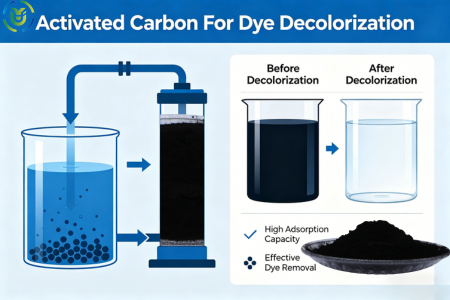
Textile wastewater is characterized by deep color, complex dyestuffs (mostly reactive dyestuffs and direct dyestuffs), large fluctuations in water quality, and a large number of additives, making decoloration more difficult.
Recommended choice: wood powdered activated carbon (PAC), requires high molasses value (≥200), specific surface area ≥1200m²/g, can efficiently adsorb large molecules of dyes, and at the same time remove some of the auxiliaries in the wastewater, the decolorization rate of up to 95% or more, and the cost is moderate.
Printing and dyeing industry wastewater has various types of dyestuffs (reactive, acidic and alkaline dyestuffs), and the concentration fluctuates greatly, so the stability of the decolorization effect is required to be high.
Selection strategy: flexibly adjust the type of activated carbon – when dealing with large molecule dyestuffs such as active and direct dyestuffs, choose wood activated carbon; when dealing with small molecule dyestuffs such as acidic and alkaline dyestuffs, choose coal-based or coconut shell activated carbon; if the quality of wastewater fluctuates a lot, “powder carbon + granular carbon” combination process can be used, taking into account the decolorization effect. If the quality of wastewater fluctuates greatly, “powdered carbon + granular carbon” combination process can be used, taking into account the decolorization efficiency and stability.
Chemical industry wastewater usually contains mixed organic matter (such as dyes, solvents, auxiliaries), complex composition, part of the wastewater is also corrosive, the adsorption of activated carbon selectivity and stability requirements.
Selection strategy: Adopt customized activated carbon solution, according to the specific composition of wastewater (dye type, organic matter content), select surface-modified coal-based or wood-based activated carbon, to enhance the adsorption capacity of the target dyestuffs, and at the same time, enhance the corrosion resistance of activated carbon, to ensure the long-term stable operation.
When choosing activated carbon, many enterprises easily fall into the following five misunderstandings, resulting in poor decolorization effect and increased costs, which need to be avoided:
1 Only look at the iodine value, ignoring the molasses value
Many enterprises mistakenly think that the higher the iodine value is, the better the decolorization effect of dyes is, in fact, the iodine value mainly reflects the number of micropores, which has little significance for the reference of decolorization of macromolecule dyes, and the molasses value (mesopore index) is the core reference of decolorization of dyes.
2 Ignoring the matching between pore size distribution and dye molecules
Blindly choosing activated carbon with high specific surface area, if the pore size does not match with the size of dye molecules, even if the specific surface area is high, the ideal decolorization effect cannot be achieved, such as using coconut shell carbon with developed microporous to treat macromolecular direct dyes.
3 Treatment of all dyes with coconut shell activated carbon
Coconut shell activated carbon with well-developed microporosity is only suitable for small-molecule dyes, and when it is used for large-molecule dyestuffs (direct and reactive dyestuffs), the decolorization rate is low and the consumption of activated carbon is large, which increases the operation cost.
4 No laboratory test before batch purchase
The performance of activated carbon from different batches and manufacturers varies greatly, and direct batch purchase without small test is prone to the situation that the decolorization is not up to standard and cannot be used, resulting in cost waste.
5 Neglect regeneration and replacement costs
Focusing only on the procurement cost of activated carbon, ignoring the regeneration difficulty of granular carbon and the replacement frequency of powdered carbon will increase the operating costs in the long run, such as powdered carbon is not regenerable and needs to be replaced frequently, which is suitable for short-term emergencies.
Prioritize the selection of cost-effective wood-based activated carbon, taking into account the adsorption effect and procurement cost; small molecule dyes can choose coal-based activated carbon, avoiding blindly selecting high-priced coconut shell activated carbon to reduce unnecessary cost expenditure.
Powdered activated carbon (PAC) has low purchasing cost and fast adsorption, but it cannot be regenerated, which is suitable for short-term and batch treatment; granular activated carbon (GAC) has high purchasing cost, but it can be regenerated (the regeneration cost is 30-50% of the cost of new carbon), which is suitable for long-term and continuous treatment, and the long-term operation is more economical.
Granular activated carbon can be reused through thermal regeneration and chemical regeneration, and the regeneration rate reaches 70%-80%. Reasonable planning of regeneration cycle can significantly reduce the long-term operating costs; powdered carbon is not regenerable, and it is necessary to control the dosage to avoid waste.
Determine the optimal dosage through laboratory trial to avoid waste caused by excessive dosage; select stable quality activated carbon to reduce the replacement frequency; optimize the treatment process to improve the utilization rate of activated carbon, and control the operation cost from various aspects.
Take 1000mL of dye wastewater and put it into a beaker, adjust the pH value to a suitable range according to the type of dye, and prepare activated carbon samples with different dosages (e.g. 50mg/L, 100mg/L, 200mg/L).
Add different dosages of activated carbon into the wastewater beaker and stir at 200 r/min for 30-60 minutes to ensure that the activated carbon is in full contact with the wastewater to complete the adsorption reaction.
After stirring, leave to settle for 30 minutes, take the supernatant, test the core indexes such as decolorization rate, COD removal rate, adsorption capacity, etc., and compare the performance differences of different activated carbons.
According to the test results, select the activated carbon with high decolorization rate and low dosage, and determine the optimal dosage of the activated carbon, so as to provide a basis for batch purchase and practical application.
Decolorization rate is the most core index to measure the effect of activated carbon, usually required ≥ 90%, calculated as (absorbance of raw water – absorbance after treatment) / absorbance of raw water × 100%, directly reflecting the dye removal ability of activated carbon.
COD removal rate reflects the removal ability of activated carbon to organic matter in wastewater, usually required ≥50%, which can reflect the decolorization effect and also assist in judging whether the adsorption performance of activated carbon is stable.
Adsorption capacity (mg/g) refers to the amount of dye that can be adsorbed per unit mass of activated carbon, the higher the adsorption capacity, the lower the dosage, the lower the long-term operation cost, and it is an important cost-effective index for selecting activated carbon.
If a certain type of activated carbon can achieve high decolorization rate and COD removal rate with high adsorption capacity under lower dosage, it is the optimal choice; if the decolorization rate is not up to the standard, it is necessary to adjust the dosage or change the type of activated carbon.
The supplier should provide test reports (iodine value, molasses value, specific surface area, etc.) of each batch of activated carbon to ensure consistent performance of different batches and avoid unstable decolorization effect due to quality fluctuation.
For chemical dye wastewater with complex composition, the supplier should have the customization ability of surface modification and pore size adjustment, and provide suitable activated carbon solutions to meet the special decolorization requirements.
Suppliers need to provide professional technical guidance, including activated carbon dosage adjustment, process optimization, regeneration methods, etc., to help enterprises solve all kinds of problems encountered in the process of decolorization and improve treatment efficiency.
Priority is given to suppliers with experience in the dye decolorization industry, to understand the customer cases they have served, to ensure that they can provide products and services in line with the industry demand, and to reduce the procurement risk.
The core of selecting activated carbon for dye decolorization is to “match the characteristics of dyes, meet the demands of process, and take into account the cost and efficiency”, which are indispensable to realize the key of high efficiency decolorization and meeting the standard of environmental protection. Enterprises need to combine their own dyestuff wastewater water quality and treatment process to accurately match the type of activated carbon, avoid falling into the selection error, and realize the dual goals of decolorization and cost control by cooperating with reliable suppliers through small trials.