In the field of water treatment, COD (Chemical Oxygen Demand) is the core indicator to measure the degree of organic matter pollution in the water body, and its content exceeding the standard will seriously damage the aquatic ecological environment, affect the utilization of water resources, and even violate the environmental protection discharge regulations. Activated carbon, as an efficient adsorption material, has become one of the mainstream technologies to remove COD from water by virtue of its unique structural properties. In this paper, we will comprehensively analyze the core logic of activated carbon to remove COD from water from the aspects of COD basic cognition, activated carbon characteristics, removal mechanism, and influencing factors, so as to provide references for water treatment engineering practice and related practitioners.
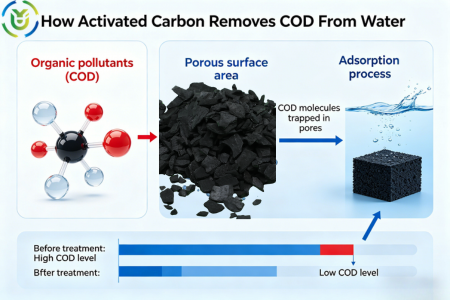


COD (Chemical Oxygen Demand), refers to the amount of oxidant consumed to oxidize organic matter in water with strong oxidants under certain conditions, converted into milligrams of oxygen consumed per liter of water sample (unit: mg/L), is an important indicator reflecting the total amount of organic matter pollution in the water body.
Many people will be confused with COD and BOD (Biochemical Oxygen Demand), the core difference between the two is that: COD is measured in the water can be oxidized by all the organic matter (including difficult to degrade the total amount of organic matter), the detection of fast, targeted; while the BOD only measure the water can be microbial degradation of the organic content, the detection cycle is long, but closer to the natural self-purification ability of the water body. Commonly used COD detection methods are potassium dichromate method (national standard method) and potassium permanganate method, of which potassium dichromate method is widely used in industrial wastewater and municipal wastewater detection due to its strong oxidizing ability.
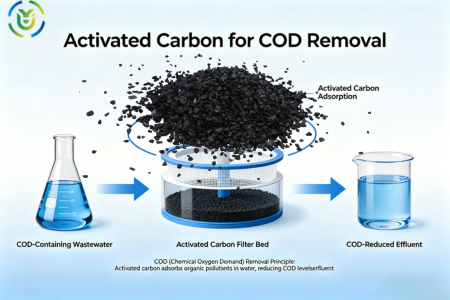
Industrial wastewater is the main source of COD in wastewater, the composition and concentration of COD in wastewater from different industries vary greatly, and most of them contain difficult-to-biodegrade organic matter, specifically including: textile printing and dyeing wastewater (dyestuffs, organics in auxiliaries), chemical wastewater (reaction intermediates, solvents), pharmaceutical wastewater (drug residues, impurities in raw materials), food processing wastewater (proteins, starch, oil and grease, etc.), the concentration of COD in such wastewater is high, the composition is complex, and the COD is high and the composition is complicated. COD concentration is high, the composition is complex, and the treatment is relatively difficult.
Municipal wastewater mainly comes from residents’ daily life and is an important supplementary source of COD, which is characterized by relatively low COD concentration, but large emissions and wide treatment coverage. Specifically, it includes kitchen wastewater and washing wastewater from residents’ lives, as well as organic matter carried by urban surface runoff, which is the key object of urban water treatment.
When the COD in water is too high, the organic matter will consume a large amount of dissolved oxygen in the process of microbial decomposition, resulting in a lack of oxygen in the water body, aquatic organisms (fish, algae) die due to a lack of oxygen, which in turn triggers the black odor of the water body, eutrophication and other problems, destroying the entire aquatic ecosystem. At the same time, some of the difficult to degrade organic matter is also toxic, will be accumulated in the water body, through the food chain to jeopardize human health.
Environmental protection departments in various countries have set strict standards for COD discharge of wastewater, industrial enterprises and municipal sewage treatment plants that discharge wastewater COD exceeds the standard will face fines, suspension and rectification and other penalties, therefore, the efficient removal of COD is the key to wastewater discharge standards.
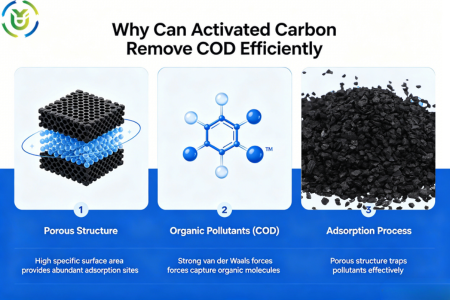
Activated carbon is a kind of porous carbon material after special activation treatment (physical activation, chemical activation), its unique structure and surface characteristics, so that it has a strong adsorption capacity, and become an ideal material for removing COD (especially difficult to degrade COD) in water.
Powdered, small particle size (usually below 100 mesh), large specific surface area, fast adsorption speed, suitable for batch dosage, emergency treatment (such as sudden COD exceeding the standard), as well as small-scale water treatment equipment, dosage flexibility and no need for complex supporting equipment.
Granular, particle size between 0.5-5mm, high mechanical strength, can be repeatedly regenerated, suitable for continuous filtration system (such as activated carbon filter), widely used in industrial wastewater treatment and drinking water purification, treatment effect is stable and long-term use of controllable cost.
Column-shaped, moderate specific surface area, high mechanical strength, not easy to be pulverized, mainly used for industrial wastewater treatment in the continuous adsorption process, especially suitable for high concentration COD wastewater pretreatment, can effectively reduce the subsequent treatment load.
Activated carbon can efficiently remove COD, the core is that it has three key characteristics, the three synergistic effect to enhance the adsorption effect:
Activated carbon is full of tiny pores, the specific surface area of 1 gram of activated carbon can reach 1,000-2,000 square meters, a huge surface area for the adsorption of organic matter provides sufficient “adsorption sites” to quickly capture COD pollutants in the water to enhance the adsorption capacity.
The pores of activated carbon are divided into micropores (pore size <2nm), mesopores (2-50nm) and macropores (>50nm), of which micropores mainly adsorb small molecules of organic matter, mesopores adsorb medium molecular weight organic matter, and macropores act as a pollutant “passageway” to allow small molecules of organic matter to enter the interior of the micropores quickly to enhance the adsorption efficiency.
The surface of activated carbon contains a large number of functional groups (such as hydroxyl, carboxyl, carbonyl, etc.), these functional groups can occur with the organic matter in the water to enhance the adsorption capacity, especially for polar organic adsorption effect is more significant, so that the adsorption is more stable.
The process of COD removal from water by activated carbon is not a single adsorption, but a comprehensive process of physical adsorption, chemical adsorption, organic matter removal and biological synergy, in which physical adsorption and chemical adsorption are the core mechanisms.
Physical adsorption is the main way of COD removal by activated carbon, the core of which relies on van der Waals force (intermolecular force), the organic molecules in the water will be adsorbed to the surface of the pores of activated carbon, without the need for chemical reaction, which is a reversible process.
Specifically, the microporous structure of activated carbon is like a “tiny container”, when COD-containing wastewater flows through the activated carbon, the organic molecules in the water will be “captured” inside the microporous structure due to van der Waals forces, realizing the separation from water. This type of adsorption is characterized by fast adsorption speed, large adsorption capacity, can quickly reduce the COD concentration in water, especially suitable for the removal of small molecules of organic matter (such as methanol, acetic acid, etc.).
Chemical adsorption refers to the chemical reaction between the functional groups on the surface of activated carbon and the molecules of organic matter in water, forming chemical bonds and stabilizing the adsorption of organic matter on the surface of activated carbon, which is an irreversible process.
For example, the carboxyl group (-COOH) on the surface of activated carbon can esterify and neutralize with amines and phenols in water to form a stable chemical bond, while the hydroxyl group (-OH) can form a hydrogen bond with organic molecules to enhance the adsorption stability. The advantage of chemical adsorption is that it can remove difficult to degrade organic matter (such as dyes, pesticide residues, etc.), to make up for the shortcomings of physical adsorption, and further reduce the COD concentration in water.
A large part of COD in water comes from dissolved organic matter (DOM), which has a small molecular weight and is not easy to settle, and is difficult to be removed by conventional treatment methods, while activated carbon can adsorb this kind of organic matter in a targeted manner.
Through microporous adsorption and the role of surface functional groups, activated carbon can not only remove the easily degradable part of DOM, but also effectively remove difficult to degrade DOM (such as humic acid, fulvic acid, etc.), and at the same time, can also reduce the color of the water body, odor, and reduce the content of micro-pollutants (such as heavy metal ions, endocrine disruptors), to achieve the “one-two punch”. Achieve “one-two punch”.
In actual water treatment, a layer of biofilm (composed of bacteria, fungi and other microorganisms) will gradually form on the surface of activated carbon, forming a “biologically activated carbon (BAC)” system, which realizes the synergistic effect of adsorption and biodegradation.
Specifically, activated carbon first through adsorption will concentrate organic matter on the surface, providing a source of nutrients for microorganisms in the biofilm; microorganisms through metabolism, will be adsorbed on the surface of the activated carbon organic matter degradation into harmless carbon dioxide and water, not only to further reduce the concentration of COD, but also prolong the service life of the activated carbon to reduce the cost of treatment.
Activated carbon COD removal efficiency is not fixed, by the characteristics of activated carbon, water quality parameters, operating conditions and other factors, master these factors, can effectively optimize the treatment effect, reduce treatment costs.
Iodine value is an important indicator of the adsorption capacity of activated carbon, the higher the iodine value, the greater the adsorption capacity of activated carbon, the higher the efficiency of COD removal, usually used for COD removal of activated carbon iodine value should not be less than 800mg/g.
The larger the specific surface area, the more adsorption sites, the higher the adsorption efficiency, but not the larger the better, according to the COD concentration of wastewater and the type of organic matter to choose the appropriate specific surface area (usually 1000-1500 square meters / g is appropriate).
The smaller the particle size, the faster the adsorption speed (such as PAC), but not easy to recover; the larger the particle size, the slower the adsorption speed (such as GAC), but the mechanical strength is high, can be regenerated, need to be selected according to the treatment process.
The higher the initial COD concentration, the higher the adsorption load of activated carbon, the shorter the time to reach adsorption saturation, and the lower the removal efficiency, so high COD concentration wastewater needs to be pre-treated (such as coagulation, sedimentation) to reduce the COD load.
pH value will affect the activity of functional groups on the surface of activated carbon and the morphology of organic matter, neutral or weakly acidic conditions (pH = 6-8), the best adsorption effect; higher temperature will speed up the rate of adsorption, but it will reduce the adsorption capacity, usually controlled at 20-30 ℃ is appropriate.
If there are heavy metal ions, chloride ions, sulfate and other pollutants in the water, they will compete with organic matter for the adsorption sites of activated carbon, reducing the COD removal efficiency, and such competing pollutants need to be removed in advance.
That is, the contact time between wastewater and activated carbon, the longer the contact time, the more fully adsorbed organic matter, the higher the COD removal efficiency, but the contact time is too long will increase the cost of treatment, usually controlled in 10-30 minutes is appropriate.
The dosage of PAC should be adjusted according to the initial COD concentration, usually 10-50mg/L; the dosage of GAC is determined according to the volume of the filter tank and the amount of treated water, to ensure the adsorption effect at the same time, to avoid waste.
Water flow rate is too fast, the waste water and activated carbon contact is not sufficient, the removal efficiency is reduced; system design is not reasonable (such as clogging of the filter tank, uneven distribution of water flow), will also affect the adsorption effect, the need to optimize the system structure, control the flow rate of the appropriate.
Powdered Activated Carbon (PAC) and Granular Activated Carbon (GAC) are the two most commonly used types for COD removal, each has its own advantages, and should be selected according to the treatment scenario, water quality and cost budget, the specific comparison is as follows:
The core advantage of PAC is the fast adsorption speed, which can quickly respond to sudden COD exceeding the standard (such as industrial wastewater discharge abnormalities), and the dosage is flexible, without the need for complex equipment, suitable for batch treatment, small water treatment equipment, and pre-treatment stage to reduce the COD load. However, its disadvantage is that it cannot be regenerated, and solid-liquid separation (e.g., sedimentation, filtration) is required after use, so the treatment cost is high and it is not suitable for large-scale continuous treatment.
The core advantage of GAC is that it can be regenerated (by thermal regeneration, chemical regeneration, etc.), has a long service life, is suitable for large-scale continuous filtration systems (e.g., deep treatment of municipal sewage treatment plants, deep purification of industrial wastewater), and has stable treatment effect, which can continue to remove COD. however, its disadvantage is that the adsorption rate is slow, the investment in equipment is high, and it needs regular regeneration treatment, and the operation is relatively complicated.
|
Comparison Dimension |
Powdered Activated Carbon (PAC) |
Granular Activated Carbon (GAC) |
|
Removal Efficiency |
Fast and efficient, suitable for emergency treatment |
Stable and efficient, suitable for long-term treatment |
|
Cost |
Low cost for single dosage, high cost for long-term use (non-renewable) |
High investment in equipment, low cost for long-term use (renewable) |
|
Operation Complexity |
Simple operation, no need for complex equipment |
Complicated operation, requires supporting filtration and regeneration equipment |
|
Application Scenarios |
Emergency treatment, small equipment, pre-treatment |
Large-scale continuous treatment, deep treatment, drinking water purification |
With efficient COD removal capability, activated carbon is widely used in industrial wastewater treatment, municipal water treatment and advanced treatment systems covering a wide range of industries, with specific applications as follows:
Activated carbon can effectively adsorb and remove dyes, auxiliaries and other organic substances in textile printing and dyeing wastewater, and at the same time reduce the COD concentration and chromaticity of the wastewater to help textile printing and dyeing enterprises to achieve wastewater discharge standards and solve the industry’s core pollution problems.
Pharmaceutical wastewater drug residues, raw material impurities are difficult to degrade organic matter, activated carbon can be targeted adsorption of such pollutants, effectively solve the problem of pharmaceutical wastewater COD exceeds the standard, to ensure that wastewater discharge in line with environmental standards.
Reaction intermediates, solvents and heavy metal ions in chemical wastewater can be removed by activated carbon adsorption, which can not only reduce the COD concentration, but also reduce the toxicity of wastewater and protect the safety of the surrounding water environment.
After the secondary treatment of municipal wastewater treatment plant, part of the wastewater COD still does not meet the discharge requirements, and the depth treatment through activated carbon adsorption can further reduce the COD concentration, ensure that the wastewater meets the discharge standards, and avoid environmental risks.
In drinking water purification, activated carbon can effectively remove trace organic matter, odor and chromaticity in water, and at the same time reduce COD content, improve drinking water quality and protect human drinking water health.
MBR mainly degrades biodegradable organic matter in the water, while activated carbon focuses on adsorption of difficult to degrade organic matter. The synergistic effect of the two can not only improve the COD removal efficiency, but also further optimize the quality of the water, which is suitable for the needs of high-standard water treatment.
Activated carbon as a pre-treatment of RO reverse osmosis system can effectively remove organic matter and suspended solids in the water, prevent RO membrane clogging, prolong the service life of the RO membrane, and safeguard the treatment effect of the reverse osmosis system.
AOPs can oxidize the difficult to degrade organic matter into easy to degrade organic matter, and then through the activated carbon adsorption of the remaining organic matter, to realize the depth of COD removal, and to solve the problem of exceeding the COD standard of difficult wastewater.
Activated carbon is particularly effective in removing difficult-to-degrade COD and trace organic matter, and can quickly reduce the COD concentration in water to below the environmental protection emission standard, solving the problem of COD removal that is difficult to overcome by conventional treatment technology.
According to different treatment scenarios, PAC (emergency treatment) or GAC (long-term treatment) can be flexibly selected, which can not only cope with sudden COD exceeding the standard, but also meet the needs of large-scale continuous water treatment, and adapt to the treatment scenarios of different scales and different water qualities.
In addition to the core COD removal function, activated carbon can also simultaneously remove color, odor, heavy metal ions and micro-pollutants in the water, one-stop to improve the quality of the effluent water, without additional treatment processes.
PAC is a one-time-use material, long-term large-scale injection will increase the cost of treatment; GAC can be regenerated, but the investment in regeneration equipment and regeneration process costs are high, which overall improves the comprehensive cost of water treatment.
The adsorption effect of activated carbon is mainly for organic COD, the removal effect of inorganic COD (such as sulfide, nitrite, etc.) is poor, if the wastewater contains a large number of inorganic COD, it is necessary to cooperate with other treatment technologies.
High concentration, high turbidity wastewater directly using activated carbon, will quickly lead to activated carbon adsorption saturation, so you need to carry out coagulation, precipitation and other pre-treatment to reduce the load of wastewater, an additional increase in the water treatment process and cost.
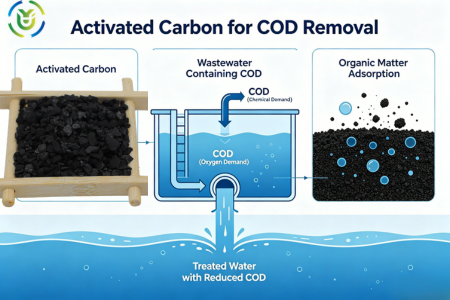
Commonly used raw materials of activated carbon are coconut shell, coal, wood, the performance of different raw materials of activated carbon varies greatly, need to be combined with the water quality selection: coconut shell activated carbon has large specific surface area, adsorption performance is good, suitable for the removal of low concentration of difficult to degrade COD; coal activated carbon has a lower cost and is suitable for the treatment of high COD wastewater; wood activated carbon has a medium adsorption capacity and is suitable for ordinary municipal wastewater treatment.
The pore structure of activated carbon should be selected according to the molecular weight of organic matter in wastewater to ensure the adsorption effect: select microporous activated carbon for small organic matter, select mesoporous activated carbon for macromolecule organic matter, and precisely match the pore structure with the characteristics of pollutants.
When choosing, focus on the two core indexes of iodine value and methylene blue value: the higher the iodine value, the higher the adsorption capacity of the activated carbon; the higher the methylene blue value, the better the adsorption effect on colored organic matter, which can be flexibly selected according to the specific type and concentration of COD.
1 What are the iodine and molasses values of the activated carbon?
Does it meet the demand of COD removal of your own wastewater?
2 Is the activated carbon suitable for high COD wastewater (e.g. COD>1000mg/L)?
What is the adsorption capacity?
3 Is the granular activated carbon renewable?
What is the regeneration cycle and regeneration cost?
4 Is there any case of similar wastewater treatment? What is the actual COD removal efficiency?
Combine activated carbon with coagulation and flocculation processes, first remove suspended solids and macromolecular organic matter in wastewater through coagulation and flocculation to reduce the COD load, and then adsorb difficult-to-biodegrade organic matter with activated carbon to avoid rapid saturation of activated carbon due to high load, so as to improve the overall COD removal efficiency.
For high concentration, high turbidity wastewater, need to carry out pretreatment (such as precipitation, filtration), effective removal of impurities in the water and part of the COD, to reduce the adsorption pressure of activated carbon, to avoid rapid saturation of activated carbon, to prolong its service life, and reduce the cost of treatment.
According to the actual water quality of wastewater, scientifically optimize the contact time (EBCT) and the amount of activated carbon dosage, not only to avoid insufficient dosage leading to COD removal does not meet the standard, but also to prevent the dosage of too much waste of materials, to achieve a two-way balance between the treatment effect and cost.
Regularly monitor the adsorption effect of activated carbon (e.g. COD concentration of effluent), draw the penetration curve, grasp the adsorption saturation of activated carbon, and replace or regenerate the activated carbon at the right time, so as to ensure that the whole COD treatment process is stable and meets the standard.
No. Activated carbon mainly removes organic COD. Activated carbon mainly removes organic COD, and the removal effect of inorganic COD (such as sulfide, nitrite, cyanide, etc.) is poor; at the same time, for some of the organic substances with very high molecular weight (such as some polymers), activated carbon is difficult to adsorb, and it needs to be combined with advanced oxidation and other technologies to deal with it.
Depending on the quality of wastewater, type of activated carbon and operating conditions, the COD removal efficiency of PAC is usually 50%-80%, and the COD removal efficiency of GAC is 70%-90%; after pretreatment and parameter optimization, the removal efficiency can be increased to more than 85%, which meets the discharge standards of most wastewater.
PAC is a one-time use, usually according to the COD concentration and the amount of water to be treated, once every 1-7 days; GAC can be regenerated, the service life of 6-12 months, when the COD concentration of the effluent continues to exceed the standard, the activated carbon adsorption is saturated, need to regenerate, and can be reused for 3-5 times after regeneration.
For small-scale treatment, emergency treatment or short-term treatment, PAC is more cost-effective (low investment in equipment, simple operation); for large-scale continuous treatment and long-term treatment, GAC is more cost-effective (regenerable, long service life). Specifically according to the scale of treatment, treatment cycle and water quality comprehensive judgment.
Activated carbon is an indispensable core material in the field of water treatment due to its high specific surface area, excellent adsorption characteristics, and the ability to remove organic COD in water efficiently through physical adsorption, chemical adsorption, biological synergism, and other mechanisms, especially suitable for the removal of difficult to degrade COD. In practical application, it is necessary to select the appropriate type of activated carbon according to the quality of wastewater, treatment scenarios, optimize the operating parameters, combined with pre-treatment and combination of treatment technologies, in order to ensure the removal efficiency of COD and reduce the cost of treatment at the same time.