Glucose syrup is a widely used sweetener and excipient in food and beverage manufacturing. Its color, clarity, and batch stability directly determine the appearance and quality of the final product. In the refining process of starch sugar production, activated carbon decolorization is one of the core processes to remove colored organic matter and improve the appearance of syrup. This article systematically reviews why glucose syrup decolorizes, how activated carbon works, common carbon type differences, industrial processes, efficiency factors, key points for selection, troubleshooting and quality control methods, for reference by purchasing, process and quality management personnel.
|
Parameter |
Typical Specification |
|
Raw material |
Wood-based powdered activated carbon (preferred) / Coconut shell PAC |
|
Grade |
Food grade |
|
Iodine value |
600–1100 mg/g |
|
Methylene blue value |
≥160–180 mg/g |
|
BET Specific surface area |
1000–1400 m²/g |
|
A-method caramel decolorization rate |
≥90% (Premium grade ≥100%) |
|
Moisture |
≤10 % |
|
Ash content |
≤3.0–5.0 % |
|
pH value |
3.0–5.0 |
|
Particle size |
200 mesh / 325 mesh (≥95% pass) |
|
Typical dosage |
0.2–0.5 % (on dry solid of glucose syrup) |
The raw syrup will carry natural pigments and colored compounds generated during processing during production. If not removed, the finished syrup will easily appear yellowish-brown, dark yellow or cloudy, affecting the visual consistency of subsequent products. The primary purpose of the decolorization process is to remove natural pigments and colored impurities, reduce the content of colored substances formed during processing, and ensure that the syrup meets food-grade quality requirements in terms of appearance, clarity, and color consistency.
The color sources in glucose syrup can be mainly divided into three categories. One is the Maillard reaction product, which is a brown or yellow substance formed by the reaction between reducing sugars and amino compounds under heat and acid-base conditions; The second is caramelization products, which are colored components formed by the degradation and polymerization of sugar under high temperature or overheating conditions; Thirdly, organic pigments and other color-forming compounds brought in by raw materials, including plant-derived pigments, polyphenols, and small molecule colored organic substances generated during production. The different molecular sizes, polarities, and structures of these impurities also determine that activated carbon needs to have corresponding pore and surface chemical characteristics to be effectively adsorbed.
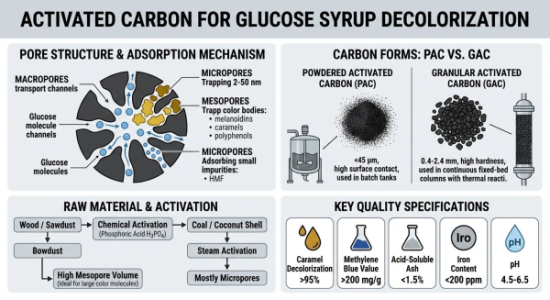
Activated carbon is a porous carbon material that has undergone activation treatment and forms a developed pore network inside. The core processes of decolorization belong to physical adsorption and surface adsorption: colored organic molecules in the syrup diffuse to the surface of activated carbon particles with the liquid phase and are captured by the pore structure, thereby separating them from the syrup body. The larger the specific surface area and the more reasonable the pore distribution of activated carbon, the more adsorption sites that colored molecules can attach to.
In terms of pore size, micropores provide a large number of adsorption sites and specific surface area, and have a strong capture capacity for small molecule colored substances; Mesopores act as molecular transport channels, facilitating larger colored molecules to enter the pore channel. The chemical properties of the carbon surface, such as the type and number of surface functional groups, also affect the affinity for organic compounds of different polarities. The pore structure and surface chemistry together determine the decolorization performance of an activated carbon on a specific syrup.
Activated carbon is widely used in syrup refining, firstly because of its high specific surface area and strong adsorption capacity for organic colorants, which can reduce the color value of syrup in a relatively short contact time. Secondly, activated carbon can be used in flexible forms, such as intermittent addition in powder form or continuous operation in granular form into an adsorption tower, which can be adapted to syrup processing systems of different scales and process layouts. Under the premise of reasonable selection and standardized process control, activated carbon has good compatibility with food-grade purification processes and is a mature and commonly used purification material in the syrup decolorization process.
|
contrast dimension |
activated carbon |
ion exchange resin |
membrane filtration |
|
Main removal objects |
Colored organic substances, some odorous substances and colloidal impurities |
Ionic components, ash, organic acids and charged impurities |
Suspended particles, colloids and macromolecules retained by pore size |
|
Operating mode |
Powdery intermittent addition, or granular fixed bed continuous adsorption |
Resin column operation requires regular regeneration and backwashing. |
Cross-flow or filter assembly runs continuously and needs to be cleaned and replaced regularly. |
|
advantage |
Wide adsorption range for organic colorants, flexible dosing, and suitable for decolorization processes |
High efficiency in removing ionic impurities and adjustable ion composition of syrup |
Removes suspension and colloidal particles, improves clarity, and eliminates the need for chemical agents. |
|
limitation |
After use, the waste carbon needs to be separated, and after adsorption saturation, it needs to be replaced or regenerated. |
Limited removal of non-ionic colored organic matter and susceptible to organic pollution |
The retention of small molecule colored substances is limited, and there is concentration polarization and membrane fouling. |
|
combination recommendation |
The common practice is to first remove suspended solids through filtration, then decolorize with activated carbon to remove organic colorants, and then combine ion exchange desalting, membrane filtration or fine filtration to improve clarity, forming a multi-stage purification process. |
||
The powdered activated carbon has small particle size and large contact surface area per unit mass, can complete adsorption in a short mixing and contact time, and the dosage can be flexibly adjusted according to the color value of the syrup. PAC is typically used in batch decolorization processes: it is proportionally added to a decolorization tank, thoroughly mixed and adsorbed with syrup, and then the waste carbon is separated through plate and frame filtration, blade filtration, or other filtration equipment. Its advantages are fast response and flexible adjustment, making it suitable for batch production or scenarios where color value fluctuations require immediate adjustment; The cost is that each batch needs to process waste carbon and requires subsequent filtration steps.
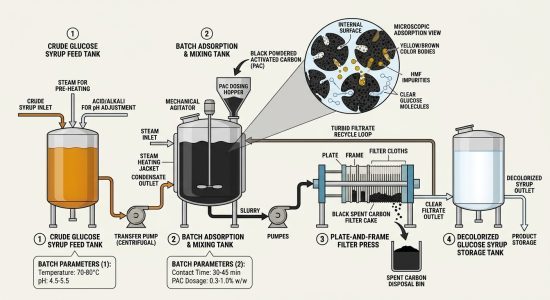
Powdered Activated Carbon (PAC) Batch Process
The granular activated carbon particles are large and have high mechanical strength, and are suitable for being loaded into an adsorption tower or fixed bed for continuous decolorization. The syrup passes through the carbon layer from top to bottom or from bottom to top, and colored organic matter is adsorbed during the flow process, and the effluent enters the next process. The advantages of GAC are continuous processes and centralized discharge of waste carbon, which facilitates automated operation; Regeneration or replacement needs to be evaluated after a certain period of use. Operating cost, regeneration feasibility, and bed resistance are key factors that need to be considered in granular carbon applications.
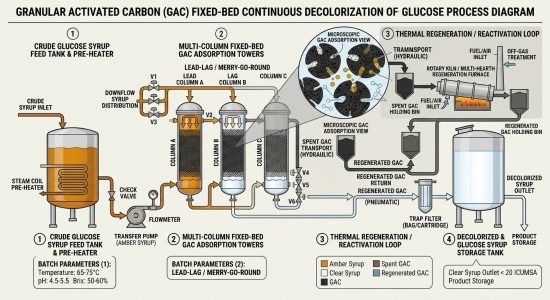
Granular Activated Carbon Fixed-Bed Process
Wood activated carbon is made from wood or wood processing residues through carbonization and activation. This type of carbon usually has well-developed pores and a relatively high proportion of mesopores, making it well suitable for colored organic compounds with large molecular sizes. It is common in syrup and sugar liquid decolorization scenarios. The pore distribution, adsorption rate and decolorization capacity of charcoal are affected by the type of raw materials and activation process. When purchasing, small-scale verification should be carried out in conjunction with the impurity composition of the specific syrup.
Coal-based activated carbon is made of coal, and coconut shell activated carbon is made of coconut shell. They have their own characteristics in raw material density, pore structure and mechanical strength. Coconut shell charcoal is typically microporous and has high strength, making it suitable for scenarios that require the adsorption of small molecules and the durability of the bed. Coal-based carbon has its own characteristics in pore distribution and cost structure. The differences in pore structure caused by different raw materials determine their suitability for colored molecules of different sizes in syrup. Whether they are suitable for decolorization of glucose syrup needs to be judged comprehensively through adsorption tests and filtration performance, rather than drawing conclusions based solely on the type of raw material.
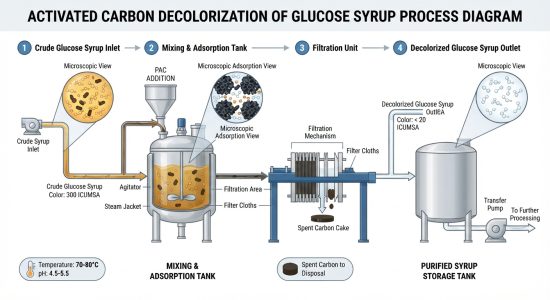
Glucose Syrup Activated Carbon Decolorization Process
Before entering the decolorization process, suspended solids, fibers and particulate impurities in the syrup are removed through initial filtration to avoid these impurities occupying the activated carbon adsorption sites and increasing the subsequent filtration load. At the same time, it is necessary to adjust the temperature and concentration of the syrup: temperature affects the viscosity and molecular diffusion rate of the syrup, while concentration is related to the fluidity of the syrup and the state of adsorption contact. The parameter setting should take into account both adsorption efficiency and subsequent process requirements.
Based on the initial color value, impurity composition, and target color value of the syrup, food-grade activated carbon that meets food contact requirements was selected, and the reasonable dosage was determined through small trials. Too low a dosage may lead to substandard color values, while too high a dosage may increase the amount of waste carbon and filtration burden, and raise material costs. In industrial production, the amount of carbon used per unit of syrup (such as g/kg or kg/t) is usually used as the measurement basis.
The charcoal and syrup are thoroughly mixed in the decolorizing tank so that the activated carbon particles are uniformly dispersed and contacted with the colored molecules. This stage requires controlling temperature, pH, and contact time: temperature affects the molecular motion and adsorption balance, pH changes the form of colored substances and the surface affinity of carbon, and contact time ensures that adsorption reaches the desired level. The mixing strength should be sufficient to keep the carbon particles suspended while avoiding excessive shear or local overheating.
After adsorption is complete, the saturated waste carbon needs to be removed from the syrup by means of a filter press, blade filter, filter or other solid-liquid separation equipment. The selection of filtration links matches the particle size of activated carbon, syrup viscosity, production batch size and residual carbon control requirements; Incomplete separation can lead to residual carbon particles in the finished product, affecting clarity.
The separated syrup enters the subsequent purification process and undergoes quality evaluation: detecting whether the decrease in color value, light transmittance, and clarity meet the standards; If the indicators do not meet the requirements of the finished product, it is necessary to determine whether to supplement decolorization, adjust process parameters, or proceed to further purification. The test results are used to review the dosage and adsorption conditions simultaneously, providing a basis for the next batch.
|
Influencing factors |
Effect on Decolorization Efficiency |
control points |
|
Activated carbon dosage |
When the dosage increases within a certain range, the color value decreases more significantly; Continued increase in revenue after saturation is limited and drives up costs |
The economic dosage was determined by using the small test color value-dosage curve to avoid blindly adding more. |
|
adsorption temperature |
Increased temperature can reduce viscosity and accelerate diffusion, but excessive temperature may affect adsorption equilibrium or promote new color reactions. |
Set appropriate temperature range based on syrup properties and maintain consistency between batches |
|
contact time |
Insufficient time for adsorption; The return decreases after the break-even point is extended. |
Determination of the shortest effective contact time by adsorption rate test |
|
Syrup concentration and viscosity |
When the concentration is high and the viscosity is high, the molecule diffusion is slow, and the difficulty of carbon particle dispersion and filtration increases. |
Control the concentration reasonably while meeting the needs of subsequent processes, and adjust the temperature to reduce viscosity if necessary. |
|
pH value |
pH affects the dissociation state of colored substances and the surface properties of carbon, thereby altering adsorption affinity. |
Verify the appropriate pH range according to the type of carbon and syrup to avoid drastic fluctuations in acid-base conditions. |
|
Particle size and pore structure |
Particle size affects contact rate and filtration difficulty; The ratio of micropores to mesopores determines the range of adsorbable molecules. |
Select the carbon type with pore matching according to the size of the colored molecules, taking into account filtration performance. |
|
Initial color value and impurity composition |
The darker the initial color and the more complex the impurities, the higher the amount of carbon required to achieve the target color value. |
For different raw materials or batches, impurity assessment is performed first, and then the carbon type and dosage are matched. |
|
Assessment dimension |
Key points to consider |
|
Adsorption capacity and decolorization rate |
Small tests were conducted on actual syrup samples to examine the decrease in color value per unit amount of carbon, the decolorization rate, and the amount required to achieve the target color value, rather than just referring to general indicators. |
|
Food Grade Certification and Safety Compliance |
Activated carbon used in food contact scenarios should have corresponding food-grade compliance certificates to confirm that the product’s scope of application is consistent with the regulatory requirements of the target market. |
|
Ash and soluble impurities |
Pay attention to the ash content and level of soluble impurities to avoid activated carbon bringing metal ions, ash or other soluble substances into the syrup and affecting the quality. |
|
Particle size and filtration performance |
The particle size distribution must ensure both the adsorption contact area and match the existing filtration equipment to avoid slow filtration, excessive filter cake stickiness, or excessive carbon residue. |
|
Moisture content and hardness |
Moisture affects the content of available carbon and measurement accuracy; The mechanical strength of granular charcoal also needs to be considered to reduce crushing and pulverization during bed operation. |
|
Inter-batch consistency |
Examine the fluctuation range of iodine value, methylene blue or corresponding decolorization index, particle size and ash content of different batches of products to ensure the stability of production indexes. |
|
Supplier Capacity and Technical Support |
Evaluate the supplier’s ability to provide stable supply, sample and pilot cooperation, on-site problem response capabilities, and whether they can provide specification adjustment recommendations based on the process. |
|
problem phenomenon |
Possible cause |
Solution direction |
|
Incomplete decolorization, high color value |
Insufficient carbon content, insufficient contact time, mismatch between carbon type and impurities, or unsuitable temperature/pH conditions. |
Review the dosage and adsorption time, replace or compound the carbon type with more matching pores, and re-verify the process parameters. |
|
Excessive consumption of activated carbon |
High initial impurity load, improper carbon type selection, unoptimized adsorption conditions, or ineffective carbon consumption. |
Optimize dosage and process conditions through laboratory comparative tests to evaluate more economical carbon or compound formulations. |
|
Slow filtration and high filtration resistance |
Too fine particle size, poor filter cake characteristics, high syrup viscosity, or filtration equipment selection that does not match the carbon type. |
Evaluate particle size distribution and filtration characteristics, adjust temperature/concentration, and verify filtration equipment area and filter cloth selection. |
|
finished syrup carbon residue |
Incomplete filtration separation, damaged filter cloth or inappropriate pore size, carbon particles penetrating the filter layer |
Inspect filtration equipment and filter media, improve filtration accuracy and process control, and add fine filtration steps if necessary. |
|
Decolorization results batch unstable |
Fluctuations in the composition of raw materials and impurities, inconsistent parameter control, differences in charcoal batches, or inconsistent test standards |
Establish standardized sampling, testing, and quality control processes, fix process parameter ranges, and track activated carbon batch consistency. |
For syrup production companies, activated carbon suppliers are not just material sellers, but also technical collaborators in supporting processes. Specialist manufacturers are typically able to provide support in the following areas.
Stable product quality and reliable supply: We have a large-scale production and quality control system, with low fluctuations in batch indicators and the ability to ensure continuous supply throughout the order cycle, avoiding production impacts due to supply disruptions or quality drift.
Customized specification capabilities: Specifications can be adjusted based on syrup raw materials, impurity composition, and process forms, in terms of raw material types, particle size distribution, and pore direction, instead of just providing standards.
Laboratory testing and sample support: Cooperate with the purchaser to provide samples and small-scale tests to assist in the comparison of indicators such as color value, decolorization rate, and filtration performance, and support selection decisions.
Industrial application technical support: Provide technical assistance in the dosage determination, process adaptation and problem troubleshooting stages to help producers use activated carbon in appropriate processes and conditions.
Bulk supply and export capabilities: We have the capabilities to organize large quantities, package, and provide international export support for industrial customers, meeting the needs of large-scale procurement and cross-regional delivery.