The pollution of perfluorinated and polyfluorinated alkyl substances (PFAS, also known as “permanent chemicals”) has spread all over the world, involving drinking water, groundwater, industrial wastewater and other fields, posing a serious threat to the ecological environment and human health. As the most mature, cost-effective, and scalable PFAS removal technology, activated carbon plays a key role in municipal water treatment, industrial wastewater treatment, and environmental remediation. This paper aims to provide comprehensive guidance to municipal water treatment operators, industrial wastewater managers, environmental remediation professionals and procurement teams to help them select the right activated carbon for their needs and ensure PFAS removal effectiveness and compliance.
PFAS are a class of synthetic chemicals with strong carbon-to-fluorine bonds, known as “permanent chemicals” because of their extreme persistence. Common types include perfluorooctanoic acid (PFOA), perfluorooctanesulfonic acid (PFOS), perfluorohexanesulfonic acid (PFHxS), GenX, and short-chained PFAS (e.g., perfluorobutyric acid, PFBA, perfluorobutanesulfonic acid). PFBA, PFBS), and so on. The sources of pollution are wide-ranging, including industrial production processes, firefighting foams, food packaging, textiles, etc., which will enter the water environment through various ways and form long-term pollution.
The hazards of PFAS contamination are reflected in many aspects. In the environment, it persists in soil and water, and bioaccumulates in aquatic and terrestrial organisms, destroying the ecological balance; for human beings, long-term exposure to PFAS increases the risk of cancer, and may also lead to immune dysfunction, cholesterol elevation, and other adverse health effects. At present, the world has introduced strict regulatory policies to control PFAS pollution, the U.S. Environmental Protection Agency (EPA) developed the National Drinking Water Regulations (NPDWR), clearly stipulated that the maximum contaminant limit (MCL) of PFOA and PFOS for 4 ng / liter, PFHxS, PFNA and GenX for 10 ng / liter, and some states have also developed a more stringent standards; the European Union has adopted the matrix method of control, requiring total PFAS control, requiring total PFAS ≤ 500 ng/l and target PFAS-20 ≤ 100 ng/l, and stipulating that large wastewater treatment plants need to be equipped with tertiary treatment processes by 2045; and rising regulatory concerns in Asian countries and regions such as South Korea and China, further driving the growth in demand for PFAS treatment solutions.
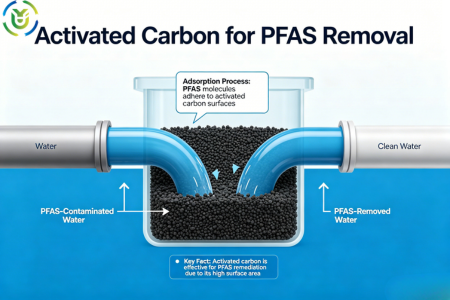
Among the many PFAS removal technologies, activated carbon is the preferred choice because of its cost-effective advantage, which is lower in cost and easier to integrate into existing water treatment systems than ion exchange, membrane filtration, and other technologies. It has been proven by practice that a reasonable choice of activated carbon can effectively remove both long and short chain PFAS, and has been recognized by the U.S. Environmental Protection Agency (EPA) as the “best available technology” for the control of PFAS in drinking water, and has become the mainstream choice for municipal, industrial, and remediation scenarios.
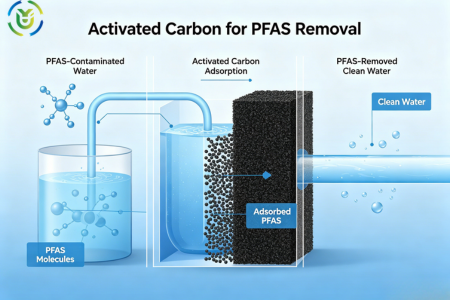
The core of PFAS removal by activated carbon is adsorption, and its effect mainly depends on factors such as adsorption force, pore structure, PFAS type and water chemistry. The adsorption of PFAS by activated carbon mainly relies on three core forces: hydrophobicity, van der Waals force and electrostatic force. Among them, hydrophobicity is the basis, and the non-polar activated carbon surface will generate attraction with fluorinated PFAS chains; van der Waals force is the key to trap PFAS molecules in the activated carbon pores; electrostatic effect is especially important for short-chain PFAS, and the adsorption effect can be enhanced by engineered surface chemistry methods such as amine functionalization.
Pore structure is the core factor affecting the PFAS capture effect, and different sizes of pores assume different roles: micropores (<2 nm) are crucial for capturing small molecules of PFAS (especially short-chained PFAS) and maximizing the adsorption capacity; mesopores (2-50 nm) facilitate the diffusion of PFAS molecules into the micropore, which is especially beneficial for the adsorption of long-chained PFAS. The optimal pore distribution should be 65%-80% of total porosity for micropores and 20%-35% for mesopores, a ratio that achieves full PFAS removal.
The adsorption behavior of long-chain and short-chain PFAS is obviously different. Long-chain PFAS (e.g., PFOA, PFOS) are more hydrophobic and easier to be adsorbed by the activated carbon, in which the coal-based activated carbon is more effective in capturing them, while the short-chain PFAS (e.g., PFBA, PFBS) are more water-soluble and difficult to be removed, and it is usually necessary to use activated carbons with high micropore rate (e.g., coconut shell activated carbon) or activated carbons modified by surface to achieve the desired effect. It is usually necessary to use activated carbon with high microporosity (such as coconut shell activated carbon) or activated carbon with surface modification to achieve the desired effect.
Water chemistry also significantly affects adsorption efficiency. Dissolved organic carbon (DOC) and natural organic matter (NOM) compete with PFAS for adsorption sites on the activated carbon, reducing adsorption; pH affects the charge of PFAS and the surface properties of activated carbon, and optimization of pH to 6.5-9.5 maximizes the adsorption efficiency in most application scenarios; furthermore, competing organics and anions in the water can interfere with PFAS. In addition, competing organic substances and anions in the water can also interfere with the binding of PFAS to the activated carbon, and such interfering substances need to be removed by pretreatment.
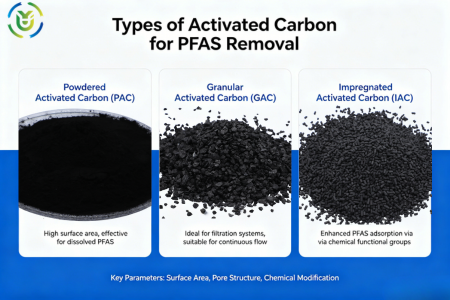
Granular activated carbon (GAC) has a large particle size and is mainly used in fixed-bed systems. Its core advantage lies in its long service life, its suitability for large-scale continuous treatment, and its stable and reliable performance as it can be regenerated to restore adsorption performance. In practice, GAC is widely used in municipal drinking water treatment, groundwater remediation, large-scale industrial wastewater treatment and other scenarios. Through engineering optimization of the pore structure and surface chemistry, it can also further enhance the capture capacity of short-chain PFAS to meet the treatment needs of different scenarios.
Powdered activated carbon (PAC) has a small particle size and is mainly used in emergency treatment or batch dosing scenarios, where it has faster adsorption kinetics and lower initial cost, and can be rapidly deployed for temporary pollution mitigation. However, powdered activated carbon also has obvious disadvantages; it is difficult to recover and cannot be regenerated, and sludge disposal is required after use, which will increase the sludge volume (up to 46%), so it is more suitable for the deep treatment of wastewater, the batch treatment of small-scale facilities, and the disposal of PFAS emergency events.
Columnar activated carbon is made by extrusion molding and has a lower pressure than granular activated carbon, which makes it easier to handle and store and is suitable for industrial gas/liquid systems. However, compared to granular activated carbon, its pore structure is poorly adapted to PFAS capture, and its application in PFAS removal is limited. It is more commonly used in industrial process water treatment where non-PFAS removal is the main objective, or as an auxiliary means for PFAS treatment.
Modified activated carbon is an emerging product developed to address the difficulties of short-chain PFAS removal, mainly including alkaline-modified, amine-functionalized, and metal-organic-framework (MOF) composite activated carbon types. The core advantage of this type of activated carbon is that it can significantly enhance the removal effect of short-chain PFAS, and the removal efficiency of some modified products can reach 99%, which is mainly used in groundwater remediation, industrial wastewater treatment with high content of short-chain PFAS and other scenarios.
The raw material of activated carbon directly determines its core performance. Currently, there are three main types of raw materials used for PFAS removal, each with its own suitable scenarios: coconut shell activated carbon has a high microporosity, which is suitable for the scenarios of short-chain PFAS and the presence of organic co-pollutants, and has a strong regeneration ability, which is most suitable for groundwater remediation, water treatment with low content of natural organic matter (NOM) and high content of short-chain PFAS; coal-based activated carbon has a wider distribution of pores, which is more suitable for the treatment of short-chain PFAS. Coal-based activated carbon has a wider pore size distribution, contains micropores and mesopores, has a high adsorption capacity for long-chain PFAS, and is cost-effective in treating mixed pollutants, and is suitable for municipal drinking water, and industrial wastewater treatment with a high content of long-chain PFAS; wood-based activated carbon has a large content of mesopores, and has a low efficiency of adsorption of PFAS when it is unmodified, and needs to be chemically modified before it can be used for PFAS removal, and is suitable for niche scenarios.
Pore size distribution directly determines the ability of activated carbon to capture PFAS, where micropores (<2 nm) are the core for capturing PFAS molecules, especially short-chain PFAS, and mesopores are responsible for facilitating the diffusion of PFAS molecules into the micropores to enhance the adsorption kinetics. High microporous volume is crucial for PFAS adsorption, and its proportion of total porosity should reach 65%-80% to ensure sufficient adsorption capacity. In practical selection, it is recommended to prefer activated carbon with specific surface area >1000 m2/g, which has a pore structure more suitable for PFAS removal.
Specific surface area and iodine value are the core indexes to measure the adsorption performance of activated carbon, the larger the specific surface area is, the more adsorption sites the activated carbon has, the stronger the adsorption capacity of PFAS, and it is recommended to choose the product with specific surface area >1000 square meters/g in PFAS application; the iodine value reflects the adsorption capacity of the activated carbon, and it is recommended to choose the iodine value in the range of 800-1200 mg/g in the scenario of PFAS treatment, the higher the iodine value is, the better the pore structure of this kind of activated carbon is. The higher the iodine value, the stronger the ability of activated carbon to capture small molecules (short chain PFAS).
The particle size and mesh size of activated carbon need to find a balance between adsorption efficiency and system pressure drop: the smaller the particle size, the faster the adsorption kinetics, the larger the contact area with PFAS molecules, which is more favorable for the removal of short-chained PFAS, but it will increase the pressure drop of the system and enhance the operation energy consumption; the larger the particle size, the lower the pressure drop, the longer the service life, which is more suitable for large-scale treatment systems. In practice, when granular activated carbon (GAC) is used in municipal scenarios, the recommended mesh size is 8-30 mesh, and powdered activated carbon (PAC) can be selected as a finer mesh size when used for emergency treatment.
Ash content will interfere with the combination of PFAS and activated carbon and reduce the adsorption performance, so the lower the ash content, the better: for drinking water applications, the ash content should be controlled below 5%; for industrial wastewater and environmental remediation applications, the ash content can be relaxed to below 10%. At the same time, it is necessary to ensure the purity of activated carbon to avoid leaching of heavy metals (such as arsenic), especially in drinking water treatment scenarios, which need to strictly comply with the relevant purity standards.
Empty bed contact time (EBCT) is a key parameter affecting the removal effect of PFAS, which is defined as the time of contact between the water and the activated carbon bed, and the recommended contact time in PFAS treatment is 10-20 minutes, longer empty bed contact time can significantly enhance the removal effect of short-chain PFAS, and if the contact time is insufficient, it will lead to incomplete removal of PFAS and early penetration.
Penetration curve analysis is the core method for judging the service life of activated carbon. By tracking the change of effluent PFAS concentration over time, the penetration point of activated carbon can be clarified – that is, the time point when the effluent PFAS concentration exceeds the regulatory limit value, so that the replacement cycle of activated carbon can be reasonably arranged accordingly to avoid the risk of compliance.
The flow rate and system design will also affect the adsorption effect, the higher the flow rate, the shorter the contact time of the empty bed, and the lower the PFAS removal efficiency, so it is necessary to optimize the flow rate according to the scale of treatment and water quality; at the same time, the design of using multiple groups of activated carbon beds in series can further enhance the effect of PFAS removal, which is especially suitable for the treatment of water bodies dominated by short-chain PFAS.
Pretreatment is an important link to ensure the adsorption effect of activated carbon, need to remove the natural organic matter (NOM) and dissolved organic carbon (DOC) in the water first, to reduce the adsorption competition with PFAS, which can be realized by coagulation, filtration and other processes; at the same time, need to be filtered before the activated carbon beds, to remove the suspended solids, to avoid clogging of the activated carbon pore space; in addition, adjust the pH value of the water body to 6.5-9.5, to maximize the adsorption efficiency of activated carbon. In addition, adjusting the pH value of water to 6.5-9.5 can maximize the adsorption efficiency of activated carbon.
|
Selection Criteria |
Granular Activated Carbon (GAC) |
Powdered Activated Carbon (PAC) |
|
System Type |
Fixed bed, continuous flow |
Batch dosing, temporary system |
|
Removal Efficiency |
High (long-term stability, effective in removing long/short chain PFAS) |
Fast (short-term effective, suitable for emergency relief, short chain PFAS removal is less effective) |
|
Cost |
High initial investment, low long-term cost (renewable) |
Lower initial cost, higher long-term cost (non-renewable, sludge disposal required) |
|
Regeneration |
Regenerable (thermal regeneration restores more than 90% of adsorption capacity) |
Non-renewable (disposal required after use) |
|
Optimal Scenario |
Municipal drinking water, large-scale industrial wastewater, groundwater remediation |
PFAS emergency events, deep wastewater treatment, small batch treatment |
|
Sludge Impact |
Very small (no sludge generation) |
Significant (up to 46% increase in sludge volume) |
Some users only focus on the removal of long-chain PFAS (PFOA/PFOS), while ignoring the short-chain variants that are more difficult to remove, resulting in a compliance risk as the PFAS concentration in the treated effluent still fails to meet regulatory requirements.
In order to reduce the initial procurement cost, the pore structure, specific surface area and other key performance indicators of activated carbon are sacrificed, resulting in insufficient adsorption capacity of activated carbon and early penetration, which in turn increases the long-term replacement cost and system operation and maintenance cost.
The interference of natural organic matter (NOM), pH value and competitive organic matter in water is not fully considered, resulting in the activated carbon adsorption sites being occupied, the PFAS removal efficiency decreasing significantly, and the expected treatment effect cannot be achieved.
In order to save equipment space and construction costs, the empty bed contact time was shortened, resulting in insufficient contact between PFAS and activated carbon, incomplete removal, and thus violation of regulatory standards.
Direct deployment of large-scale treatment systems without verifying the suitability of activated carbon with actual water samples may result in a mismatch between the performance of activated carbon and the actual water quality, resulting in wasted investment and compliance risk.
In water bodies dominated by short-chain PFAS, ordinary activated carbon is still used without selecting surface-modified activated carbon, resulting in poor removal of short-chain PFAS and failure to meet treatment needs.
The core purpose of laboratory isotherm test is to measure the adsorption capacity of activated carbon on specific PFAS types in the target water body, and to clarify the adsorption performance of activated carbon through Langmuir and Freundlich isotherm parameters, so as to provide a scientific basis for subsequent selection.
Rapid Small-Scale Column Test (RSSCT) can simulate the operational performance of large-scale granular activated carbon (GAC) and powdered activated carbon (PAC) in a laboratory environment, which has the advantages of cost-effectiveness and speed, and can effectively predict the penetration curve and service life of activated carbon, reducing the risk of large-scale deployment.
Pilot column study is a key part of verifying the performance of activated carbon under actual water flow conditions. By testing different activated carbon types, different empty bed contact times (EBCT) and pretreatment methods, the most suitable treatment solution is determined to ensure stable and standardized operation of large-scale systems.
When interpreting the data sheet provided by the supplier, focus on the core indicators such as pore size distribution, specific surface area, iodine value, ash content, PFAS removal efficiency, etc., and be wary of products with vague performance statements and lack of special PFAS test data. At the same time, ¹⁹F nuclear magnetic resonance (NMR) can be used as a low-cost, efficient PFAS removal quantification method to further verify the treatment effect of activated carbon.
For granular activated carbon (GAC), its adsorption performance can be restored by a thermal regeneration process, specifically by heating the spent granular activated carbon in a reducing environment to destroy the PFAS adsorbed in the pores and at the same time restore the pore structure. This process can restore more than 90% of the adsorption capacity, which not only reduces activated carbon waste, but also lowers life cycle costs, saving 20-40% compared to replacing with new activated carbon. During the regeneration process, it is necessary to ensure that the destruction efficiency of PFAS reaches more than 99.98%, and the regenerated activated carbon has no PFAS residue to avoid secondary pollution.
The replacement cycle of activated carbon is affected by a variety of factors, including PFAS concentration in the water body, water flow rate, empty bed contact time (EBCT) and water chemistry, etc. The best practice is to monitor the penetration curve and arrange for the replacement of the activated carbon before the PFAS concentration in the effluent water exceeds the regulatory limit, so as to avoid the risk of compliance.
Life Cycle Cost Analysis (LCCA) is the core methodology for achieving cost optimization, which requires a comprehensive consideration of initial activated carbon cost, installation cost, operating cost, regeneration/replacement cost, and sludge disposal cost of Powdered Activated Carbon (PAC) in order to achieve a balance between cost and effectiveness while safeguarding performance and compliance. Specific cost-saving recommendations include: giving preference to renewable granular activated carbon (GAC) for long-term applications; optimizing the pretreatment process to extend activated carbon service life; and selecting activated carbon based on the distribution of a particular PFAS to avoid cost wastage due to over-specification.
Global PFAS regulatory policies continue to tighten, the U.S. Environmental Protection Agency (EPA) not only updated the maximum contaminant limits (MCL), but also provide $ 10 billion in funding for PFAS testing and treatment, some states have more stringent standards; the EU will strengthen the requirements of PFAS limits in 2026, and large-scale wastewater treatment plants are required to implement a tertiary treatment mandate; South Korea, China and other Asian countries and regions continue to raise regulatory concerns, and the regulatory attention of the EU is increasing. The rising regulatory concerns in Asian countries and regions such as South Korea and China are driving the demand for PFAS treatment market.
In terms of market trends, the global PFAS treatment market is expected to grow at a compound annual growth rate (CAGR) of 15% through 2034, with the core driver being elevated global regulatory pressure. The market is currently showing three major trends: first, the rise of hybrid systems, where granular activated carbon (GAC) combined with ion exchange technology can significantly enhance short-chain PFAS removal; second, the acceleration of R&D for PFAS-specific activated carbons, such as metal-organic-framework (MOF) composite activated carbons and amine-functionalized activated carbons, which are targeted to solve the short-chain PFAS removal challenges; and third, the increase in demand for sustainable solutions. Third, the demand for sustainable solutions has increased, and renewable activated carbon and PFAS destruction technology have become hot spots in the industry.
In order to ensure compliance, it is necessary to keep abreast of regional regulatory standards. For drinking water treatment scenarios, activated carbon with special certifications for drinking water, such as NSF 61, NSF 42, etc., should be selected; at the same time, it is necessary to record the activated carbon’s treatment performance data, which can be used to prove compliance, and to avoid regulatory risks due to lack of data.
Suppliers are required to have quality certifications such as ISO 9001 (quality management), ISO 14001 (environmental management), ISO 45001 (occupational health), etc. Drinking water treatment scenarios are also required to provide special certifications such as NSF 61, NSF 42, Prop 65, etc. If it involves a specific regional market, it is also required to have certifications such as Halal (Halal) and Kosher (Kosher), etc., to Ensure the quality of products meets the relevant standards.
The supplier should be able to provide PFAS special test data and pilot test support, customize the pore structure and surface chemistry of the activated carbon according to the distribution of PFAS in the target water body, and at the same time, provide on-site system design, troubleshooting and performance optimization services, to ensure that the activated carbon is highly adapted to the actual treatment needs.
The supplier should have strict quality control process to ensure the consistency of product specifications between batches, and transparent production and testing process, and can provide complete product testing reports to avoid the impact of quality fluctuations on the treatment effect.
The supplier should have mature cases of PFAS removal in municipal, industrial and restoration scenarios, and have internal R&D team focusing on PFAS treatment solutions, with experience in dealing with different water quality and different scenarios of PFAS treatment, and be able to provide professional technical guidance for users.
The supplier should have a reliable supply chain to avoid supply delays and ensure timely delivery of activated carbon; it should also have the ability to export global projects and, if required, provide sustainable logistics practices to reduce supply chain risks.
Selecting activated carbon for PFAS removal is centered on the steps of “understanding PFAS distribution → selecting the type of activated carbon → prioritizing key criteria → testing and validation → selecting a reliable supplier”, and there is no “one-size-fits-all” activated carbon that can be used in all scenarios. There is no “universal” activated carbon that can be used in all scenarios, and the selection should be customized according to the chemical properties of the water body, the type of PFAS and the specific application scenario. In practice, it is necessary to avoid common misconceptions, pay attention to testing and validation, and combine regulatory requirements and cost optimization goals to select the appropriate activated carbon and suppliers to ensure that the PFAS removal effect is up to standard and compliant. It is recommended to consult with PFAS treatment experts to further optimize the activated carbon selection plan to achieve the double optimization of treatment effect and cost.