In industrial production, gas separation is an indispensable key link in many fields – from the preservation of freshness in food packaging, inert protection in electronic manufacturing, to the purification of raw materials in petrochemical industry, and carbon capture in new energy field, all of them are inseparable from efficient and precise gas separation technology. The emergence of carbon molecular sieve (CMS) completely breaks this dilemma, and with its unique structure and performance, it becomes the optimal solution in the field of gas separation, showing irreplaceable selectivity, high efficiency and cost advantages in various industrial scenarios. This article will be from the basic concept of carbon molecular sieve, working principle, core advantages, industry applications, to the comparison with other separation technologies, selection points and future trends, comprehensive analysis of why gas separation should give priority to carbon molecular sieve, to provide practical reference and guidance for industrial practitioners.
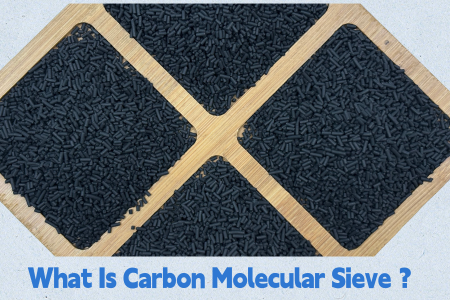


Carbon molecular sieve is a kind of porous adsorbent material based on carbon, which is specially used to achieve accurate separation at the molecular level, and is the core consumable for industrial gas purification and separation. Unlike ordinary adsorbent materials, carbon molecular sieve can screen gas molecules of different sizes and diffusion rates by virtue of its controllable pore structure, thus realising efficient separation.
From the raw material point of view, the preparation of carbon molecular sieve mainly adopts coconut shell, coal, synthetic polymers, etc., of which coconut shell has become the most widely used raw material due to its natural porous, low cost, environmentally friendly and renewable characteristics (SEO keywords: raw materials for carbon molecular sieve, carbon molecular sieve from coconut shell). These raw materials after carbonisation, activation, shaping and a series of processes, the formation of carbon-based adsorbent materials with a uniform microporous structure, the core value of which lies in the ‘accurate sieving’.
The most significant feature of carbon molecular sieve is its unique wedge-shaped uniform microporous structure, the pore size range is usually between 0.28 ~ 0.38 nm, the core role of this precise pore size design is ‘molecular sieving’ – according to the size of the diameter of the gas molecules and the difference in the rate of diffusion, the target gas molecules can be sieved by the molecular sieving mechanism. The core function of this precise pore size design is ‘molecular sieving’ – according to the difference in the diameter and diffusion rate of gas molecules, the target gas molecules can diffuse into the microporous adsorption quickly, while the gas molecules to be separated can pass through smoothly, so as to realise the high efficiency separation.
Many people will confuse carbon molecular sieve and activated carbon, but there is an essential difference between the two: carbon molecular sieve pore size is uniform and controllable, mainly used for ‘selective kinetic separation’, focusing on the precise separation of specific gases; while the pore size of activated carbon is irregular and widely distributed, mainly used for general adsorption and purification (such as the removal of impurities and odour), and cannot achieve precise separation at the molecular level. The pore size of carbon molecular sieve is irregular and widely distributed, which is mainly used for general adsorption purification (such as removing impurities and odour), and it can’t achieve accurate separation at the molecular level (SEO keywords: difference between carbon molecular sieve and activated carbon).
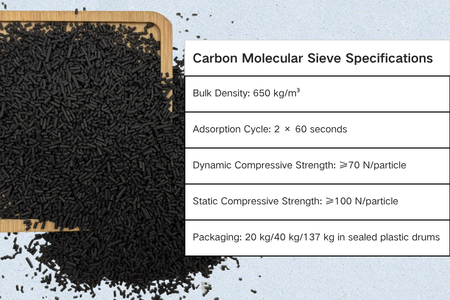
The core logic of carbon molecular sieve to achieve gas separation is ‘kinetic separation’ and ‘selective adsorption’, combined with pressure swing adsorption (PSA) process, to achieve continuous and efficient gas separation to meet the needs of industrial scale production.
Different gas molecules have different diameters, and their diffusion rates in the micropores of the carbon molecular sieve are also different. Smaller gas molecules (such as oxygen, carbon dioxide) diffusion rate is faster, can quickly enter the microporous carbon molecular sieve and be adsorbed; while the larger gas molecules (such as nitrogen, methane) diffusion rate is slower, it is difficult to enter the microporous, can only be from the carbon molecular sieve particles through the interstices, so as to achieve the separation of the two kinds of gas.
The pore size of carbon molecular sieve is precisely regulated, which can just match the molecular diameter of the target adsorbed gas to achieve ‘targeted adsorption’. For example, in the separation of oxygen and nitrogen, the pore size of carbon molecular sieve can be adjusted to 0.28~0.36nm, which just allows oxygen molecules (diameter of 0.346nm) to enter into the adsorption, while nitrogen molecules (diameter of 0.364nm) are blocked, so as to realise the purification of nitrogen.
The most important application process of carbon molecular sieve is Pressure Swing Adsorption (PSA), whose core process is divided into four steps:
Pressure Swing Adsorption – Under a certain pressure, the mixed gas passes through the carbon molecular sieve bed, the target impurity gas is adsorbed, and the gas to be purified (e.g. nitrogen) is discharged from the bed outlet;
Decompression desorption – reduce the bed pressure, so that the adsorbed impurity gas desorption, to achieve the regeneration of carbon molecular sieve;
Blowing and cleaning – using a small amount of purified gas to blow the bed, thoroughly remove the residual impurities;
Boosting preparation – to restore the bed pressure to the adsorption pressure, into the next round of circulation.
This cyclic operation enables continuous, stable on-site gas production and is the mainstream method of industrial gas separation.
The key gases that can be separated by carbon molecular sieve include oxygen/nitrogen (the most common application), carbon dioxide/methane, hydrogen purification, etc., covering the most core gas separation needs in industrial production (SEO keywords: carbon molecular sieve oxygen and nitrogen separation, carbon molecular sieve hydrogen purification).
Carbon molecular sieve has a precise and controllable pore size distribution, especially for oxygen and nitrogen separation and other common scenarios, the pore size can be accurately regulated to 0.28~0.36 nanometres, which can efficiently separate gas molecules of similar size (such as oxygen and nitrogen). This precise sieving ability makes the purity of the separated gas far exceed that of ordinary adsorbent materials, which can meet the needs of electronics, food, medicine and other industries that require very high purity of gases.
Carbon molecular sieve has fast adsorption kinetics, which can quickly complete the adsorption-regeneration cycle, effectively shorten the production cycle and improve the production efficiency of PSA system. Take nitrogen purification as an example, carbon molecular sieve can increase the purity of nitrogen to 99.999%, which can fully meet the strict purity requirements of inert protection and food preservation in industrial production, and the capacity is stable, and there will not be any fluctuations in purity.
Carbon molecular sieve has strong mechanical strength, can withstand frequent pressure fluctuations in the PSA process, not easy to break, pulverisation, effectively avoiding system downtime due to adsorbent loss. At the same time, it has a strong resistance to pressure cycling, and its service life can reach 3~5 years under normal operating conditions, which significantly reduces the adsorbent replacement frequency and maintenance costs.
In the PSA system, the operating cost of carbon molecular sieve is much lower than other separation technologies, and there is no need for complex auxiliary equipment. Compared with traditional technologies such as deep-cooling distillation, the energy consumption of carbon molecular sieve PSA system can be reduced by more than 30%, which can significantly reduce the energy consumption of industrial production and lower operating costs for enterprises.
Carbon molecular sieve has excellent thermal and chemical stability, can operate stably in high temperature, corrosive gases and other harsh industrial environments, will not affect the adsorption performance due to environmental changes. Its performance is stable for a long time, which can effectively reduce the system downtime and guarantee the continuity of industrial production.
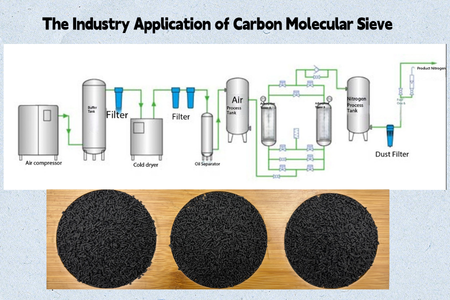
Carbon molecular sieve is the core adsorbent of PSA nitrogen generator, which is widely used in the on-site preparation of industrial nitrogen. The prepared high-purity nitrogen can be used in many scenarios, such as food packaging (to prevent oxidation and deterioration, and extend shelf life), electronic manufacturing (inert protection, to avoid oxidation of components), chemical industry (to prevent oxidation and combustion in the process of reaction, and to ensure production safety), etc., and it is the optimal solution for the industrial nitrogen preparation at present.
In the field of air separation, carbon molecular sieve is mainly used to remove oxygen from compressed air and prepare inert gas to meet the demand of on-site gas production. For example, in the metal heat treatment industry, the inert gas can prevent metal oxidation; in the field of pharmaceutical manufacturing, it can be used for inert protection in the process of drug production to ensure the quality of drugs.
In the hydrogen production process, carbon molecular sieve can effectively remove carbon dioxide, methane and other impurities in the hydrogen, after purification of high-purity hydrogen can be used in petrochemical (hydrogen refining), fuel cells (new energy vehicles, energy storage) and other fields, is the key purification material in the hydrogen industry chain.
The main components of biogas are methane and carbon dioxide, through the carbon molecular sieve can efficiently remove the carbon dioxide, increase the concentration of methane, and convert biogas into clean fuel, which can be used in power generation, heating and other fields, realising the efficient use of new energy, and contributing to the realization of the goal of ‘double carbon’.
In the petrochemical industry, carbon molecular sieve is used in natural gas decarbonisation, refinery gas purification and other processes; in chemical processing, it can be used for purification and separation of various types of gas raw materials to ensure the stability of the production process and product quality, and it is an indispensable core consumable in the chemical industry.
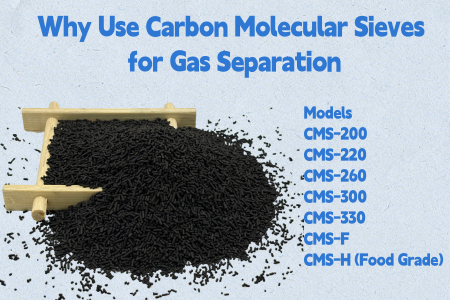
Both belong to adsorption separation materials, but carbon molecular sieve is better at kinetic separation, gas molecules of similar size (such as oxygen and nitrogen) selectivity is stronger; zeolite molecular sieve mainly rely on adsorption affinity separation, selectivity is relatively weak, more suitable for the adsorption capacity of the requirements of the high separation accuracy requirements of the scenario is not high (SEO keywords: carbon molecular sieve vs zeolite molecular sieve comparison).
Membrane separation technology is simple to operate, but the separation purity is low (nitrogen purity is usually 95~99.5%), and the membrane module is easy to wear and tear, high replacement cost; carbon molecular sieve can achieve 99.999% high purity separation, and long service life, is more suitable for industrial scenarios with high gas purity requirements.
Deep-cooled distillation can achieve ultra-high purity gas separation, but equipment investment, high energy consumption, wide area, suitable for large-scale, ultra-high purity gas separation; carbon molecular sieve PSA system investment is small, low energy consumption, on-site production of gas, suitable for small and medium-sized, high-purity gas separation needs, more cost-effective.
In summary, when there are high purity requirements for industrial production, the need for on-site gas production, the pursuit of cost savings and energy consumption reduction, and the need for stable, low-maintenance separation programme, carbon molecular sieve is the optimal choice.
|
Separation Technology |
Core Advantages |
Applicable Scenarios |
|
Carbon Molecular Sieves (CMS) |
Strong selectivity, high purity, low energy consumption, on-site gas production, simple maintenance |
Small and medium scale, high purity requirements, on-site gas production scenarios |
|
Zeolite molecular sieve |
Large adsorption capacity, wide range of applications |
High adsorption capacity and low separation accuracy requirements |
|
Membrane Separation |
Simple operation, lightweight equipment |
Low purity requirement, small scale gas separation scenario |
|
Deep Cold Distillation |
Ultra-high purity gas separation |
Large-scale, ultra-high purity gas separation |
According to the type of target separation gas (such as oxygen and nitrogen separation, hydrogen purification), select the carbon molecular sieve with large adsorption capacity and strong selectivity to ensure separation efficiency and purity. For example, carbon molecular sieves with a pore size of 0.28~0.36nm should be selected for oxygen and nitrogen separation.
The particle size and shape of the carbon molecular sieve will affect the pressure drop and adsorption efficiency of the PSA system, and it is necessary to select the appropriate particle specifications according to the system design parameters, so as to avoid insufficient adsorption due to oversized particles or high system pressure due to undersized particles.
The packing density affects the filling amount of carbon molecular sieve in the adsorption bed, and the mechanical strength determines its pressure cycle resistance and service life, so it is necessary to choose the product with moderate packing density and high mechanical strength to reduce the loss.
Carbon molecular sieve needs to be compatible with the design parameters of PSA/VPSA system (such as pressure, temperature, cycle time) to ensure that the system can operate stably and play the optimal separation effect.
Select suppliers with reliable quality and stable production capacity to ensure the consistency of pore size distribution, adsorption performance and other indicators of the carbon molecular sieve, to avoid product quality fluctuations affecting the operation of the system, and at the same time to protect the subsequent after-sales and technical support.
By precisely regulating the pore size, distribution and morphology of carbon molecular sieve, its selectivity and adsorption efficiency can be further improved, for example, through heteroatom modification and other technologies to optimize the adsorption performance of specific gases, and to adapt to more subdivided separation scenarios.
As the requirements for flexibility and cost control in industrial production increase, on-site gas production (such as PSA nitrogen and hydrogen production) will become mainstream, and the demand for carbon molecular sieve, as a core consumable for on-site gas production, will continue to expand.
Driven by the goal of ‘double carbon’, carbon molecular sieve will play a more important role in the field of clean energy, such as carbon dioxide capture, hydrogen purification, and become a key material to achieve carbon emission reduction.
With the accelerated industrialisation process in emerging economies such as Asia, Africa and Latin America, the demand for industrial gas separation will increase significantly, driving the continuous growth of the carbon molecular sieve market, and also promoting the localisation of carbon molecular sieve technology.
On the whole, carbon molecular sieve, with its core advantages of high selectivity, high efficiency, long life, high cost-effectiveness and strong stability, perfectly solves the core pain points of industrial gas separation, such as efficiency, cost and purity, and has become the preferred material for gas separation in many fields at present. From nitrogen preparation, hydrogen purification to biogas upgrading and petrochemical processing, the application of carbon molecular sieve covers many key aspects of industrial production, providing strong support for enterprises to improve quality and efficiency, energy saving and consumption reduction.