The extensive use of solvents in the industrial production process generates a large number of volatile organic compounds (VOCs), which not only results in a waste of solvent resources, but also pollutes the environment, increases the operating costs of enterprises, and even violates environmental regulations. Solvent recovery as a key means to solve this problem, its efficiency depends directly on the choice of adsorption materials. Activated carbon pellets, with its unique structure and performance, has become the preferred material in the field of industrial solvent recovery, which can not only realise the efficient capture of VOCs, but also reduce the operating costs and help enterprises to meet the environmental standards. In this article, we will analyse in detail the characteristics of activated carbon pellets, the working principle of solvent recovery system, as well as the core reasons why it has become the ideal choice for solvent recovery.
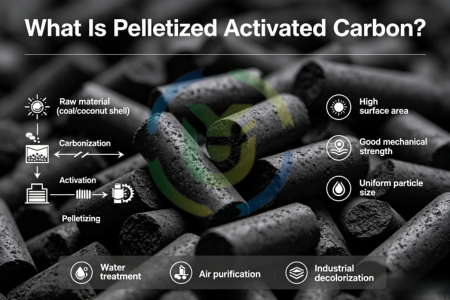


Activated carbon pellets are a kind of adsorbent material with highly developed pore structure after special treatment. Its appearance is in the form of regular columns or spheres, with hard texture and uniform particles, which distinguishes it from other forms of activated carbon such as powder and granule. Its core advantage comes from the unique preparation process and raw material selection, which can accurately match the demanding needs of industrial solvent recovery.
The raw materials of activated carbon pellets come from a wide range of sources, and there are three main types of common raw materials, each with its own performance focus, which can be adapted to the solvent recovery needs of different industries:
Coal-based activated carbon pellets: easy to obtain raw materials, low cost, high mechanical strength, suitable for dealing with high concentration, high viscosity organic solvents, widely used in petrochemical, coal chemical industry and other industries.
Coconut shell-based activated carbon pellets: more developed pore structure, larger specific surface area, excellent adsorption performance, especially suitable for capturing low concentrations of VOCs, commonly used in pharmaceutical, food and other fields requiring high adsorption precision.
Wooden activated carbon pellets: strong environmental protection, good renewability, fast adsorption rate, suitable for the treatment of water-soluble solvents, widely used in printing, coating and other industries.
The preparation of activated carbon pellets is divided into two main steps to ensure its excellent adsorption performance and industrial applicability:
Extrusion moulding: after crushing and mixing the raw materials, the raw materials are made into uniform columnar or spherical particles by extrusion equipment to ensure the uniform size of the particles, which lays the foundation for the subsequent adsorption and airflow circulation.
Activation: High-temperature steam or chemical activation is used to activate the moulded particles, resulting in the formation of a large number of micropores and mesopores, which dramatically increases the specific surface area and enhances the adsorption capacity – the core reason why activated carbon pellets are able to capture solvent molecules with high efficiency.
The physical properties of activated carbon pellets directly determine their performance in solvent recovery, and the core advantages include:
High mechanical strength: it is not easily broken or abraded, and can be adapted to the dynamic operating environment of the industry, so as to avoid clogging the equipment with dust generated by the broken particles.
Uniformity of particles: consistent size, which ensures uniform distribution of airflow in the adsorption bed, avoiding local airflow too fast resulting in inadequate adsorption.
Low dust generation: Compared with powdered activated carbon, it can effectively reduce dust pollution, reduce equipment maintenance costs and safety risks.
High specific surface area: the specific surface area of each gram of activated carbon pellets can reach hundreds or even thousands of square metres, which can maximally adsorb solvent molecules.
The core of solvent recovery is to use adsorption materials to capture VOCs and organic solvents in industrial waste gas, and then separate and recover the solvents through desorption, condensation and other steps, so as to achieve resource recycling. Activated carbon, as the core of adsorption, runs through the whole recovery process, and its performance directly affects the recovery efficiency and cost.
The core of the solvent recovery system is ‘adsorption – desorption’ cycle: adsorption stage, containing solvent waste gas through the activated carbon adsorption bed, solvent molecules are captured by the microporous structure of the activated carbon to achieve the purification of the waste gas; when the activated carbon reaches adsorption saturation, into the adsorption stage, the activated carbon is heated through the high-temperature steam or hot gas to make the adsorbed solvent molecules adsorbed out of the solvent. When the activated carbon reaches adsorption saturation, it enters the desorption stage, the activated carbon is heated by high temperature steam or hot gas, so that the adsorbed solvent molecules are desorbed; the desorbed solvent vapour is condensed and separated, and becomes liquid solvent which can be put into the production again, while the activated carbon restores adsorption capacity and continues to be recycled.
In the solvent recovery system, activated carbon assumes the key role of ‘capturing solvent’. Due to the strong adsorption capacity and affinity for organic substances, activated carbon can efficiently capture VOCs and all kinds of organic solvents (such as acetone, toluene, ethanol, etc.) in the exhaust gas, and does not react with the solvent, and will not produce secondary pollution, it is the most ideal adsorbent material in solvent recovery.
Adsorption stage is the first part of solvent recovery, containing solvent loaded exhaust gas will continue to pass through the activated carbon adsorption bed, all kinds of organic solvent molecules in the exhaust gas will be activated carbon pellets developed microporous structure to quickly capture and firmly adsorbed, after adsorption of purified exhaust gas, can directly meet the emission standards for emissions, but also according to the needs of production recycling for the production process, to achieve high efficiency in the use of exhaust gas.
When the adsorption of activated carbon pellets reaches saturation, and can no longer capture more solvent molecules, it enters the desorption stage, at this time, the adsorption bed is fed with high temperature steam or hot gas, and the activated carbon pellets are heated up by heat, so that the solvent molecules that were originally adsorbed in its micropores are detached from adsorption, and ultimately form a high concentration of solvent vapour, which can be ready for the subsequent condensation and recovery.
The solvent vapour produced by desorption will be introduced into the condenser, and under the cooling effect of the condenser, the high temperature solvent vapour will quickly condense into liquid solvent, which can then be put back into industrial production after simple treatment such as separation, purification and removal of a small amount of impurities, thus truly realizing the recycling of solvent resources, reducing wastage and lowering the production cost.
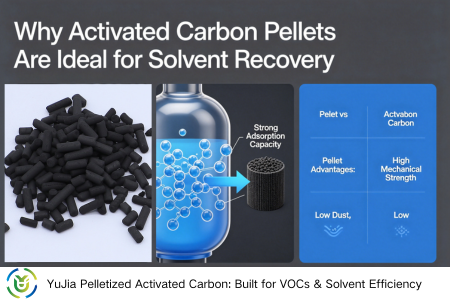
The high specific surface area and developed microporous structure of activated carbon pellets make them have strong adsorption capacity for organic solvents and VOCs. On the one hand, the large volume of its micropores can accommodate a large number of solvent molecules; on the other hand, activated carbon has a strong affinity for organic substances, which enables it to capture solvents in exhaust gases quickly and efficiently, and achieve ideal adsorption effects even for low concentrations of VOCs. This advantage can greatly improve the solvent recovery efficiency, reduce solvent waste and lower the cost of raw materials for enterprises.
Industrial solvent recovery system is mostly dynamic operation, fast airflow speed, equipment vibration, the mechanical strength of the adsorption material is very high. Activated carbon pellets after extrusion and high-temperature activation treatment, the mechanical strength far exceeds that of powdered and ordinary granular activated carbon, which is not easy to break, wear and tear, and can be stably operated for a long period of time in fixed-bed adsorption towers and other industrial equipment, avoiding the dust generated by the fragmentation of the particles from blocking the pipeline, affecting the operation of the system, and reducing the cost of maintenance of the equipment.
Activated carbon pellets of uniform size, filled in the adsorption bed, will form a uniform gap, so that the airflow can pass smoothly, effectively reducing the pressure loss of the system. Lower pressure loss means less energy consumption of fans and other equipment, especially for large-scale solvent recovery systems, long-term operation can save a lot of electricity costs, and improve the economic efficiency of enterprises. In contrast, powdered activated carbon is prone to agglomeration, which will lead to excessive pressure loss and increase energy consumption; ordinary granular activated carbon is uneven in size, which also affects airflow distribution and reduces energy saving.
Activated carbon pellets can be regenerated by steam or hot gas desorption during the solvent recovery process, and the regeneration process is simple and efficient, and the adsorption performance basically does not decay after regeneration. After many adsorption-desorption cycles, the adsorption effect can still be maintained, and the service life is much longer than that of powdered activated carbon. This advantage can reduce the replacement frequency of activated carbon, reduce the purchase cost of adsorption materials, and reduce the generation of waste, in line with the concept of environmental protection.
The industrial solvent recovery workshop has high requirements for environmental cleanliness and safety. Powdered activated carbon produces a large amount of dust in the process of using, which not only pollutes the environment, but also may lead to fire, explosion and other safety hazards. Activated carbon pellets, however, produce a very low amount of dust, which can effectively avoid the dust from blocking the equipment and polluting the production environment, and at the same time reduce the safety risk, enhance the safety of the workshop operation and reduce the cost of environmental protection treatment.
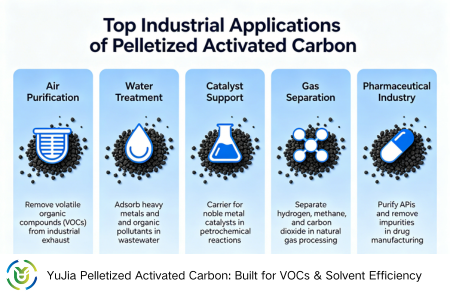
In the pharmaceutical manufacturing industry, activated carbon pellets are mainly used for drug synthesis, preparation production and other aspects of organic solvent recovery, common recovery solvents, including ethanol, methanol, acetone, etc., not only can effectively reduce the waste of solvent resources, reduce the cost of raw material procurement, but also to avoid atmospheric pollution caused by the volatilisation of organic solvents, in strict compliance with the pharmaceutical industry’s stringent environmental standards and production hygiene requirements, to ensure that the production process of green compliance. Green compliance.
The chemical industry produces a large number of exhaust gases containing VOCs and waste solvents during the production process, activated carbon pellets can efficiently achieve the control of VOCs and solvent recovery, focusing on the recovery of acetone, ethyl acetate, toluene and other commonly used solvents, not only to help enterprises to meet the national and local environmental requirements for environmental protection, to avoid the risk of environmental penalties, and also through the recycling of solvents to reduce operating costs and enhance the efficiency of the production process.
Coatings and painting factories will evaporate a large amount of organic solvents, such as toluene, xylene, butanol, etc., in the process of raw material mixing and spraying, etc. Activated carbon pellets can accurately capture these evaporated solvents, which not only reduces atmospheric pollution and improves the operating environment of the workshop, but also puts the recovered solvents into the production again after a simple purification process, so as to realise solvent recycling and reduce the cost of the enterprise’s production.
Printing and ink production line in the printing, drying and other processes will evaporate a large number of ink solvents, such as isopropanol, butanone, ethyl acetate, etc., activated carbon pellets can be efficiently recovered these solvents, not only to reduce the waste of solvents, reduce the cost of procurement of raw materials, and also effectively improve the working environment of the workshop to reduce the impact of dust and harmful gases on the operators, enhance production safety.
Petrochemical and oil refineries in the refining, cracking and other production processes will produce a large number of volatile gases, which contain a variety of solvents and hazardous components, activated carbon pellets can efficiently capture these substances to achieve the purification of the exhaust gas treatment, and at the same time to recover the solvent resources that can be used to comply with the environmental requirements of the emission, and also enhance the utilisation rate of the resources to reduce the cost of environmental protection management of the enterprise.
In solvent recovery, common forms of activated carbon are powder (PAC) and granular (GAC), compared with activated carbon pellets, the latter two have obvious gaps in performance and applicability, the specific comparison is as follows:
Powdered Activated Carbon (PAC) is a fast adsorber, but has many disadvantages that make it difficult to adapt to the long-term operational needs of industrial solvent recovery:
Advantages of activated carbon pellets: less dust, easy to handle, no additional filtration equipment required, high mechanical strength, renewable, long service life, suitable for fixed bed adsorption systems, low maintenance costs.
Disadvantages of powdered activated carbon: large amount of dust, easy to block the equipment, pollution of the environment, can not be regenerated, need to be treated as hazardous waste after use, high replacement frequency, high long-term operating costs, and need to be equipped with special filtration equipment.
Granular Activated Carbon (GAC) is not uniform in size and has properties between powdered and activated carbon pellets, and is not as well suited for solvent recovery as activated carbon pellets:
Advantages of activated carbon pellets: uniform size, better airflow distribution, lower pressure loss, higher mechanical strength, less prone to wear, more stable regeneration, suitable for large-scale, long-term operation of solvent recovery systems.
Disadvantages of granular activated carbon: uneven size, easy to lead to uneven distribution of airflow, local adsorption is not sufficient, poor mechanical strength, easy to break in long-term operation, pressure loss is higher than activated carbon pellets.
Overall, in fixed bed solvent recovery systems (the mainstream equipment for industrial solvent recovery), activated carbon pellets have the best overall performance and are the most cost-effective choice.
|
Activated Carbon Forms |
Core Advantages |
Major drawbacks |
|
Pelletized Activated Carbon |
Low dust, high mechanical strength, easy regeneration, low pressure loss, suitable for fixed-bed systems. |
No obvious disadvantages, suitable for most industrial solvent recovery scenarios |
|
Powdered Activated Carbon (PAC) |
Fast adsorption speed |
Dusty, non-renewable, prone to clogging, high long-term operating costs |
|
Granular Activated Carbon (GAC) |
In-between performance, moderate adsorption effect |
Uneven size, high pressure loss, poor mechanical strength, easily broken |
Iodine value is an important index to measure the adsorption capacity of activated carbon, the higher the iodine value, the stronger the adsorption capacity; the larger the specific surface area, the stronger the ability to capture solvent molecules, which is suitable for low concentration solvent recovery.
Directly affect the service life of activated carbon pellets, the higher the hardness and the better the abrasion resistance, the better it can adapt to the industrial dynamic operating environment and reduce fragmentation and dust generation.
Choose the appropriate pore size distribution according to the molecular size of the target solvent – micropores for small solvents and mesopores for large solvents to ensure maximum adsorption efficiency.
The choice of activated carbon pellets is based on the type of solvent to be recovered (polar vs. non-polar), e.g. coconut-based activated carbon is more suitable for non-polar solvents and coal-based activated carbon is more suitable for polar solvents.
According to the bed height and airflow speed of the solvent recovery system, select the appropriate size of activated carbon pellets to ensure smooth airflow, full adsorption, and reduce pressure loss.
The use of activated carbon pellets for solvent recovery can not only bring significant economic benefits for the enterprise, but also help the enterprise to achieve environmental objectives, to achieve ‘economic benefits + environmental benefits’ double enhancement.
On the one hand, the activated carbon pellets can be regenerated many times, long service life, reduce the frequency of adsorption material replacement, reduce procurement costs; on the other hand, through the recovery of solvents, the original waste solvent can be re-invested into the production, to reduce the purchase of new solvents, and significantly reduce the cost of raw materials. At the same time, the advantage of low pressure loss can reduce the energy consumption of fans and other equipment, long-term operation can save a lot of electricity, further reducing the operating costs of enterprises.
Activated carbon pellets can efficiently capture VOCs and organic solvents in the exhaust gas, reduce exhaust emissions, avoid pollution of the atmospheric environment, and help the enterprise to comply with national and local environmental regulations (such as the VOCs emission standards) and avoid environmental penalties. At the same time, the solvent recycling reduces the waste generated to achieve resource recycling, in line with the development concept of ‘green production’, to enhance the environmental image of the enterprise.
In the field of industrial solvent recovery, activated carbon pellets have become the ideal adsorption material suitable for all kinds of industrial scenarios by virtue of its core advantages such as high adsorption efficiency, excellent mechanical strength, low pressure loss, easy regeneration and low pollution. It can not only help enterprises to achieve solvent recycling, reduce operating costs, but also help enterprises to meet environmental standards and achieve green production.
For industrial enterprises, choosing the right activated carbon pellets, and scientifically designed solvent recovery system, standardised operating procedures, can maximise the performance of activated carbon pellets to enhance the efficiency of solvent recovery, to achieve a win-win situation of economic and environmental benefits. In the future, with the continuous improvement of environmental protection requirements, the application of activated carbon pellets in the field of solvent recovery will be more extensive, and become an important support for the green development of enterprises.