In pharmaceutical production, activated carbon is the core adsorption material to ensure the quality of drugs, which is directly related to drug purity, GMP compliance and patient drug safety. For pharmaceutical enterprises, it is very important to choose the right activated carbon. The wrong choice can easily lead to problems such as incomplete decolorization and impurities exceeding the standard, and even trigger regulatory penalties and product recall. This article will provide practical activated carbon selection guidelines for practitioners from core selection factors, scenario matching and other dimensions.
Pharmaceutical-grade activated carbon is not ordinary industrial activated carbon, but a special adsorbent material that is strictly purified and meets the exclusive standards of the pharmaceutical industry. Its quality and performance directly determine the safety and purity of medicines, and its core specifications and features are as follows:
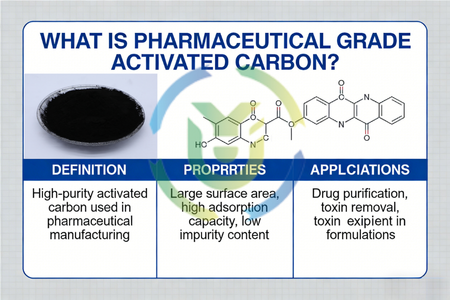
The purity of pharmaceutical-grade activated carbon must reach a very high standard, and must strictly follow the USP (United States Pharmacopoeia), EP (European Pharmacopoeia) and other international authoritative pharmacopoeia norms, and each index needs to be strictly tested and verified. Its ash content is controlled at a very low level, which avoids the secondary pollution of drugs caused by the impurities of activated carbon itself from the source, and guarantees the safety and purity of drugs. Meanwhile, it has a stable pH value, which can be flexibly adapted to the acid and alkaline environment of different pharmaceutical processes, and the particle size can be precisely adjusted according to the specific production requirements, which is suitable for all kinds of pharmaceutical scenarios.
The core demand of industrial-grade activated carbon is low cost and high adsorption capacity, which is mainly used in general industrial wastewater treatment, exhaust gas purification and other scenarios, and does not need to meet the strict standards of hygiene and purity. On the other hand, pharmaceutical-grade activated carbon takes ‘safety compliance’ as the primary premise, and has extremely stringent requirements on heavy metal content, impurity residue, adsorption selectivity, and the whole process needs to comply with the GMP norms of the pharmaceutical industry. From raw material selection, production and processing to storage and transport, pharmaceutical-grade activated carbon has exclusive standards to ensure that it will not have any negative impact on the quality of medicines, which is irreplaceable by industrial-grade activated carbon.
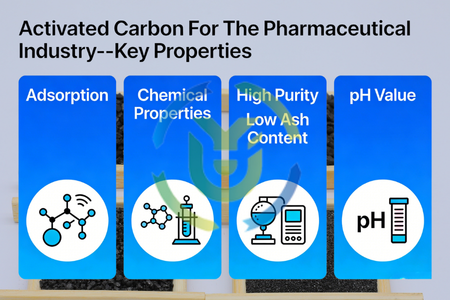
Pharmaceutical-grade activated carbon has a well-developed porous structure and a large specific surface area, which is the core foundation for its efficient adsorption, and can quickly capture all kinds of impurities in pharmaceutical production. Its fast adsorption speed, large adsorption capacity and strong adsorption selectivity allow it to accurately target the removal of harmful impurities such as heat sources and pigments without destroying the active ingredients in pharmaceuticals. This precise adsorption capacity can effectively guarantee the purity of drugs and avoid the negative impact of impurities on the efficacy and safety of drugs, which is suitable for the demanding needs of pharmaceutical production.
Pharmaceutical-grade activated carbon has good chemical stability, can maintain stable performance in the acid-base environment of different pharmaceutical processes, and will not produce new impurities in chemical reactions. Its pH value is stable and controllable, and it can flexibly adapt to different production systems such as water quality and solvent properties. There is no need to worry about the decline in adsorption performance or drug pollution due to environmental changes. The stable chemical properties ensure that activated carbon continues to play a role throughout the production process, providing reliable support for the stability of drug quality.
The purity of pharmaceutical grade activated carbon needs to reach a very high standard, the core of which is to strictly follow the USP, EP and other international pharmacopoeia norms as well as the GMP production standards to eliminate any impurity residues that may affect the quality of drugs. High purity is one of the core indicators of pharmaceutical-grade activated carbon, which directly determines the safety of medicines and can effectively avoid the contamination of medicines due to the lack of purity of activated carbon and ensure the safety of medicines. Each batch of activated carbon has to undergo strict purity testing to ensure that it meets the stringent requirements of the pharmaceutical industry and provides a reliable guarantee for the production of medicines.
Ash content is the key control index of pharmaceutical-grade activated carbon, which needs to be controlled at a very low level to avoid the secondary pollution of pharmaceuticals caused by the ash impurities of activated carbon itself from the source. Low ash content means that the purification process of activated carbon is more exquisite, which can reduce the problems of filter clogging and drug purity degradation caused by ash shedding during the production process and improve the production efficiency. Strict control of ash content is not only a clear requirement of Pharmacopoeia and GMP, but also an important prerequisite to guarantee the appearance, purity and stability of drugs.
Pharmaceutical-grade activated carbon needs to have a stable pH value, which can maintain stable performance in the acid-base environment of different pharmaceutical processes, and will not produce new harmful impurities in chemical reactions. Its pH value can be accurately regulated according to production needs, and it can be flexibly adapted to different production systems such as water and solvent, so as to ensure that the adsorption performance is not affected by the environment. Stable pH can ensure that activated carbon continues to play an adsorption role throughout the production process, avoiding fluctuations in pH value affecting drug quality and production progress.
One of the core roles of activated carbon in pharmaceutical production is the efficient removal of all types of impurities from pharmaceutical raw materials and intermediates, including pyrogens (e.g. endotoxins), pigments, proteins, colloidal impurities and so on. These impurities, if not completely removed, will not only affect the appearance and purity of the drug, but also may reduce the efficacy of the drug, and even cause adverse reactions in patients, endangering the safety of medication. Therefore, the selection of activated carbon with appropriate adsorption performance is the key link to ensure that the final drug meets the purity standard.
The pharmaceutical industry is regulated by strict standards at home and abroad, such as GMP, USP, EP, etc. Activated carbon, as a key auxiliary material in the production process of pharmaceuticals, must be fully compliant with the relevant standards in terms of quality. If non-compliant activated carbon is used, it will directly lead to non-compliance of the final product, and the company will face a series of serious risks, such as regulatory penalties, production standstill and product recall. Compliance is the bottom line for pharmaceutical companies, so the selection of activated carbon must be based on the premise of complying with the relevant standards.
The right activated carbon can effectively increase the filtration speed in the production process, optimise the crystallisation effect, reduce energy consumption and waste generation in the production process, and thus reduce the overall production cost. If the wrong activated carbon is selected, problems such as low adsorption efficiency and filtration clogging will occur, which will not only affect the production schedule, but also increase the production cost and production cycle, dragging down the operational efficiency of the enterprise. The selection of activated carbon is directly related to the production efficiency and cost control of the enterprise, and needs to be accurately matched with the production process.
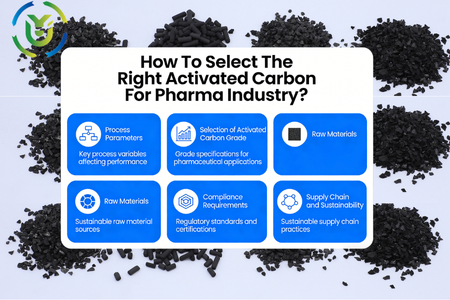
Before selection, it is necessary to define the types of impurities to be removed in production, commonly including heat, pigment, protein, organic pollutants, solvent residues, etc. Different impurities correspond to different activated carbons. Different impurities correspond to different adsorption characteristics of activated carbon, for example, to remove heat sources need to give preference to activated carbon with appropriate pore size. Clearly identifying the type of impurity is the basis for accurate selection, which can avoid problems such as low adsorption efficiency and incomplete removal of impurities.
It is necessary to clearly define the target of activated carbon treatment. Common pharmaceutical raw materials include API intermediates, plant extracts, organic solvents, process water, etc. Different raw materials have different impurity contents and viscosities. Different raw materials have different impurity content and viscosity, and have different adsorption capacity and suitability requirements for activated carbon. Defining the source of raw materials can match the performance of activated carbon to ensure adsorption effect and avoid production problems caused by improper adaptation.
The core is to distinguish the production system as aqueous or solvent system, the requirements of the two systems on the activated carbon are quite different, and need to be targeted selection. For aqueous system, conventional pharmaceutical-grade activated carbon can be used, while for solvent system, solvent-resistant special models with strong adsorption selectivity should be selected. Correctly distinguishing the process medium can avoid the decay and dissolution of activated carbon, and ensure the adsorption effect and production safety.
Pharmaceutical production is divided into batch and continuous mode, different modes have different tempo and demand, and need to be adapted to the corresponding activated carbon. Batch production is suitable for activated carbon with fast adsorption speed to enhance efficiency, while continuous production is suitable for styles with strong stability and easy recovery. The selection of the appropriate production method can guarantee the adsorption effect, optimise the process, reduce the loss and improve the overall operational efficiency.
The core advantage of powdered activated carbon (PAC) is its fast adsorption kinetics, which enables it to quickly capture and adsorb impurities and pigments in production, and is suitable for high efficiency in mass production scenarios. Common applications include decolourisation of antibiotics and vitamins, as well as removal of heat sources from injectables. The high adsorption efficiency and moderate cost make it cost-effective. It should be noted that powdered activated carbon is not easy to recycle and should be used with appropriate filtration equipment to avoid its residue affecting the quality of the drug and the production process.
Granular activated carbon (GAC) has high mechanical strength and good stability, can be repeatedly regenerated, recycled, and can continue to play a long-term adsorption effect. It is more suitable for continuous production scenarios, such as purification of organic solvents, process water treatment, etc. Its long service life effectively reduces the long-term operating costs of enterprises. Compared with powder activated carbon, the adsorption speed of granular activated carbon is relatively slow, and it is necessary to reasonably select the type in combination with the production rhythm to avoid affecting the production efficiency.
|
Comparison Item |
Powdered Activated Carbon (PAC) |
Granular Activated Carbon (GAC) |
|
Adsorption Rate |
Rapid adsorption with strong kinetic properties |
Slower |
|
Recoverability |
Difficult to recover, requires dedicated filtration equipment |
Can be repeatedly regenerated and recycled |
|
Suitable Scenarios |
Batch production applications (e.g., decolorization, pyrogen removal in injectables) |
Continuous production (e.g., solvent purification, water treatment) |
|
Core Advantages |
High efficiency with moderate cost |
High stability, low long-term operating costs |
The core advantages of coconut shell-based activated carbon are high purity, extremely low impurity content, and uniform pore size distribution, which can accurately adapt to pharmaceutical scenarios with high purity requirements. It is widely used in high-end scenarios such as injection API purification and sensitive drug production, which can effectively remove harmful impurities such as heat sources and heavy metals, and ensure drug safety. With excellent purity and adsorption performance, coconut shell-based activated carbon has become the preferred raw material for high-end production scenarios in the pharmaceutical industry, adapting to strict production standards.
The most important feature of wood-based activated carbon is its large mesopore volume, which has an outstanding adsorption effect on pigment and polyphenol impurities, and is suitable for all kinds of decolourisation and purification needs. It is commonly used in the decolourisation of pharmaceutical raw materials and plant extracts, such as vitamin C and plant extracts, which can quickly remove impurities and improve the appearance and purity of products. Compared with coconut shell-based activated carbon, wood-based activated carbon has an outstanding cost performance, which can ensure the adsorption effect and effectively control the production cost.
Coal-based activated carbon has the advantage of large adsorption capacity and relatively low cost. It is suitable for pharmaceutical production scenarios with moderate purity requirements, taking into account performance and cost. Its common applications include organic solvent recovery, pharmaceutical wastewater treatment, etc., which can efficiently adsorb organic impurities, reduce the COD and TOC content of wastewater, and meet the needs of environmental protection and production. Coal-based activated carbon can effectively balance adsorption performance and production cost. It is the preferred raw material for low-end scenarios and large-scale processing needs in the pharmaceutical industry.
Core demand: efficiently remove pigment and polyphenol impurities in raw materials, improve product purity and appearance, ensure that API products comply with the appearance and purity standards of the pharmaceutical industry, and avoid product failure due to impurities; Applicable activated carbon: wood-based PAC, the characteristics of this type of activated carbon are highly suitable for API decolouration demand, and it is the preferred type for this scenario; Core performance focus: large mesopore volume, adsorption of pigments, strong ability of colloidal impurities, and the ability to adsorb pigments, Core performance highlights: large mesopore volume, strong adsorption of pigments, colloidal impurities, and can accurately distinguish between active ingredients and impurities, without affecting the activity of API, to ensure that the efficacy of the drug is not affected.
Core requirements: strictly remove heat sources, heavy metals and other harmful impurities, to ensure that the drugs are sterile and non-toxic, because injections directly into the human body, any harmful impurities may cause serious drug safety problems; applicable activated carbon: coconut shell-based PAC, its ultra-high purity characteristics to meet the stringent requirements of the injections; the core performance highlights: extremely high purity, very low level of impurity content, and can efficiently adsorb endotoxin and other heat source material It can eliminate harmful impurity residues from the source and ensure the safety of injections.
Core requirements: remove organic impurities and odour in organic solvents, and achieve solvent recovery and reuse, which can not only improve solvent purity to ensure the quality of production, but also reduce production costs and practice the concept of green production; Applicable activated carbon: coal-based activated carbon (PAC/GAC can be), which can be flexibly selected according to the production mode; Core performance highlights: large capacity of adsorption, which can be adapted to different solvent systems and is easy to be regenerated for repeated use, which further reduces the operating costs of enterprises. It is easy to regenerate and can be used repeatedly, which further reduces the operation cost of the enterprise.
Core requirements: remove organic pollutants and odour in process water, reduce COD and TOC content of wastewater to meet discharge or reuse standards, which not only meets the requirements of environmental protection regulation, but also achieves the rational use of water resources; Applicable activated carbon: GAC, whose characteristics are suitable for long-term continuous treatment; Core performance focus: high mechanical strength, good adsorption stability, long-term continuous use without frequent replacement, ensuring a smooth water treatment process and improving the efficiency of water treatment. Ensure smooth water treatment process and improve production efficiency.
Core requirements: remove the pigment, tannin, colloidal impurities in the extract, improve the purity and stability of the extract, to avoid impurities affecting the efficacy of the extract and the storage period; applicable activated carbon: wood-based PAC, its adsorption selectivity meets the needs of the purification of plant extracts; the core performance highlights: adsorption of strong selectivity, does not adsorb the active ingredients in the extract, and in the high efficiency of decolourisation and de-emulsification at the same time, the extracts retain the activity of the product integrity, to ensure product quality. It can efficiently decolourise and remove impurities, while retaining the activity of the extracts and ensuring product quality.
Myth 1: Only taking iodine value as the selection standard – Iodine value can only reflect part of the adsorption capacity of activated carbon, which can not represent its adsorption effect on specific impurities in the pharmaceutical industry (e.g., heat source, pigment), and ignoring pore size structure and application suitability, which can easily lead to low adsorption efficiency.
Myth 2: Neglect heavy metal content – pharmaceutical grade activated carbon has strict limits on heavy metal content, if the selection of heavy metal exceeds the standard activated carbon, will lead to drug contamination, triggering compliance risks and drug safety issues.
Myth 3: Neglecting filtration performance – Some enterprises only pay attention to the adsorption effect and neglect the filtration performance of activated carbon, which leads to problems such as filtration clogging and slow filtration speed during the production process and affects the production efficiency.
Myth 4: Not doing laboratory tests before batch purchase – different enterprises have different production processes and raw material impurities, and it is easy to have adaptability problems only based on experience, and it is necessary to verify the adsorption effect and adaptability of activated carbon through laboratory tests before batch purchase.
Myth 5: Ignoring compliance requirements – Selecting activated carbon that does not comply with USP/EP and GMP standards to reduce costs may seem like a cost-saving measure, but in reality, it may lead to greater losses such as regulatory penalties and product recalls.
As regulatory standards continue to improve, ultra-low heavy metal, ultra-high purity activated carbon will become mainstream, especially for injectables, high-end APIs, and other scenarios that require very high purity.
Activated carbons with customised pore size distribution according to the types of impurities in different pharmaceutical scenarios can improve adsorption selectivity and efficiency, achieve ‘precise adsorption’ and reduce production costs.
Activated carbon made from renewable raw materials such as coconut shells and bamboo will gradually replace traditional coal-based activated carbon as the preferred choice for the pharmaceutical industry due to its environmental friendliness and sustainability.
Countries will further improve the standards for pharmaceutical-grade activated carbon, and the regulation of its purity, impurity content, and production process will become stricter, with compliance becoming a core prerequisite for companies to select the right type.
When choosing activated carbon for the pharmaceutical industry, the core is ‘fit’ – fit for the production process, fit for the product demand, and fit for the compliance standard. To summarise, it is necessary to first define the parameters of the process and the type of impurities, then combine the grade of activated carbon, raw material substrate, and compliance, while avoiding common misconceptions, and verifying the suitability through laboratory testing, in order to select an activated carbon that can not only guarantee product quality and meet compliance requirements, but also improve operational efficiency.
The right choice of pharmaceutical-grade activated carbon can not only help companies avoid compliance risks and improve product competitiveness, but also help them achieve green and efficient production. If you are still troubled by the selection of activated carbon, you can contact us for a full range of solutions, relying on professional selection experience, to help your pharmaceutical enterprises to avoid selection errors, to ensure smooth production, and to achieve the double improvement of quality and efficiency.