In the gold cyanidation gold extraction process, activated carbon is the core adsorption material to realize efficient gold recovery. Adsorption of gold from gold-bearing solution, and then extracting and purifying gold from activated carbon through professional process is the most mainstream and economic production route of gold processing plant at present. This article will systematically explain how gold adsorbed on activated carbon, the mainstream method of activated carbon gold extraction, the complete process flow, key influencing factors, equipment configuration, environmental protection and safety and economic benefits, to help you fully grasp the activated carbon gold extraction technology.
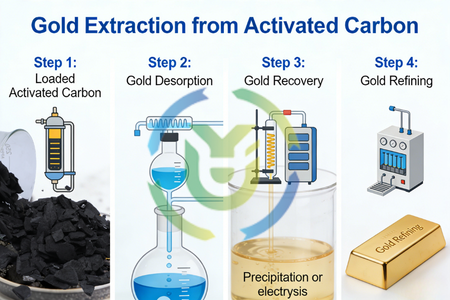
In cyanidation process, activated carbon mainly assumes the function of adsorption and enrichment, which is the key link connecting gold dissolution and gold recovery. It can efficiently capture the gold-cyanine complex from the low concentration of gold-containing precious liquid, and highly concentrate the originally dispersed trace gold, so as to fully prepare for the subsequent desorption, electrolysis and other purification processes. At the same time, the adsorption reduces the gold content in the solution, minimizes the loss of gold in the tailings, and directly improves the gold recovery rate of the gold mine.
In the alkaline cyanide system, gold will not exist in the form of monomers, but dissolved in the solution in the form of Au(CN)₂-complex ions, which is the premise that activated carbon can adsorb gold. Activated carbon can realize efficient adsorption of gold through the joint action of physical adsorption and chemical adsorption: on the one hand, it provides sufficient adsorption sites for gold-cyanide complexes by utilizing its own well-developed pore structure; on the other hand, the functional groups on its surface will have specific interactions with gold-cyanide complexes, and ultimately realize the stable loading of gold on the surface of activated carbon, which lays the foundation for the subsequent extraction of gold.
Iodine value is the core index of gold adsorption activity of activated carbon, which directly reflects the strength of its adsorption capacity. Activated carbon for gold extraction needs to reach a specific iodine value in order to efficiently capture the gold-cyanide complex in the gold-containing solution. The higher the iodine value, the stronger the adsorption activity of the activated carbon, and the more gold can be adsorbed per unit mass of activated carbon, which lays the foundation for the subsequent gold extraction efficiency.
Pore size distribution directly affects the diffusion efficiency and adsorption effect of gold-cyanide complexes, of which the ratio of mesopores and macropores is especially critical. The gold-cyano complex needs to diffuse to the adsorption site inside the activated carbon through the pore space, and a reasonable pore size distribution can accelerate the diffusion speed. If the pore size is too small, the complex cannot penetrate smoothly; if the pore size is too large, the adsorption sites will be reduced, which will reduce the efficiency of gold adsorption.
Specific surface area refers to the total surface area per unit mass of activated carbon, and its value determines the number of adsorbable gold sites. The larger the specific surface area, the more sufficient the adsorption sites on the surface of the activated carbon, and the more gold-cyanide complexes can be adsorbed at the same time. High-quality activated carbon for gold extraction usually has a large specific surface area, which can significantly improve the adsorption capacity and efficiency of gold adsorption.
Hardness and abrasion resistance determine the service life of activated carbon in the gold extraction process and are directly related to production costs. Activated carbon is subject to friction and impact during screening, acid washing, desorption, etc. If the hardness and abrasion resistance are insufficient, it is easy to be pulverized and depleted. This will not only increase the purchase cost of new carbon, but also may affect the stability of the whole gold extraction process due to carbon powder clogging equipment.
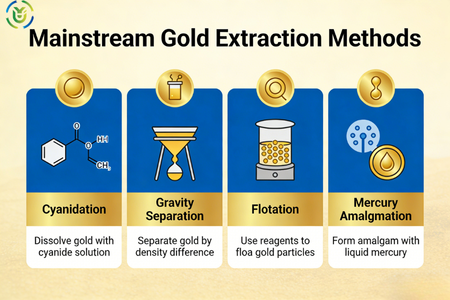
The core of desorption is to “elute” the gold from the surface of activated carbon and reintegrate it into the solution to obtain a high concentration of gold-containing precious liquid, which lays the foundation for the subsequent electrolytic gold extraction. The core operating conditions are high temperature, high pressure (or atmospheric pressure) and alkaline environment, and two mainstream processes are commonly used in the industry:
Zadra process: It adopts atmospheric pressure, high temperature and alkaline conditions for desorption, with simple equipment structure, stable operation and convenient operation, which is suitable for small and medium-sized mines and enterprises sensitive to investment cost, and is most widely used.
AARL process: adopts high-pressure and high-temperature desorption, with faster desorption speed and more thorough gold desorption, which can greatly improve the production efficiency and is suitable for large-scale and high-yield mines, but the investment in equipment and energy costs are relatively high.
Comparison of the two processes, Zadra process advantage lies in low investment, low operating difficulty, medium efficiency; AARL process advantage lies in high desorption efficiency, short time-consuming, disadvantage lies in the high cost of energy consumption and equipment, enterprises can choose according to their own production scale and budget.
Electrolytic deposition is a key step to recover gold directly from the desorbed gold-containing precious liquid, which is also the core link to realize gold purification. The principle is to use the electric field, so that the gold ions in the solution in the cathode reduction reaction, the deposition of gold powder or gold mud.
The core advantage of this method lies in the fact that high purity gold slime can be obtained directly without additional complex purification steps; the process can realize continuous operation with a high degree of automation, which is suitable for industrial scale production; and the difficulty of subsequent refining of gold slime is low, which makes it easy to be cast into standard gold ingots.
Direct incineration smelting is a method of gold recovery by incinerating gold-carrying charcoal at high temperature so that the activated charcoal is completely ashed, and then separating and recovering gold from the ashes. Its application is relatively limited, mainly used in small-scale, simple gold extraction system, or activated carbon regeneration difficulty, serious pollution can not continue to use the situation.
The obvious disadvantages of this method are that the activated carbon cannot be recycled, which will greatly increase the cost of carbon consumption; the incineration process produces a large amount of smoke, which is difficult and costly to deal with environmentally friendly; the gold is easy to be dispersed in the ash after incineration, which makes it more difficult to be recovered and leads to a low recovery rate of gold, so it is less used in industrial production.
|
Gold Extraction Methods |
Applicable Scenarios |
|
Desorption Method |
Small to large-scale mines, most widely applied |
|
Electrolytic Deposition Method |
Requires high-purity gold slime, large-scale gold extraction processes |
|
Direct Pyrometallurgical Smelting |
Small-scale, simplified gold extraction, or scenarios where carbon cannot be regenerated |
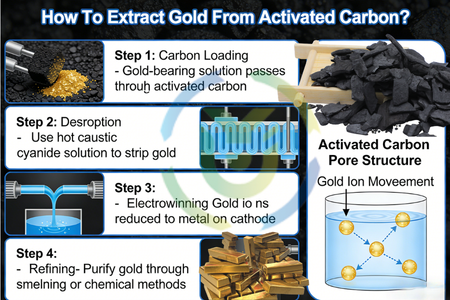
The gold-carrying carbon adsorbed with gold is strictly sieved, and the impurities, mineral powder, wood chips and other debris are separated out by the special sieving equipment. This step is the basis for the smooth operation of the subsequent process, which can effectively avoid the debris from entering the subsequent equipment and prevent the clogging of the equipment pipeline. At the same time, the pretreatment can also remove the loose slag attached to the surface of the gold-carrying charcoal, which creates good conditions for the subsequent pickling and desorption processes and ensures the desorption process to be smooth and efficient.
The pretreated gold-carrying carbon is put into dilute acid solution for acid washing, and the time and concentration of acid solution should be reasonably controlled according to the degree of pollution of the gold-carrying carbon. The main purpose is to remove the carbonate impurities such as calcium, magnesium and inorganic scale attached to the surface of the carbon, which will block the pore structure of the activated carbon. If acid washing is not carried out, it will seriously affect the diffusion of gold-containing complexes in the subsequent desorption process, reducing the desorption efficiency and gold recovery rate.
According to the enterprise’s production scale, capacity demand and cost budget, it is reasonable to choose Zadra or AARL two mainstream desorption process. The desorption process is carried out in a specific high temperature, high pressure (or atmospheric pressure) alkaline environment to elute the gold from the surface of the activated carbon and incorporate it into the solution, and ultimately obtain a high concentration of gold-containing precious liquid. The desorbed activated carbon is called depleted carbon, and after subsequent regeneration treatment, it can restore the adsorption activity and be put back into the adsorption process for recycling, which effectively reduces the production cost.
The highly concentrated gold-containing precious liquid obtained from the desorption section is fed into the electrolyzer at an even speed, and under the action of electric field, the gold ions in the solution will undergo reduction reaction. These gold ions will be gradually deposited on the cathode surface of the electrolyzer to form gold slime with high purity and complete the initial recovery of gold. This process has a high degree of automation, can realize continuous operation, and can effectively separate the gold and other impurities in the gold-containing precious liquid, laying the foundation for subsequent smelting and refining.
The gold mud obtained by electrolysis is washed and dried many times to completely remove the electrolyte, impurities and moisture attached to the surface of the gold mud to ensure the purity of the gold mud. Then, the treated gold mud is sent to the melting furnace for smelting in a high-temperature environment to further remove non-metallic and metallic impurities. Finally, through refining process purification, it is finally cast into gold ingots that meet industrial standards, and the whole activated carbon gold extraction process is successfully completed.
The higher the adsorption capacity of activated carbon, the greater the amount of gold per ton of charcoal, and the less turnover of activated carbon, which can reduce the loss and regeneration cost of carbon; the more thorough the desorption, the less gold residue on the activated carbon, which can reduce the loss of gold in the tailings and improve the gold recovery rate; even if the comprehensive efficiency of activated carbon is only 5%-10%, a large amount of gold can be recovered every year under the 10,000-ton ore processing capacity, bringing significant economic benefits.
Simply put, making good use of activated carbon is the most direct way to reduce gold loss, improve gold production and increase enterprise profits.
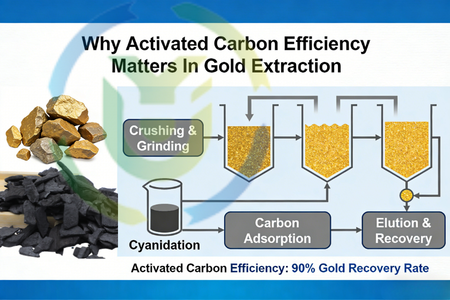
The quality and activity of activated carbon are the core factors affecting the efficiency of gold extraction. Whether its iodine value, strength and pore size distribution are up to the standard or not, it directly determines its ability to adsorb gold and desorption efficiency. High-quality activated carbon for gold extraction needs to have high iodine value, suitable pore size distribution and sufficient hardness in order to capture gold-cyanide complexes efficiently. If the quality of activated carbon is not up to standard, it will lead to insufficient adsorption and incomplete desorption, which will directly reduce the gold recovery rate.
Cyanide concentration should be controlled in a reasonable range, too low will affect the dissolution efficiency of the gold in the ore, resulting in a low concentration of gold in the gold-containing solution, which in turn affects the adsorption effect of the activated carbon, resulting in gold loss. Too high a concentration will significantly increase the cost of procurement of chemicals, while there are serious safety hazards, not in line with the production safety norms. Reasonable control of concentration is the key to balance efficiency, cost and safety.
Temperature and pressure mainly affect the efficiency of the desorption process, which is an important condition for the smooth operation of the desorption process. If the temperature and pressure are insufficient, the desorption speed will be obviously slowed down, and the gold desorption will be incomplete, resulting in too much gold residue on the activated carbon and lowering the recovery rate. If the temperature and pressure are too high, it will increase the energy consumption and loss of the equipment, and increase the production cost, which needs to be precisely regulated according to the type of desorption process.
The contact flow and contact time between the gold-containing solution and the activated carbon directly affect the adequacy of adsorption. If the flow rate is too fast and the contact time is insufficient, the activated carbon cannot fully capture the gold-cyanine complex in the solution, which will lead to incomplete adsorption, and a large amount of gold will be lost in the solution, thus reducing the overall efficiency of gold extraction. According to the size of the equipment and process requirements, the flow rate and contact time should be reasonably controlled.
During the production process, organic matter, impurities, etc. will cover the surface of activated carbon, blocking its pore structure, leading to a decline in adsorption activity, a phenomenon known as “carbon poisoning”. This phenomenon is called “carbon poisoning”. Carbon poisoning will seriously affect the adsorption and desorption performance of activated carbon, resulting in a significant decrease in the efficiency of gold extraction, the need for regular inspection of the state of activated carbon, timely treatment of the pollution problem, and regeneration or replacement when necessary.
At present, the most commonly used regeneration method in the industry is the thermal regeneration process: the desorbed poor carbon is sent to the activated carbon regeneration kiln, where it is heated and processed under high-temperature and anoxic conditions to remove the residual organic matter, impurities and other pollutants on the surface of the activated carbon, and to restore its original pore structure and adsorption activity, and the regenerated activated carbon can be put into the adsorption process again.
The core value of activated carbon regeneration is reflected in three aspects: prolonging the service life of activated carbon, significantly reducing the cost of carbon consumption, and reducing the expenditure on the purchase of new carbon; reducing the emission of waste activated carbon, lowering the pressure of environmental protection treatment, and realizing green production; and maintaining the adsorption and gold extraction efficiency of the whole gold extraction system in a stable manner, and guaranteeing the continuity of production.
It is used to complete the desorption operation of the gold-carrying carbon, and is the core equipment of the desorption section, which directly determines the desorption efficiency and the concentration of the gold-containing precious liquid. Its internal structure is professionally designed to ensure the full contact between the gold-carrying carbon and the desorption solution to enhance the desorption effect of gold. At the same time, the specifications of the desorption column should be reasonably matched according to the daily handling capacity of the gold-carrying carbon to ensure the continuous and stable operation of the entire desorption section.
The heat exchanger is used to heat up the solution required for desorption to accurately meet the high temperature requirements of the desorption process and provide stable temperature conditions for efficient desorption. It transfers heat from the heat source to the desorption solution through the heat exchange principle, and the temperature can be flexibly adjusted according to the different desorption processes (Zadra or AARL). Reasonable heat exchange efficiency not only enhances the desorption speed, but also reduces energy consumption and production costs.
Used to realize the electrolytic deposition of gold-containing precious liquid, it is the core equipment for the recovery of gold sludge, which can realize the efficient reduction and separation of gold ions. The electrolysis tank is equipped with a cathode and anode, and the gold ions in the gold-containing precious liquid are deposited at the cathode by applying a stable electric field. With simple operation and high automation, it can effectively separate gold from other impurities and provide high-purity gold slime raw materials for the subsequent smelting and refining process.
Used for melting and purifying gold slimes, removing impurities through high temperature treatment, and finally casting the gold slimes into gold ingots that meet industrial standards. The melting furnace provides a stable high temperature environment to melt the gold in the slurry into liquid form, and at the same time separates the non-metallic and metallic impurities from the slurry. Subsequent refining processes can further increase the purity of the gold to ensure that the final product meets the requirements of industrial gold or standard gold ingots.
It is used for thermal regeneration of depleted carbon, removing pollutants through high-temperature anaerobic heating, restoring the adsorption activity of activated carbon and realising recycling. The regeneration kiln adopts an oxygen-free high-temperature environment, which can effectively remove organic matter, impurities and other pollutants left on the surface of the poor carbon and prevent them from blocking the pores of the activated carbon. The adsorption performance of regenerated activated carbon can be restored to more than 80% of that of new carbon, which can significantly reduce the procurement cost of new carbon and realise green production.
Cyanide is a dangerous chemical, and its storage and transportation must be fully sealed, and leakage is strictly prohibited. The concentration of cyanide solution should be tested regularly to ensure that it meets the process requirements, and it should be neutralized in a timely manner after use to completely eliminate potential safety hazards. Strict control can effectively avoid personnel safety accidents, and at the same time prevent cyanide contamination of soil and water resources to ensure production safety and environmental safety.
The production process will produce cyanide wastewater, pickling wastewater and other wastewater, such wastewater can not be discharged directly, it must be purified and treated professionally. Targeted wastewater treatment processes are required to remove toxic and hazardous substances in the water and ensure that the wastewater meets national emission standards before discharge, or to realize recycling. This not only reduces the waste of water resources, but also avoids wastewater pollution of the surrounding environment.
Activated carbon thermal regeneration process will produce smoke, harmful gases and other pollutants, if directly discharged will pollute the air. It is necessary to equip professional flue gas treatment equipment to filter and purify the flue gas generated during the regeneration process to remove the soot and harmful components. Ensure that the flue gas emissions comply with environmental requirements, reduce the impact on the atmospheric environment, and practice the concept of environmentally friendly production.
In the whole process of activated carbon gold extraction, it is necessary to actively optimize the production process to reduce the consumption of chemicals and pollutants. Improve the utilization rate of water recycling, reduce the consumption of water resources, and realize the recycling of water resources. Through the green production mode, we take into account the production efficiency and environmental protection, realize sustainable and responsible gold production, and help the industry to develop in a green and healthy way.
Q1. How much gold can activated carbon adsorb?
In industrial production, the grade of gold-bearing charcoal can usually reach several kilograms/ton of carbon or even higher. The specific adsorption amount depends on the concentration of the gold-containing solution, the contact time between activated carbon and the solution, and the performance of the activated carbon itself (such as iodine value, specific surface area, etc.).
Q2. How high is the temperature required for gold desorption?
The temperature requirements of different desorption processes are different. The desorption temperature of conventional Zadra processes is generally above 90℃, and the temperature of high-pressure AARL processes is higher, which can further accelerate the desorption speed and improve the desorption efficiency.
Q3. Can activated carbon be reused after gold withdrawal?
Yes. After desorption and thermal regeneration treatment, gold-carrying carbon can restore adsorption activity and be recycled for many years, which is the key link to controlling the cost of activated carbon gold withdrawal.
Q4. What is the general recovery rate of activated carbon gold withdrawal?
In well-managed and standardized mines, the total gold recovery rate of activated carbon gold can reach more than 90%. In some high-quality mines, the recovery rate can be close to 95% by optimizing the process and activated carbon performance.
Activated carbon gold extraction is the core of modern cyanide gold production, and each step of its adsorption, desorption, electrolysis, smelting and refining directly affects the gold recovery rate and production costs. To realize high-yield, stable and low-cost gold extraction, it is necessary to grasp the four major cores: selecting special activated carbon with high iodine value, high hardness and suitable pore size; strictly implementing the standard process; doing a good job of activated carbon regeneration to reduce costs; and strictly abiding by the environmental protection and safety norms. For mining enterprises, optimizing the performance of activated carbon and process control is the most direct and effective path to improve gold recovery and efficiency.