The production of wine and spirits is based on natural raw materials, and some bad pollutants are often produced in the process. These pollutants not only affect the color, smell and taste of the product, but also may shorten their shelf life. Therefore, decolorization and purification will be added to many alcohol refining processes, and special activated carbon is the core material of this link. For a long time, activated carbon, as an efficient decolorization and purification medium, has been an indispensable auxiliary material in the brewing industry. Choosing the appropriate activated carbon and mastering its mechanism of action is the key to improving the quality of wine efficiently and economically.
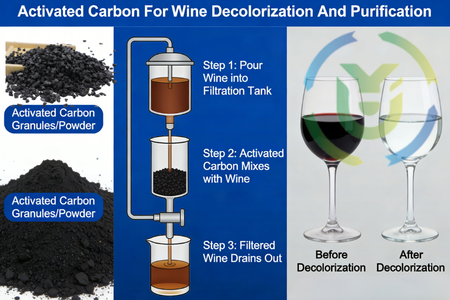
Common pollutants in wine production include mold, microorganisms, sulfur-containing compounds, herbal compounds and smoke residues. These pollutants will bring many negative effects: destroy the color stability of the wine, produce unpleasant odors and taste, and shorten the shelf life of the product. In order to solve these problems, it is necessary to use special activated carbon for processing in the refining stage of alcohol production. With its excellent adsorption performance, activated carbon can accurately remove all kinds of adverse substances. It is a high-efficiency decolorization and purification medium that has been used in the brewing industry for a long time to protect the quality of wine.
Activated carbon has a highly porous structure and a huge specific surface area, which is also the core reason for its excellent adsorption efficiency. Its pore size distribution (micropore, medium hole) is closely related to the purification effect of wine. Activated carbon with different aperture diameters can specifically adsorb different types of pollutants, providing diversified solutions for wine decolorization and purification.
The adsorption effect of activated carbon is mainly achieved through physical adsorption and chemical interaction. It can selectively bind the target compounds in wine, including flavor substances that affect the taste, volatile components that produce odor, and pigment molecules that cause abnormal color. This selective adsorption ability enables it to retain the excellent characteristics of wine to the greatest extent while removing bad substances.
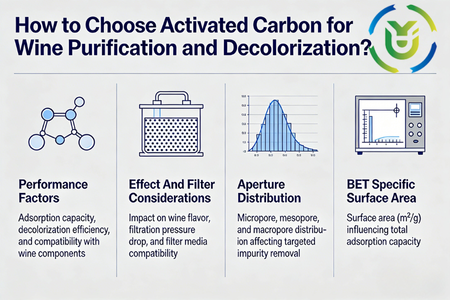
When choosing activated carbon, first of all, you need to pay attention to the matching of the pore size and the target pollutant: medium pores (2-5 nanometers) are suitable for adsorbing phenolic substances in white wine, while activated carbon with large pore diameters is more suitable for removing pigment molecules in red wine. Secondly, the choice of raw material type is also very important: compared with coal-based activated carbon, the speed of adsorption of cacatechin (an important tannin) is 85% faster, which is more suitable for scenarios with high requirements for adsorption efficiency and flavor retention.
Powdered activated carbon (PAC) has a fast reaction speed, and 92% decolorization effect can be achieved within 15 minutes. The surface area is as high as 1,200 square meters/gram, and the ability to adsorb impurities is extremely strong, which is very suitable for the processing of high-end vintage wine. However, its dosage needs to be strictly controlled, otherwise it may lead to excessive adsorption of wine flavor.
Granular activated carbon (GAC) is suitable for continuous flow operation, but when processing thick wine, the pigment removal rate will be reduced by 30%, because its granular morphology is difficult to fully contact all impurities in wine.
In terms of practical application, powdered activated carbon is preferred for small-batch wines with high quality accuracy requirements; granular activated carbon is more suitable for large-scale production scenarios that require continuous processing.
The adsorption effect of activated carbon depends on the matching of the pore size distribution and the pollutants to be removed. Micropores (less than 2 nanometers) are mainly used to adsorb low molecular weight compounds, such as gallic acid (150-300 Daltons); medium pores (2-50 nanometers) are suitable for adsorb macromolecular substances, such as anthocyanins and polymer tannins in red wine (1500-5000 Daltons). Research shows that the pigment removal rate of activated carbon, which accounts for 15%-20% of medium-pore volume, can reach 89% of Cabernet Sauvignon wine, which is much higher than that of microporous activated carbon (only 54%).
The specific surface area of BET is a key indicator. The specific surface area of activated carbon suitable for wine treatment is usually between 800-1200 square meters/gram. Data shows that for every 100 square meters/gram increase in the specific surface area, the residual amount of tannin in wine can be reduced by 15%-18% (the specific effect is affected by experimental conditions). However, it should be noted that when the specific surface area exceeds 1,500 square meters/gram, activated carbon will adsorb various substances indiscriminately, which will not only remove bad ingredients, but also adsorb flavor esters in wine, resulting in a decrease in the aroma level, so it needs to be controlled within the best range.
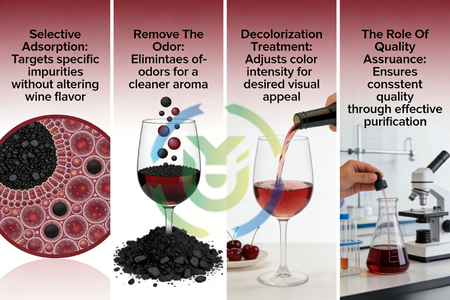
Activated carbon can precisely remove unpleasant flavor substances in wine, such as bitterness, astringency and earthy odor, while retaining and enhancing the excellent flavor characteristics of the wine itself, such as aroma and floral fragrance. Relevant research in the Journal of Agriculture and Food Chemistry shows that specific types of activated carbon can significantly reduce the fishy and bitter taste of wine and improve its fruity and floral fragrance. Winemakers and tasters are also generally recognized that the flavor of wine treated with activated carbon will be significantly improved, which is more in line with the market demand for high-quality wine.
Activated carbon can specifically remove irritating compounds in wine, such as hydrogen sulfide, smoke smell, mold smell, etc., which will seriously affect the sensory experience of wine. According to industry data, the removal rate of activated carbon for odors in wine can reach more than 90%, which can effectively improve the odor purity of wine, ensure the sensory integrity of the product, and give consumers a more pleasant drinking experience.
Activated carbon has remarkable effect in decolorization of wine, which can effectively remove excess pigments and impurities in wine, and solve the problem of color stability, such as eliminating excessive brownish tint or other undesirable colors. Treated wines are more transparent, brighter and visually appealing, and more desirable to consumers. It should be noted that there are differences in the application of different types of wines: in the production of white and rosé wines, the decolorization effect of activated carbon is particularly obvious; while in the production of red wines, the dosage should be carefully controlled to avoid affecting the stability of its color.
In addition to decolorization, deodorization and flavoring, activated carbon can also provide a multi-faceted guarantee for the quality of wine. First, remove iron and other heavy metals to avoid these substances from causing oxidation, color change and odor of wine; second, purify winemaking water, remove organic impurities and chlorine in water, and water quality is the key basis for affecting the quality of wine; third, improve the transparency of wine by combining colloids, proteins and other unstable components in wine to precipitate it, so as to make the wine clearer and brighter.
Low dosage, convenient operation and low cost are the core practical advantages of activated carbon for wine purification, which is very suitable for the production needs of winemaking enterprises. In actual production, the amount of activated carbon added is usually only a few thousandths of the total base wine, which can achieve the ideal decolorization and purification effect without a lot of investment and effectively control the cost of raw materials. There is no need for complex professional equipment for operation. Whether it is powdered or granular activated carbon, it can be directly mixed with liquor or put into use through a simple filtration device. There is no need for additional training of professional operators, which greatly saves manpower costs and time costs. At the same time, under the premise of ensuring the purification effect, it can significantly improve the production efficiency of brewing, shorten the cycle of refining links, and help enterprises achieve large-scale and efficient production.
Activated carbon has strong universality and can adapt to the decolorization and purification treatment of all kinds of base wines. Whether it is white wine, red wine, rosé wine, or fruit wine and spirits base wine of different degrees, it can play a good purification effect. For different production scenarios, such as mass production in small workshops, continuous production in large wineries, or emergency purification after fermentation, pre-treatment before storage, etc., activated carbon can be flexibly adapted, and there is no need to replace the adsorption material according to the wine type or scene. Its adaptability is also reflected in the treatment of base wine with different degrees of pollution. Whether it is a base wine with slight turbidity and light odor, or base wine with severe pollution and abnormal color, the ideal purification effect can be achieved by adjusting the dosage and processing time, which is extremely flexible.
High efficiency is one of the most prominent advantages of activated carbon in wine purification. Its highly porous structure and huge specific surface area give it an extremely strong adsorption capacity, enabling it to remove all kinds of undesirable substances in wine quickly and precisely. Whether it is impurities such as colloids and proteins that cause turbidity in wine, or pigments and odor compounds that affect quality, activated carbon can complete adsorption in a short period of time, quickly improving the clarity and purity of wine. Compared with other purification methods, activated carbon treatment can complete the purification process in a short time without the need for long standing or complex chemical reactions, and the quality of the treated wine liquid is stable without secondary pollution or quality fluctuations, which can effectively guarantee the consistency and stability of the wine products and satisfy the market’s demand for the supply of high-quality wines in large quantities.
Activated carbon has a certain retention effect on acid substances in wine, which can better maintain the original acidity balance of wine and ensure the taste level of the wine. However, at the same time, it has a strong adsorption ability on ester substances, and ester substances are an important part of wine aroma. Excessive adsorption may lead to a large loss of ester substances, making the aroma of wine thin and monotonous, affecting the flavor of the product.
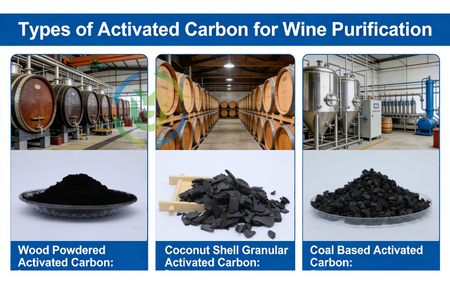
Wood powdered activated carbon is made of high-quality wood and activated at high temperature. It has the characteristics of balanced pore size distribution, mild adsorption and fast reaction speed, and is widely used in the wine industry. Its core feature is that the aperture size is mainly medium and large, which is suitable for adsorbing pigments, polyphenols and some odorous compounds in wine; the powder-like form makes it excellent in dispersion, can fully contact with wine, and has high purification efficiency; at the same time, the adsorption effect is mild, which can preserve the original aroma and flavor structure of wine to the greatest extent, which is suitable for short-term processing and fine quality adjustment.
In practical application, wood powdered activated carbon is mainly used for color correction of white wine or light wine, removal of slight odor during fermentation or storage, and rapid purification after fermentation. It should be noted that the best dosage needs to be determined through small-scale tests. It is appropriate to use a low dose to avoid excessive adsorption leading to the loss of wine flavor.
Coconut shell granular activated carbon is made of natural coconut shell and activated at high temperature. It has the advantages of high mechanical strength, stable pore structure, developed micropore, etc., and is more suitable for continuous or long-term contact purification technology. Its core characteristics are high microporous content, which can effectively adsorb small molecule impurities and odorous compounds; stable particle structure, not easy to wear, easy to filter and recycle; natural raw materials, low impurity content, in line with food-grade standards; strong controllability during use, suitable for column filtration or continuous filtration systems.
Its typical applications include auxiliary purification before and after wine filtration, removal of slight odors during storage or transportation, and continuous, low-dose and long-term precise processing technology. Compared with powdered activated carbon, the adsorption effect of coconut shell granular activated carbon is milder and more controllable, which is especially suitable for scenarios with high requirements for wine structure and flavor stability.
Coal-based activated carbon is suitable for the treatment of red wine, because it can effectively adsorb larger pigment molecules in red wine and improve the color stability of red wine. However, it should be noted that while adsorbing bad substances, coal-based activated carbon may also remove some of the good aroma components in wine. When using, the dosage and processing time should be strictly controlled.
|
Types of activated carbon |
Typical application scenarios |
|
Wood powder activated carbon |
1 White wine/light wine color correction; 2 Slight odor removal during fermentation/storage; 3 Rapid purification after fermentation |
|
Coconut shell granular activated carbon |
1 Auxiliary purification before and after wine filtration; 2 Slight odor removal during storage/transportation; 3 Continuous and low-dose accurate treatment |
|
Coal-based activated carbon |
Red wine decolorization and purification, focusing on improving color stability |
Through the high-efficiency decolorization and purification effect of activated carbon, it can effectively improve the quality of the base wine that was originally scrapped due to abnormal color, strange smell, turbidity and other problems, so that it can meet the qualified standards and be smoothly put into the market. This process can greatly reduce the waste of raw materials in the brewing process, reduce the loss of liquor caused by non-standard quality, and improve the utilization rate of raw materials. At the same time, the quality of purified wine is more stable and the shelf life is longer, which can effectively avoid the secondary waste caused by quality deterioration in the subsequent storage and transportation process, and reduce economic losses for winemaking enterprises.
High-quality activated carbon can be reused through the regeneration process. After professional regeneration treatment, its adsorption performance can be restored to the original level, and it can be used again for the decolorization and purification of wine without the need to use new activated carbon raw materials every time. This recycling model can greatly reduce the consumption of activated carbon, reduce the dependence on raw materials such as wood, coconut shells and coal, and reduce the environmental pressure caused by resource mining. In addition, the activated carbon treatment process does not need to consume a lot of water resources and electricity. Compared with other purification methods, it can further reduce the consumption of resources in the production process.
Activated carbon used for wine purification is mostly made of natural raw materials (such as high-quality wood and natural coconut shells). These raw materials are renewable and environmentally friendly. There are no harmful gases and wastewater discharge during the processing process, which will not cause pollution to the ecological environment. At the same time, activated carbon itself is non-toxic and harmless, and the treated liquor will not leave harmful ingredients, which not only protects the health of consumers, but also avoids secondary pollution of water bodies, soil and other environments. In addition, its regeneration process adopts environmental protection technology, which can effectively reduce pollutant emissions compared with traditional purification methods, which is in line with the industry development trend of green brewing and low-carbon production.
Activated carbon plays an irreplaceable role in the decolorization, purification and quality improvement of wine. It removes bad pollutants through selective adsorption and optimizes the color, smell and taste of wine. At the same time, it has the advantages of low dosage, low cost, convenient operation, etc., and adapts to the production needs of various wines. For winemakers, mastering the raw material type, pore size distribution, specific surface area and other key indicators of activated carbon, selecting the appropriate activated carbon according to the type and quality needs of wine, and controlling the dosage and processing process, is the key to achieving efficient purification and ensuring product stability. In the future, with the continuous deepening of research, the application of activated carbon in the field of wine will be more accurate and efficient, providing stronger support for the production of high-quality wine.