H₂S is a colorless gas with highly toxic and highly flammable properties, and its signature odor is “rotten egg”. It is widely found in the natural environment and industrial production, posing a serious threat to human health, industrial equipment and the ecological environment. Among the many hydrogen sulfide removal technologies, activated carbon has become the preferred solution in industrial scenarios due to its high efficiency, economic and environmental advantages. In this paper, we will comprehensively analyze the basic characteristics of hydrogen sulfide, the necessity of removing it, as well as the principles, types, influencing factors, application scenarios and other core contents of activated carbon for removing hydrogen sulfide, so as to provide reference for the relevant industries in choosing the appropriate treatment solutions.
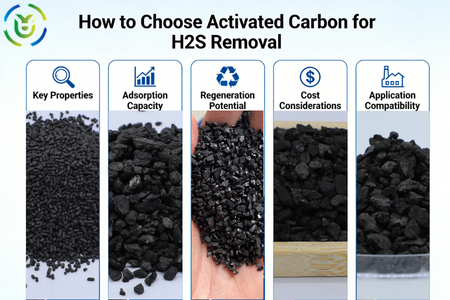
Hydrogen sulfide (H₂S) is an inorganic compound composed of hydrogen and sulfur, which is highly toxic, flammable, colorless and has the core characteristic of “rotten egg smell”, and it can paralyze the olfactory nerves in high concentration. Its source is divided into two categories: natural and industrial, natural decomposition of decaying organic matter, and industrial, natural gas processing, oil refining, sewage treatment and other common by-products of the industry, the need to focus on controlling the risk of emissions.
Hydrogen sulfide is extremely hazardous, inhalation can damage the human respiratory system, central nervous system, and in severe cases can be fatal, and is highly corrosive, can damage industrial equipment, increase maintenance costs. At present, all countries have strict regulations on hydrogen sulfide emissions, violations will face fines, shutdown and other penalties; untreated emissions will also pollute the air and damage the ecosystem, so its effective removal is not only the compliance needs of enterprises, but also an important step in environmental protection.
Effective removal of hydrogen sulfide can be avoided from the source of employees exposed to dangerous concentrations of toxic gases, reducing the various types of health damage caused by hydrogen sulfide inhalation.
This initiative can significantly reduce occupational health hazards, create a safe and harmless working environment for the employees of the enterprise, to protect the health and safety of employees.
Strictly controlling the emission of hydrogen sulfide can help enterprises accurately meet the requirements of air quality and exhaust gas emission regulations in various countries and realize compliant production.
At the same time, it can effectively avoid high fines, suspension of production and other adverse consequences brought about by illegal emissions, so as to ensure that the production and operation activities of the enterprise are carried out in a stable and orderly manner.
Hydrogen sulfide is highly corrosive, and removing hydrogen sulfide can reduce its corrosive loss on production equipment and transportation pipelines and slow down the aging speed of equipment.
This can effectively extend the service life of infrastructure, reduce the cost of daily maintenance, fault repair and regular replacement of equipment, and save operating expenses for enterprises.
In the case of biogas plants, for example, hydrogen sulfide, if not thoroughly removed, will corrode engines, turbines and other energy recovery equipment, affecting the normal operation of the equipment.
Thoroughly removing hydrogen sulfide can protect all kinds of energy recovery equipment, ensure the stability and high efficiency of the production process, and improve the production efficiency and resource recycling rate of the enterprise.
Activated carbon has a very high specific surface area (usually 800-1200 m2/g), and its interior is covered with a dense microporous structure, and the size of these micropores (about 0.4 nanometers) matches highly with that of the hydrogen sulfide molecules, which is highly effective in capturing the hydrogen sulfide molecules in the air. The core of physical adsorption is to concentrate and immobilize the hydrogen sulfide molecules on the surface of the activated carbon through intermolecular forces to achieve initial separation and removal.
While ordinary activated carbon has a limited ability to remove hydrogen sulfide, the core advantage of specialized activated carbon lies in chemical impregnation. By loading the surface of activated carbon with an active reagent (impregnating agent), the hydrogen sulfide adsorbed on the surface of the activated carbon undergoes a chemical reaction and is converted into a harmless, stable compound, thus achieving complete removal. The type of impregnating agent determines the path of the chemical reaction, the H2S removal capacity, and the suitability of the activated carbon for different applications, which is the key reason for the difference in the performance of different types of specialized activated carbon.
In response to the demand for hydrogen sulfide removal, the special activated carbons available in the market are mainly divided into two categories: impregnated and non-impregnated, with impregnated activated carbons becoming the mainstream choice for industrial scenarios due to their higher removal capacity and relevance. Depending on the impregnating agent, there are several common impregnating activated carbons as follows, with the addition of iron oxide desulfurizers that complement activated carbon:
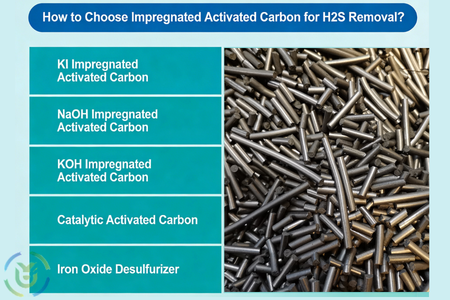
KI-impregnated activated carbon mainly removes hydrogen sulfide through catalytic oxidation reaction, which requires the provision of two times the stoichiometric amount of oxygen to be converted into monosulfur, and the interruption of the air flow causes irreversible damage to the activated carbon bed, and the gas and activated carbon are fully mixed. High loading of singlet sulfur can be achieved, the gas needs to be heated when the relative humidity of the environment is higher than 70%; its working temperature range is 10-70℃, too high or too low will affect the treatment effect, hydrogen sulfide and mercaptan can be removed by catalytic reaction, it can also be used for flue gas desulfurization and enhance the capacity of sulfur dioxide adsorption through the cyclic reaction.
NaOH impregnated activated carbon does not need oxygen in the gas when it is used, and it can realize chemical adsorption and removal through the neutralization reaction between sodium hydroxide and acidic hydrogen sulfide, and the core reaction is that the hydrogen sulfide and mercaptan react with sodium hydroxide to generate the corresponding products; its adsorption capacity is limited by the dosage of sodium hydroxide, and it will react with all the acidic components, so it is suitable for the scenario that the acidic impurity is relatively small, and other alkaline substances can be adopted as the impregnating agent. Other alkaline substances can also be used as impregnating agents.
KOH-impregnated activated carbon is removed through the reaction between potassium hydroxide and hydrogen sulfide, the core reaction is that 2 molecules of potassium hydroxide react with 1 molecule of hydrogen sulfide to produce potassium sulfide and water; its performance is greatly affected by the environment, the relative humidity should be controlled at 40-60%, the working temperature is 20-40℃, and the oxygen content is lower than 5%, and it can optimize the effect by adjusting the flow rate of the gas, and the environmental conditions can be reasonably controlled to improve the desulfurization effect and service life. Reasonable control of environmental conditions can enhance the effect and service life of desulfurization.
Catalytic activated carbon for removing hydrogen sulfide requires gas containing oxygen, can withstand up to 90% relative humidity, it is recommended that the concentration of hydrogen sulfide does not exceed 50 ppm, too high will lead to incomplete oxidation; its removal effect is better in a high temperature and high humidity environment, it can be regenerated and reused through water washing but the adsorption capacity will decrease, the core reaction is hydrogen sulfide and oxygen to generate sulfuric acid, the reaction is incomplete and will produce monolithic sulfur that can’t be removed by water washing, the reaction will be incomplete. The reaction is not complete will produce a single sulfur that can not be removed by washing, but also can remove ammonia simultaneously, suitable for high humidity and ammonia-containing odor control scenarios.
Iron oxide desulfurizer is often used in conjunction with activated carbon to achieve “crude desulfurization + fine desulfurization”, and its working principle is divided into desulfurization and regeneration of the two cycles of reaction, can be reused; the applicable environment for the relative humidity of 20-100% (forbidden to bring water to the bed), the gas flow rate 300-800h -¹, temperature 15-80 ℃, atmospheric pressure to 8.0MPa, contact time ≥ 45 seconds, oxygen content affects the processing capacity, suitable for hydrogen sulfide concentration higher than 50ppm coarse desulfurization scenarios, the cost is more advantageous, can be applied to natural gas, biogas and other industries.
|
Activated Carbon |
Removal Method |
Application Scenarios |
|
KI-impregnated activated carbon |
Catalytic oxidation reaction |
Flue gas desulphurisation, low concentration hydrogen sulphide deep treatment |
|
NaOH-impregnated activated carbon |
Neutralisation reaction |
Hydrogen sulphide treatment scenarios with low acid impurities |
|
KOH-impregnated activated carbon |
Chemical reaction |
Hydrogen sulphide deep treatment in specific environments |
|
Catalytic activated carbon |
Catalytic oxidation reaction |
High humidity, odour control with ammonia and low concentration desulphurisation |
|
Iron oxide desulphuriser |
Cyclic desulphurisation + regeneration reaction |
Crude desulphurisation scenarios with hydrogen sulphide >50ppm |
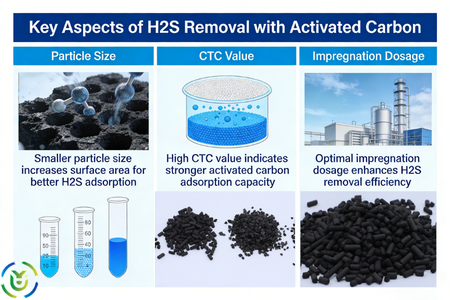
The size of activated carbon particles directly affects its mobility in the hydrogen sulfide treatment system, as well as the contact area with sulfur gas. If the particle size is too large, it will cause insufficient contact between the gas and the surface of the activated carbon, which will greatly reduce the effective adsorption sites and thus significantly reduce the adsorption efficiency of hydrogen sulfide. On the contrary, too small particles will increase the flow resistance of the gas in the treatment device, which will easily cause bed blockage and affect the stable operation of the whole treatment system.
CTC value, i.e. carbon tetrachloride adsorption value, is one of the core indexes to measure the adsorption performance of activated carbon, which is closely related to the adsorption efficiency of hydrogen sulfide. Normally, the higher the CTC value is, the larger the apparent specific surface area of the activated carbon is, and the more developed and dense the internal microporous structure is. These well-developed micropores can capture and accommodate hydrogen sulfide molecules more efficiently, so the adsorption efficiency of hydrogen sulfide is usually higher.
For impregnated activated carbon, the dosage of impregnant is a key factor in determining its hydrogen sulfide removal performance. A suitable impregnation amount can provide sufficient active sites for the activated carbon, effectively enhance its chemical transformation ability of hydrogen sulfide, and then significantly improve the capacity and efficiency of hydrogen sulfide removal. If the impregnation amount is too high, it may cause agglomeration of active sites, and if it is too low, the activity will be insufficient, both of which will affect the treatment effect and should be adjusted accurately according to the actual working conditions.
The effect of relative humidity on the removal efficiency is dual: with the rise of relative humidity, the liquid film formed on the surface of the desulfurizer will gradually become thicker, which increases the gas mass transfer resistance, reduces the effective diffusion coefficient, and leads to a decrease in the slope of the penetration curve; at the same time, however, the rise of humidity will lower the deactivation coefficient and increase the working sulfur capacity. This is because when the moisture is insufficient, a sufficient liquid film cannot be formed in the micropores of the activated carbon, and the active sites required for the chemical reaction are reduced, which affects the removal effect; while too high a humidity prevents the contact of hydrogen sulfide molecules with the active sites. Therefore, the relative humidity should be controlled according to the type of activated carbon.
For activated carbons that require oxygen to participate in the reaction (e.g. potassium iodide impregnated and catalytic types), oxygen content is a key factor affecting the removal efficiency. Experiments show that the optimal oxygen content for adsorbent adsorption of hydrogen sulfide is 2%, and the working conditions are recommended to be controlled as follows: oxygen content of 2%, temperature of 95 ℃, and air velocity of 1000-2000h-¹ (i.e., 1000-2000 m3 of gas processed per hour). At low oxygen content, the adsorption capacity of the adsorbent is low; with the increase of oxygen content, the adsorption capacity is gradually increased, and when the oxygen content is more than 3.5%, the effect of increasing the oxygen content on the adsorption capacity will gradually decrease.
Temperature mainly affects the type of adsorption of activated carbon: in the range of 20-70℃, physical adsorption is dominant, and the physical adsorption effect gradually decreases with the increase of temperature; in the range of 70-95℃, chemical adsorption is dominant, and the increase of temperature promotes the chemical reaction, which improves the adsorption capacity. Overall, the adsorption capacity shows a trend of “decreasing and then increasing” with the temperature change, and it is necessary to control the appropriate working temperature according to the type of activated carbon and the reaction mechanism.
The mass concentration of hydrogen sulfide in the gas affects the reaction rate: when the concentration is too high, the macroscopic reaction rate is fast, the product deposition is fast, which will lead to the activated carbon being close to saturation quickly, and part of the active sites can not be fully utilized, thus lowering the working capacity of sulfur; when the concentration is too low, the reaction rate is slower, and the product sulfur can be gradually deposited, the active sites can be fully utilized, and the working capacity of sulfur is higher. In terms of gas flow rate, too fast flow rate will reduce the contact time between hydrogen sulfide and activated carbon and reduce the adsorption capacity; too slow flow rate will affect the processing efficiency and increase the processing cost, which needs to be optimized and adjusted according to the processing scale.
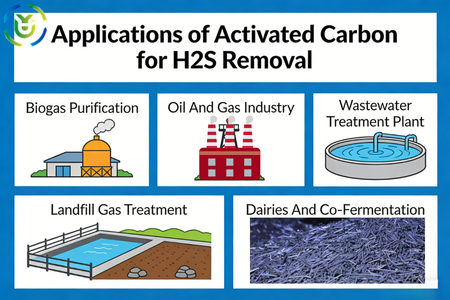
Biogas is mainly produced through anaerobic digestion of organic waste (e.g., agricultural waste, food waste), and the core component is methane, which also contains a certain amount of hydrogen sulfide. If left untreated, hydrogen sulfide corrodes biogas utilization equipment (e.g., engines, turbines) and produces sulfur dioxide after combustion, polluting the environment. Activated carbon can efficiently remove hydrogen sulfide from biogas, as well as volatile organic compounds (VOCs) and siloxanes, improving the quality and availability of biogas, reducing environmental and health risks, and helping biogas to achieve resource utilization.
Hydrogen sulfide is a common byproduct of oil and gas production and refining processes. Both associated gases in the extraction process and process gases in the refining process may contain high concentrations of hydrogen sulfide. Activated carbon can effectively remove hydrogen sulfide from these gases to ensure the safety and stability of the production process, avoid the corrosion of equipment and pipelines caused by hydrogen sulfide, and extend the service life of the infrastructure, as well as to meet the requirements of regulatory emissions and safeguard the occupational health of employees.
In the process of wastewater treatment, especially in the effluent settling tank and anaerobic digestion stage, the decomposition of organic waste will produce hydrogen sulfide, whose strong toxicity and odor will seriously affect the safety of the working environment, and will also corrode the wastewater treatment facilities. The use of specially treated activated carbon can efficiently adsorb and transform hydrogen sulfide during the sewage treatment process, improve the air quality of the plant, avoid the corrosion of hydrogen sulfide on the facilities, and protect the normal operation of the sewage treatment facilities and the safety of employees.
The anaerobic digestion of organic waste in landfills generates landfill gas, which contains hydrogen sulfide and other pollutants, and if directly discharged, it will pollute the air and corrode the treatment equipment. Activated carbon plays an important role in landfill gas treatment by virtue of its excellent adsorption properties. It can convert hydrogen sulfide into harmless monosulfur, which not only protects the downstream equipment from corrosion, but also improves the overall quality of the landfill gas, and creates the conditions for landfill gas recycling (e.g., power generation).
Anaerobic digestion of wastes generated by dairies releases gases containing hydrogen sulfide, which cause corrosion of equipment as well as odors that affect the surrounding environment; co-fermentation facilities also produce sulfur-rich biogas when treating a wide range of organic wastes. Activated carbon can efficiently adsorb and convert hydrogen sulfide in these gases into harmless single sulfur, achieve odor control, protect production equipment, enhance the efficiency of exhaust gas treatment, and help enterprises achieve clean production.
Activated carbon can remove hydrogen sulfide to a very low concentration, especially the special impregnated activated carbon, which, with its optimized microporous structure and activated impregnating agent, can easily meet the strict emission requirements of different industries. For example, in the biogas purification scenario, it can accurately reduce the concentration of hydrogen sulfide to a level that meets the standards for the operation of engines, turbines, and other equipment, effectively avoiding corrosion of the equipment and ensuring the stable advancement of the subsequent resource utilization process. This in-depth removal ability is one of the core advantages that ordinary desulfurization materials can hardly reach.
Although activated carbon has the basic cost of regular replacement or regeneration in the process of use, compared with the maintenance and replacement costs brought by the corrosion of equipment by hydrogen sulfide, the medical costs of employees’ health damage, and the high fines faced by violation of the emissions, its long-term use is more cost-effective, and it can achieve significant cost savings. In addition, some activated carbon, such as catalytic type, can be reused by washing and regeneration, which further reduces the loss of consumables and helps enterprises to better control the overall treatment costs.
The process of hydrogen sulfide treatment by activated carbon does not require the addition of any toxic and harmful chemical reagents, and relies on a combination of physical adsorption and mild chemical conversion, with the reaction products being mostly harmless single sulfur, water and other environmentally friendly substances. This treatment method will not produce secondary pollutants, will not cause additional burden on the air, soil and water, fully in line with the current development trend of cleaner production and green environmental protection in the industry, and help enterprises to achieve environmental compliance and sustainable development.
activated carbon has a variety of types, including KI impregnation, NaOH impregnation, KOH impregnation and catalytic type, etc., so that you can flexibly choose the appropriate type of activated carbon according to the differences in working conditions of different industries, the level of concentration of hydrogen sulfide, as well as the environmental humidity, temperature and other conditions. Whether it is biogas purification, oil and gas processing, sewage treatment, landfill gas treatment, we can find suitable activated carbon products, and its strong adaptability can meet the needs of multiple industries and scenarios of hydrogen sulfide removal.
Choosing a high-quality activated carbon supplier is the key to ensure the removal effect of hydrogen sulfide and guarantee the stability of production. Enterprises can focus on the following five aspects when choosing:
The supplier should be equipped with a professional technical team, which can provide targeted solutions in combination with the actual working conditions of the enterprise (such as hydrogen sulfide concentration, treatment scale, environmental conditions, etc.). Activated carbon selection and hydrogen sulfide treatment solutions. At the same time, we need to have perfect product testing capability to accurately test the core performance indexes of activated carbon (such as specific surface area, impregnation amount, hydrogen sulfide removal capacity, etc.) to ensure that the quality of each batch of products meets the use standard and to avoid affecting the treatment effect due to the failure of the products to meet the standard.
The demand for hydrogen sulfide treatment varies significantly in different industries and scenarios, such as biogas purification and petroleum refining scenarios, which have very different requirements for the type of impregnant and impregnation concentration of activated carbon. Suppliers need to have customized production capacity, be able to tailor the impregnation plan according to the specific needs of the enterprise (such as hydrogen sulfide concentration, environmental humidity, temperature and other operating parameters), optimize the desulfurization performance of the activated carbon, and ensure that it is perfectly adapted to the actual treatment scenarios of the enterprise.
The stability of the desulfurization performance of activated carbon directly affects the continuity and reliability of the enterprise’s hydrogen sulfide treatment, so the supplier needs to establish a perfect quality control system. From the procurement of raw materials, production and processing to the delivery of finished products, each link needs to be strictly controlled to ensure that the performance of mass-produced activated carbon is consistent, to avoid the decline in desulfurization efficiency and damage to equipment due to fluctuations in product quality, and to ensure the stability of the enterprise’s production.
For enterprises with export needs, it is crucial to choose suppliers with rich export experience. Such suppliers are familiar with relevant international regulations, import and export procedures and environmental standards of different countries, and can successfully complete the product customs clearance, inspection and other related procedures. At the same time, they should have reliable logistics channels to ensure that the activated carbon products are delivered to their destinations in a timely and safe manner, so as to avoid any logistical delays affecting the production progress of the enterprises.
The supplier should be able to provide detailed product performance data, clearly labeling the core parameters such as desulfurization capacity, applicable working conditions and service life of different types of activated carbon, so as to facilitate the enterprises to quickly assess the applicability of the products. In addition, it is also necessary to provide successful application cases in similar industries, including the initial concentration of hydrogen sulfide, treatment effect, operating costs and other key information, to help enterprises learn from experience and reduce the risk of selection.
Q1: Can activated carbon remove high concentration of hydrogen sulfide?
A: Ordinary activated carbon is not suitable for high concentration scenarios, special impregnated type can handle certain concentration, hydrogen sulfide more than 50ppm is recommended to use “coarse desulfurization + fine desulfurization” combination process, taking into account the efficiency and cost.
Q2: What is the difference between ordinary activated carbon and impregnated activated carbon for removing hydrogen sulfide?
A: The core difference is in the removal mechanism and capacity: ordinary activated carbon relies on physical adsorption, with low capacity, suitable for low requirement scenarios; impregnated activated carbon combines physical adsorption and chemical conversion, with high capacity and thorough removal, suitable for industrial high requirement scenarios.
Q3: How do environmental factors (humidity and temperature) affect the performance of activated carbon in removing hydrogen sulfide?
A: Humidity should be controlled according to the type of activated carbon (e.g. KI impregnation type ≤70%RH, catalytic type ≤90%RH); temperature 20-70℃ is mainly for physical adsorption, and 70-95℃ is mainly for chemical adsorption, which should be adjusted according to the need to ensure the efficiency.
With the unique advantage of combining physical adsorption and chemical conversion, activated carbon has become an efficient, economic and environmentally friendly solution for hydrogen sulfide removal. Different types of activated carbon (impregnated, catalytic, etc.) can be adapted to different industries and scenarios, and can meet the requirements of the whole process of treatment, from crude desulfurisation to fine desulfurisation.
When choosing an activated carbon solution for removing hydrogen sulfide, enterprises need to fully consider factors such as hydrogen sulfide concentration, environmental conditions, treatment requirements, etc., choose the right type of activated carbon, match it with a reliable supplier, and optimise the operating parameters to ensure the removal efficiency. In the future, with the continuous upgrading of activated carbon preparation technology, its hydrogen sulfide removal performance will be further improved, and the application scenarios will be more extensive, providing stronger support for industrial clean production and environmental protection.