As a porous material with strong adsorption properties, activated carbon is widely used in many fields such as water treatment, chemical industry, food and medicine, etc. Its core function is to adsorb various types of impurity molecules through its porous structure. As a key indicator of the adsorption performance of activated carbon, the Methylene Blue (MB) value directly reflects the adsorption capacity of activated carbon for molecules of specific sizes, and is the core reference for assessing the quality of activated carbon and matching the application scenarios in the industry. In this article, we will systematically disassemble the definition, importance, testing methods, application scenarios and other core contents of the methylene blue value to help readers fully understand its core value in the field of activated carbon.
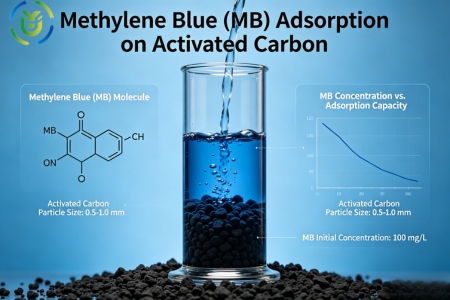
Methylene Blue (MB) value, known as Methylene Blue Adsorption Capacity, refers to the amount of Methylene Blue that can be adsorbed by a unit mass of activated carbon under specific conditions, and is measured in milligrams per gram (mg/g), i.e., the number of milligrams of Methylene Blue that can be adsorbed by each gram of activated carbon.
In essence, the MB value is a visual representation of the adsorption performance of activated carbon, which directly reflects the adsorption capacity of activated carbon on medium-sized organic molecules – MB, as a typical medium-sized organic dye molecule, the adsorption amount can accurately correspond to the adsorption effect of activated carbon on the impurities of similar sizes in the practical application. The adsorption capacity of methylene blue as a typical medium-sized organic dye molecule Generally speaking, under the same test conditions, the higher the value of methylene blue, the stronger the adsorption ability of activated carbon on medium-sized molecules, and its adsorption performance is relatively better (need to be judged in combination with the specific application scenarios, and is not absolute).
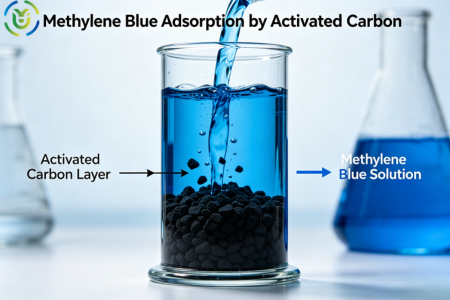
The core function of MB value is to measure the adsorption capacity of activated carbon on medium-sized organic molecules. In practical applications, many impurities that need to be treated by activated carbon (e.g., some dyes, organic pollutants) belong to medium-sized molecules, so the MB value can directly reflect the treatment effect of activated carbon in this kind of scenario, and it is a “barometer” for evaluating the adsorption performance of activated carbon.
Methylene blue value is an important quality control index in the production process of activated carbon. By testing the methylene blue value of each batch of products, manufacturers can ensure the consistency and stability of product quality and avoid unqualified adsorption performance due to fluctuations in the production process. At the same time, in the quality inspection, the methylene blue value is also a key basis for determining whether the activated carbon products comply with the industry standards and whether they are qualified.
Different application scenarios have different adsorption requirements for activated carbon, and the methylene blue value can help buyers quickly match activated carbon products that suit their needs. For example, when dealing with wastewater containing medium-sized dye molecules, activated carbon with high MB value should be selected; while when dealing with small molecule impurities, there is no need to excessively pursue high MB value, and it can be reasonably selected according to the actual demand to avoid cost waste.
The adsorption performance of activated carbon is closely related to its pore structure, and the MB value mainly reflects the volume and performance of mesopore in activated carbon – the pore size of mesopore is usually in the range of 2-50 nanometers, which is exactly matched with the size of methylene blue molecules, so the methylene blue molecules are adsorbed by the mesopore of activated carbon. Therefore, methylene blue molecules are mainly adsorbed by the mesopores of activated carbon.
In order to understand this relationship more clearly, we first briefly distinguish three types of pore structures of activated carbon: micropores (pore size <2 nm), which mainly adsorb small molecules; mesopores (2-50 nm), which mainly adsorb medium-sized molecules; and macropores (>50 nm), which mainly act as a substance transport, and have weak adsorption capacity. It is because the size of the methylene blue molecule and the pore size of the mesopore are highly compatible that the adsorption amount can directly reflect the number of mesopores and the adsorption efficiency. Therefore, the higher the value of methylene blue, the larger the volume of the mesopore of the activated carbon and the more developed the mesopore structure.
|
Pore structure type |
Pore size range |
Main functions |
|
Microporous |
<2 nanometers |
Adsorption of small molecules |
|
Medium Pore |
2-50 nanometers |
Adsorption of medium-sized molecules |
|
Large pore |
>50nm |
Substance transport, weak adsorption capacity |
At present, the testing of methylene blue value in the industry mainly follows the international and domestic standards, commonly found in the American Society for Testing and Materials (ASTM) standards, China’s national standards (GB) and the International Organization for Standardization (ISO) standards. The testing conditions of different standards are slightly different, but the core principle and testing process are basically the same, ensuring the universality and comparability of the test results.
The detection process of methylene blue value can be simplified into three core steps: firstly, prepare a certain concentration of methylene blue standard solution to ensure that the concentration of the solution is uniform and stable; secondly, take a certain quality of activated carbon samples, and fully contact with the methylene blue solution and oscillate it under specific conditions, so as to allow the activated carbon to fully adsorb the methylene blue molecules; lastly, test the concentration of methylene blue remaining in the adsorbed solution through the instrument to calculate the methylene blue adsorbed by the activated carbon. Finally, the concentration of methylene blue remaining in the solution after adsorption is detected by the instrument, and the total amount of methylene blue adsorbed by the activated carbon is calculated, which leads to the value of methylene blue (mg/g).
The particle size of activated carbon will affect the test results, the smaller the particle, the larger the specific surface area, the faster the adsorption speed, which may lead to high test values, and the particle size specification should be strictly controlled.
Insufficient contact time will lead to insufficient adsorption of methylene blue by activated carbon, which will make the detection value low, and it is necessary to ensure sufficient contact reaction time.
Too high or too low temperature, abnormal pH value of the solution will affect the normal adsorption reaction, and ultimately affect the accuracy of the test results, need to control the environmental parameters of the test.
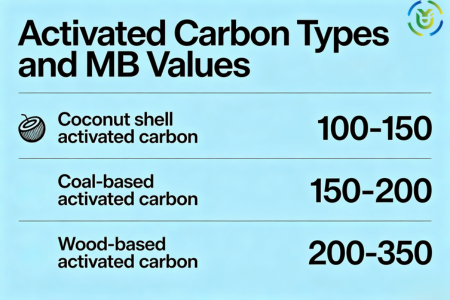
Coconut shell activated carbon: the methylene blue value is relatively low, usually around 100-150mg/g. Its pore structure is dominated by micropores, which is more suitable for adsorption of small molecules, and it is commonly used in drinking water purification, gas adsorption and other scenarios.
Coal-based activated carbon: the methylene blue value is at a medium level, usually around 150-250mg/g, with a balanced microporous and mesoporous structure and comprehensive adsorption performance, which is widely used in various scenarios, such as industrial wastewater treatment and flue gas purification.
Wooden activated carbon: relatively high methylene blue value, usually in the range of 250-400mg/g or even higher, well-developed mesopore structure, good at adsorption of medium-sized molecules, suitable for dyestuff wastewater treatment, food decoloration and other scenarios.
|
Activated Carbon Types |
Typical MB value (mg/g) |
Core pore structure |
Main Applications |
|
Coconut shell activated carbon |
100-150 |
Predominantly microporous |
Drinking water purification, gas adsorption |
|
Coal-based activated carbon |
150-200 |
Balanced between micropores and mesopores |
Industrial wastewater treatment, flue gas purification |
|
Wood-based activated carbon |
200-350 |
Well-developed mesopore structure |
Dye wastewater treatment, food decolorization |
Methylene blue (MB) value: mainly for mesopore adsorption, testing the adsorption capacity of activated carbon for medium-sized molecules (such as methylene blue), applicable to assess the performance of activated carbon for processing medium-sized impurities, such as decolorization of dye wastewater, removal of organic impurities and other scenarios.
Iodine value: mainly for microporous adsorption, detecting the adsorption capacity of activated carbon on small molecules (e.g. iodine molecules), suitable for assessing the performance of activated carbon in dealing with small molecules of impurities, such as deodorization of drinking water, adsorption of small molecules of gases and other scenarios.
In practical application, it is necessary to choose the priority reference index according to the size of impurity molecules: if dealing with medium-sized molecules, give priority to the value of methylene blue; if dealing with small molecules, give priority to the value of iodine; if it is necessary to take account of impurities of various sizes, it is necessary to combine the two to make a comprehensive judgment.
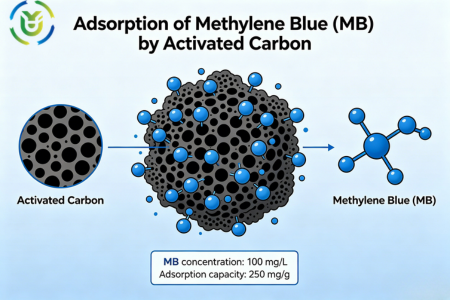
Dye molecules in industrial wastewater are mostly of medium size, and have the characteristics of difficult degradation and high chromaticity, which need activated carbon with high MB value for adsorption treatment – high MB value means that activated carbon has developed pores, which can adsorb dye molecules efficiently and decolorize the wastewater, and at the same time it can assist in lowering the COD of the wastewater to meet the emission standards. ) in the wastewater to meet discharge standards.
In the process of chemical production, all kinds of organic impurities will be generated, these impurities are mostly medium-sized molecules, if not removed in time, it will affect product quality. Activated carbon with high methylene blue value can efficiently adsorb these organic impurities, purify raw materials and products, and ensure the stability of chemical production.
In the production of food and medicine, it is often necessary to decolorize and purify raw materials and finished products to remove organic pigments, impurities and other medium-sized molecules. Activated carbon with high methylene blue value has strong adsorption capacity and is non-toxic and harmless, so it can meet the strict requirements of the food and pharmaceutical industries and ensure product purity and safety.
If the pollutant is medium-sized (such as dyes, most organic impurities), select the activated carbon with high methylene blue value (more than 200mg/g); if it is a small molecule impurity, select the methylene blue value can be moderate, no need to pursue too high, to avoid increasing the procurement cost.
Different industries have clear requirements on the methylene blue value of activated carbon, for example, dye wastewater treatment usually requires methylene blue value ≥250mg/g, and drinking water purification requires ≥150mg/g, which can be selected in combination with industry standards.
Many purchasers think that “the higher the value of methylene blue, the better”, but it is not true – too high a value of methylene blue means that the percentage of activated carbon mesopores is high, and the percentage of micropores may be low, and if the application scenarios require the adsorption of small molecule impurities, it will affect the treatment effect; at the same time, activated carbon with a high value of methylene blue will have a higher value of methylene blue. At the same time, the price of activated carbon with high methylene blue value is higher, and blind selection will cause cost waste.
Choose cellulose-rich raw materials such as wood, fruit shells, etc., which are more likely to form a developed mesoporous structure after activation, which is conducive to increasing the MB value; while coal-based raw materials need to adjust the ratio of raw materials if they want to increase the MB value.
The activation process can be divided into steam activation and chemical activation – steam activation is more likely to form micropores. If you want to increase the methylene blue value, you can adjust the temperature and time of steam activation or adopt the “steam + chemical” composite activation process to promote the formation of mesopores; Chemical activation (such as zinc chloride, phosphoric acid activation) can be adjusted by regulating the amount of activator to increase the volume of mesopores.
Control the pore structure distribution of activated carbon by adjusting the crushing particle size and post activation treatment, reduce the proportion of large pores and increase the number of mesopores, so as to improve the methylene blue value.
There is no absolute “good” or “bad”, the key depends on the application scenario. For example, drinking water purification needs 150-200mg/g, dye wastewater treatment needs more than 250mg/g, matching their own needs of the methylene blue value is the most appropriate.
Not necessarily. Methylene blue value only reflects the mesopore adsorption ability, if the application needs microporous adsorption (such as small molecule gas purification), the high value of methylene blue may affect the proportion of microporous, which may lead to poor treatment effect. Good or bad quality should be judged by combining methylene blue value, iodine value, strength and other indicators with specific application scenarios.
No, it can’t. The adsorption objects of the two tests are different, the methylene blue value is for mesopore and medium-sized molecules, and the iodine value is for micropores and small molecules, so the two can not replace each other, and we need to choose the reference index according to the size of the impurity.
A third-party testing organization can be commissioned to re-test in accordance with ASTM, GB and other standards to compare the test results with the data provided by the supplier; at the same time, the supplier can be requested to provide test reports to check whether the testing methods and conditions are in line with the standards to ensure that the data are true and reliable.
As a core index of activated carbon mesoporous adsorption performance, methylene blue (MB) value is not only a key criterion for evaluating the quality of activated carbon, but also an important basis for matching the application scenarios and optimizing the production process. It directly reflects the adsorption capacity of activated carbon for medium-sized molecules, and is closely related to the pore structure, raw materials and production process of activated carbon. The MB value of different types of activated carbon varies significantly, so it should be reasonably selected according to the specific application scenarios.