In municipal sewage treatment, industrial wastewater treatment and recycling, BOD (biochemical oxygen demand) and TSS (total suspended solids) are two core indicators to measure whether effluent meets standards. High BOD consumes dissolved oxygen in the receiving water body, while TSS leads to problems such as increased turbidity, pipeline siltation, and damage to the aquatic environment. Activated carbon, with its developed porous structure and large specific surface area, is widely used in advanced wastewater treatment to control effluent quality. This paper systematically reviews the removal paths, performance boundaries, influencing factors, and common judgment points for engineering selection of activated carbon for these two types of indicators.
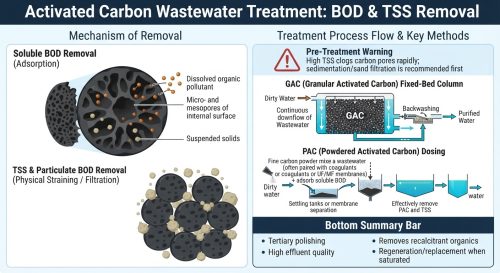
BOD reflects the total amount of organic matter in water that can be oxidized and decomposed by microorganisms, and is a classic indicator for judging the degree of organic pollution in water bodies. BOD can be divided into soluble BOD and particulate BOD according to its form of existence: the former is mainly small and medium-molecular organic matter dissolved in water, while the latter is attached to suspended particles. When the BOD of the effluent is too high, a large amount of dissolved oxygen will be consumed after being discharged into natural water bodies, leading to oxygen deficiency in the water bodies and threatening the survival of fish and aquatic organisms.
TSS refers to insoluble solid particles that can be trapped by the filter media, including sediment, organic debris, colloids, and some floes. TSS directly determines the turbidity of effluent. Long-term discharges will cause siltation in rivers and pipelines, and affect aquatic ecosystems by blocking light and carrying pollutants. Unlike soluble pollutants, the removal of TSS relies more on physicochemical processes such as interception, precipitation, filtration, and floc aggregation.
Activated carbon is made from carbonaceous raw materials such as coal, wood, and fruit shells through carbonization and activation. Inside, a multi-level pore network consisting of micropores, mesopores, and macropores is formed, with a large specific surface area and certain adsorption activity on the surface. The two most commonly used forms in water treatment are granular activated carbon (GAC) and powdered activated carbon (PAC), which have their own division of labor in terms of dosing methods, contact forms, and application links.
|
Contrast dimension |
Granular Activated Carbon (GAC) |
Powdered Activated Carbon (PAC) |
engineering implications |
|
form |
Larger particles are filled into a filter bed. |
Fine powder form, dispersed and added to water bodies |
GAC forms a fixed filter layer, while PAC contacts wastewater in a suspension and dispersion manner. |
|
dosing position |
Depth filtration unit after precipitation and biochemistry |
Dose point before coagulation precipitation, aeration tank or filtration |
GAC is suitable for continuous and stable bed processing, while PAC is suitable for flexible dosage adjustment. |
|
Typical Use |
Adsorption of soluble organic matter, trapping of fine suspended matter |
Emergency decontamination, decolorization and deodorization, and assisting flocculation |
In practical processes, both are often used in combination with precipitation, biochemical, and filtration units. |
|
regeneration mode |
After failure, some capabilities can be restored through methods such as thermal regeneration. |
Generally discharged with sludge, disposable |
The long-term operating costs of GAC can be amortized through regeneration, while PAC costs accumulate with investment volume. |
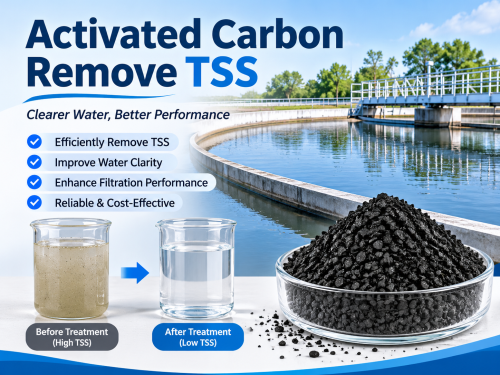
When water flows through the GAC filter bed, the pore channels formed between the carbon particles will mechanically intercept the larger suspended particles; For fine particles and colloidal impurities passing through the filter layer, the fixation is achieved by means of van der Waals forces and pore adhesion on the surface of the carbon particles. When the two pathways of interception and adsorption are superimposed, the effluent turbidity and TSS indicators usually improve significantly.
After PAC is dispersed in water, the fine carbon particles can act as the attachment skeleton of flocs, helping fine particles and colloids that are otherwise difficult to aggregate to form denser flocs, which can be removed together in subsequent precipitation or filtration. This coagulation-promoting effect is not equivalent to direct filtration, but rather improves the subsequent solid-liquid separation efficiency by improving the floc structure.
Activated carbon is not a heavy-duty slag removal medium, and its ability to remove large specific gravity sediment, fibrous impurities, and coarse particulate solids is limited. These impurities are more suitable for prior stripping by grid, sand settling, and sedimentation units. The advantageous range of activated carbon is concentrated on the fine particles, colloids and organic pollutants attached to the particles remaining after primary slag removal.
|
Suspended particle type |
Typical features |
Activated carbon removal performance |
|
Coarse particles and heavy solids |
Sand, gravel, fibers, large organic debris, good settling properties |
The removal capacity is limited, and the removal should be prioritized in the pre-precipitation and sand settling units to avoid coal seam blockage. |
|
fine suspended particles |
Particles of small size that pass through the primary precipitate with water flow |
It can be trapped and adsorbed on the surface of the carbon bed gap, and is one of the main removal objects of the GAC filter layer. |
|
colloidal impurities |
The particles are extremely fine, charged, and difficult to settle naturally. |
Removal of activated carbon alone is limited and usually requires coagulation, coagulation aid, or PAC adsorption to improve the coalescence effect. |
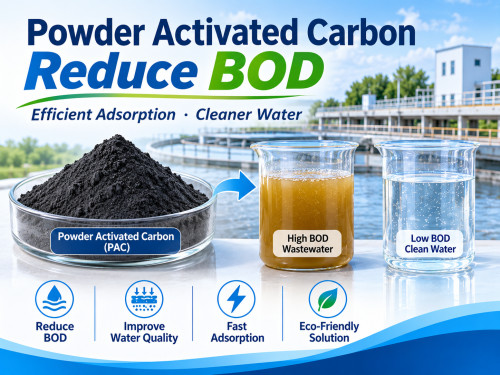
When the water flow contacts the carbon layer, the dissolved organic matter diffuses into the pores and is fixed inside the carbon material by the pore surface by van der Waals force. This is the most direct way for activated carbon to reduce BOD, especially for organic compounds with medium molecular weight and strong hydrophobicity. The effluent BOD decreases as such substances are fixed, and the substrates available to subsequent microorganisms decrease accordingly.
Biofilms will gradually form on the surface of a carbon bed that has been operating for a long time and under suitable conditions. Microorganisms on the film feed on organic matter adsorbed on the carbon surface and continuously decompose it into carbon dioxide, water and metabolites. Physical adsorption is responsible for “capturing” organic matter and buffering water quality fluctuations, while biodegradation is responsible for continuously consuming the adsorbed substrate. The combination of the two can extend the effective working cycle of the carbon bed, which is also the core principle of the bioactivated carbon process.
Some BOD in water does not exist in a dissolved state, but adheres to suspended organic debris and is included in the organic load together with TSS. After this particulate organic matter is trapped with suspended solids or removed with flocculent sedimentation, the BOD of the effluent will decrease simultaneously, which is an indirect benefit brought about by the TSS removal process of activated carbon.
The actual removal effect of activated carbon on BOD and TSS is not a fixed value, but is determined by the carbon specifications, influent water quality, and hydraulic conditions. The effluent performance of the same type of activated carbon may differ significantly under different water quality and operating conditions, and each item needs to be checked during type selection and commissioning.
|
factor category |
Specific indicators |
Impact on BOD/TSS removal |
|
Carbon material standards |
Iodine value, CTC adsorption rate, particle size, pore distribution, ash content |
Iodine value and CTC reflect adsorption capacity and adsorption tendency for different organic compounds; Particle size affects the flow rate, interception capacity and pressure drop of the filter layer; The pore distribution must match the molecular weight of the target organic substance. |
|
influent water quality |
Initial BOD/TSS concentration, pH, water temperature, oil and grease content |
Excessive concentration will accelerate saturation; pH and temperature affect the existence form and adsorption equilibrium of organic matter; Oils envelop carbon particles, clog pores, and occupy adsorption sites. |
|
hydraulic conditions |
Contact time, filtration rate, bed height, backwash cycle |
Insufficient contact time will lead to insufficient adsorption and retention; Too fast filtration rate affects particle retention; Bed depth determines the effective filtration and adsorption volume; Control of coal seam loosening and suspended matter retention by backflushing |
|
interfering factors |
Competing adsorbents, high concentration heavy solids, refractory macromolecules |
Coexisting other organics compete for pore sites; Heavy solids can easily cause bed blockage; Some low molecular weight, highly hydrophilic organic compounds are difficult to adsorb effectively. |
Powdered activated carbon is usually added in the form of dry powder or slurry before coagulation and precipitation, aeration or filtration. The dosage can be adjusted in a short time, and at the same time, it undertakes the tasks of adsorbing organic matter, assisting floc formation and partial decolorization and deodorization. This method is suitable for scenarios where water quality fluctuates greatly, emergency treatment is required, or the water volume is small, making it inconvenient to set up a charcoal bed.
Granular activated carbon is generally arranged after primary or secondary precipitation or biochemical treatment as an advanced treatment unit to ensure the stability of the effluent. When the water flows through the filter bed, fine particles are trapped and organic matter is adsorbed. The filter bed can be maintained unobstructed by backwashing, and the whole filter bed can be replaced or regenerated after it fails.
In the process of reclaimed water reuse or advanced treatment that requires long-term maintenance of low BOD effluent, the bioactivated carbon process can be used: the carbon bed cultivates biofilms during operation, using microorganisms to continuously degrade adsorbed organic matter and extend the effective cycle of the carbon. Biological activated carbon has corresponding requirements for the biodegradability of influent water, dissolved oxygen, and operational management level, and is not suitable for all wastewater types.
|
process form |
placement position |
Main tasks |
Typical applicable scenarios |
|
powder activated carbon addition |
Dose point before coagulation precipitation or filtration |
Adsorption of soluble organic matter, coagulation aid, removal of some fine particles and color odor |
Emergency treatment, water quality fluctuations, small water volume projects |
|
granular activated carbon fixed bed |
Depth filtration unit after precipitation and biochemistry |
Intercepting fine suspended matter, adsorbing residual organic matter, and controlling effluent indicators. |
Advanced treatment of municipal sewage and standard discharge of industrial wastewater |
|
biological activated carbon system |
Biochar beds prior to advanced treatment or reuse |
Adsorption and biodegradation work together to maintain low BOD effluent for a long time. |
Reclaimed water reuse and treatment processes with high requirements for effluent organic matter |
|
Common knowledge |
Actual boundary description |
|
Activated carbon can completely remove TSS and BOD on its own. |
Activated carbon is typically positioned as an advanced treatment and control unit, with the effluent baseline determined by pre-grid, sedimentation, and biochemical treatment. In the absence of effective pretreatment, it is difficult to stably meet the standards by relying only on carbon beds. |
|
Activated carbon has good adsorption effect on all organic matter |
The adsorption effect is related to the molecular weight, polarity and solubility of organic matter; It has limited removal capabilities for low molecular weight, strong hydrophilicity, and partially water-soluble organic matter. |
|
High TSS water inflow does not affect bed life |
Heavy solids and high concentration suspended matter can accelerate bed blockage, increase pressure drop and squeeze adsorption sites, shorten the effective period of charcoal, so pre-slag removal is essential. |
|
After adsorption saturation, the effluent will immediately deteriorate dramatically. |
The saturation process usually manifests as a gradual increase in effluent BOD, TSS, or chromaticity; After exceeding the breakthrough point, the adsorption capacity tends to be depleted, requiring regeneration or replacement, and the economic efficiency of continued operation decreases. |
|
Ttreatment process |
Main removal objects |
Advantage |
Limitation |
|
coagulation flocculation precipitation |
Suspended particles, colloids, partially particulate organic matter |
High efficiency of residue and colloid removal, large processing capacity, and low unit cost |
The removal of soluble organic matter is limited, and chemical sludge is generated. It is necessary to add chemicals and control sludge disposal. |
|
membrane filtration |
Fine particles, colloids, some macromolecular organic matter and salts |
The effluent has high clarity, controllable particle size range, and relatively compact footprint. |
Membrane fouling and replacement costs are high, requiring high pretreatment and operation and maintenance, and its ability to trap small molecule organic matter is limited by membrane pore size. |
|
activated carbon adsorption |
Soluble organic matter, some fine particles and colloids, color and odor |
The adsorption of soluble organic matter is highly targeted, the process is flexible, and it can be combined with biochemical and precipitation units. |
The removal of heavy solids and strongly hydrophilic small molecules is limited, and the adsorption capacity is limited. After saturation, regeneration or replacement is required. |
The key to stable operation lies in timely identification of carbon saturation and bed blockage signals, and extending the carbon life through pre-treatment and regular monitoring. After GAC failure, part of the adsorption capacity can be restored by thermal regeneration or other methods according to the type of carbon and process conditions. The number of regenerations and the recovery ratio need to be evaluated in conjunction with actual operation data. PAC is generally discharged with sludge and is not regenerated.
|
Monitoring/Maintenance Matters |
judgment signal |
Disposal recommendations |
|
effluent quality |
The BOD, TSS, color, or odor of the effluent gradually increase, approaching the emission limit. |
Verify whether the adsorption breakthrough point has been reached, arrange sampling and comparison, and develop a replacement or regeneration plan. |
|
Bed pressure differential and flux |
The pressure drop of the filter bed increased and the effluent flow decreased, resulting in limited recovery after backwashing. |
Check whether the pre-slag removal is in place, adjust the backwashing cycle and intensity, and check for blockages or compaction in the carbon layer if necessary. |
|
preprocessing |
Influent carries heavy solids, oils, or high concentrations of suspended matter |
First, improve the sedimentation, oil removal, and filtration processes to prevent impurities from directly entering the carbon bed and occupying the adsorption site. |
|
Regeneration and replacement |
Carbon adsorption capacity is exhausted, and the recovery rate after regeneration is insufficient. |
Compare the economic efficiency of recycling and reuse versus overall replacement by combining operating cycle, recycling cost, and new carbon price. |
The removal of TSS by activated carbon is mainly achieved through physical trapping, surface adsorption, and assisted floc coalescence. The reduction of BOD is achieved through three paths: soluble organic matter adsorption, synergistic degradation of biologically activated carbon, and indirect removal of granular organic matter. It is more suitable as a deep treatment and effluent control unit, rather than replacing pre-biochemical treatment or slag removal processes. In engineering applications, front-end pretreatment should be improved first, then the carbon type, particle size and contact time should be matched according to the target pollutant form, and the timing of saturation and regeneration should be judged based on the effluent index and bed pressure difference in order to achieve a balance between stable compliance and operating costs.