Granular activated carbon is an indispensable core material in the field of water treatment, widely used in drinking water purification, industrial water treatment, wastewater treatment and other scenarios, and its core role is to remove various types of pollutants in the water through adsorption to ensure that the water quality meets the standards. This article provides a comprehensive and operable selection guide from the basic knowledge of granular activated carbon, core selection parameters, application scenarios, common misunderstandings, etc., to help accurately select the right granular activated carbon products to achieve efficient, economical and compliant water treatment goals.
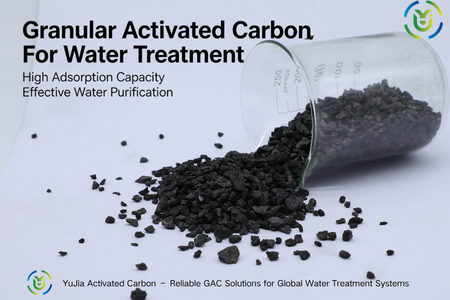


Granular activated carbon is an organic, highly porous adsorbent material, based on carbon rich raw materials such as coconut shell, coal, wood, etc., which is processed at high temperature to form a huge internal pore structure – this special structure gives granular activated carbon an extremely strong adsorption capacity, making it a ‘mainstay’ for removing pollutants from water treatment. ‘main force’ in water treatment.
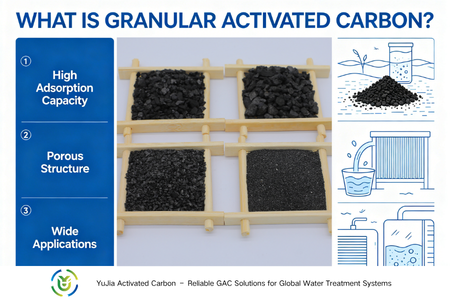
In terms of its core function, the main role of granular activated carbon is to remove all kinds of impurities in water, including chlorine, volatile organic compounds (VOCs), pesticides, chemical oxygen demand (COD), pigments, heavy metals, etc., through a combination of physical adsorption and chemical adsorption.
Its core advantage lies in its strong versatility, which can be adapted to different types of water treatment scenarios, not only to improve the taste and safety of drinking water, but also to help industrial production to achieve process water purification, and also to help wastewater treatment to meet the emission standards, which is a kind of water treatment materials with both practicality and economy.
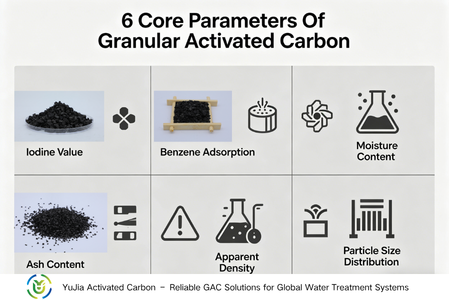
The consistency of particle size directly affects the stability of the water treatment system: uniform particle size ensures stable water flow rate, reduces the pressure loss of the system, and avoids the problem of ‘ditch flow’ (short circuit of water flow) or blockage, ensuring that the granular activated carbon is in full contact with the water, and enhancing the adsorption efficiency.
It is necessary to match the appropriate mesh size according to the filter design. The common mesh size of granular activated carbon for water treatment is 8×30 mesh or 12×40 mesh, which can be adjusted according to the specifications of the actual filtration system.
Ash content is an important index for measuring the purity of granular activated carbon, which directly affects the adsorption effect and filter service life. Usually, the lower the ash content, the higher the purity of granular activated carbon, the better the adsorption performance, and also can effectively avoid the clogging of the filter and secondary pollution caused by ash shedding.
It is recommended to choose granular activated carbon with ash content lower than 5%. If used for drinking water treatment, the ash content should be controlled below 3% to ensure the safety of water quality.
High ash content will reduce the adsorption capacity of granular activated carbon, shorten its service life, and may lead to turbidity of the effluent water, which can not meet the standard requirements.
The adsorption capacity of granular activated carbon mainly depends on its specific surface area – the larger the specific surface area is, the more developed the pore structure is, the more pollutants can be adsorbed and the higher the adsorption efficiency is. The specific surface area of high quality granular activated carbon for water treatment is usually between 900-1200 square metres/gram.
According to the molecular size of the target pollutants, it is necessary to select the pore type – microporous (suitable for adsorption of small molecule pollutants such as VOCs), mesoporous (suitable for adsorption of large molecule organic matter such as dyes), to ensure that the pore structure matches the characteristics of the pollutants and to avoid ‘using too little for too long’ or ‘using too much for too little’. Avoid ‘using too much for too little’ or ‘using too much for too little’.
Iodine value is a standard index to measure the adsorption capacity of granular activated carbon, mainly reflecting its adsorption capacity for small molecule pollutants. The higher the iodine value, the stronger the adsorption capacity, and the better the effect of removing small molecule impurities in water.
The iodine value of granular activated carbon used for water treatment is recommended to be not less than 1000 mg/g, among which the iodine value of granular activated carbon used for drinking water treatment should be strictly controlled to be above 1000 mg/g, so as to ensure effective removal of residual chlorine, VOCs and other pollutants.
Stacking density mainly affects the design of the filter and the handling and filling of granular activated carbon, and it is also related to the adsorption capacity – in the same volume of the filter, granular activated carbon with moderate stacking density can ensure sufficient adsorption capacity, and at the same time, it is convenient for system operation and maintenance.
The ideal packing density of coconut shell granular activated carbon is 0.45-0.55 g/cm3, which can be flexibly adjusted according to the filter volume and treatment capacity.
The certification qualification of granular activated carbon is an important prerequisite for guaranteeing the effect and safety of water treatment. Particularly, granular activated carbon used for drinking water treatment must comply with relevant industry standards and certification requirements.
It is necessary to ensure that granular activated carbon has AWWA (American Water Works Association), ISO (International Organisation for Standardisation), NSF (National Sanitation Foundation) and other certifications, of which NSF certification is a key qualification for granular activated carbon for drinking water, which ensures that the product complies with drinking water safety standards.
The quality, safety and adsorption performance of granular activated carbon with formal certification have been rigorously tested, which can effectively avoid water treatment failures caused by product quality problems.
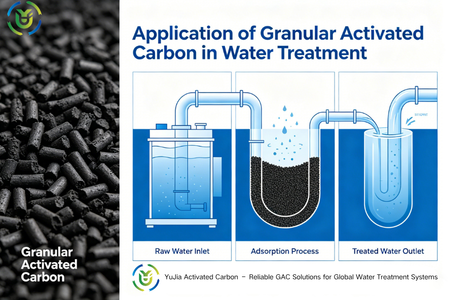
Remove residual chlorine in the water, odour, taste impurities, adsorption of VOCs, pesticides and other harmful organics, reduce the content of heavy metals, to ensure that drinking water meets the national health standards, to protect human health, which is the core of the drinking water treatment, not only to meet the demand for drinking water taste, and more importantly, to protect the bottom line of drinking water safety, to avoid the potential harm caused by harmful pollutants long-term intake of the human body.
Coconut shell granular activated carbon – with developed microporous structure, low ash content, high purity and food-grade safety, it can effectively remove small molecule pollutants in drinking water and improve the taste and smell of water. Compared with other types of granular activated carbon, it is more suitable to meet the strict requirements of drinking water treatment without the risk of secondary pollution, and it can better balance the purification effect and drinking water safety. better balance between purification effect and drinking water safety.
Iodine value ≥1000 mg/g, ash content <3%, NSF certification to ensure product safety and high efficiency, in which the iodine value determines the adsorption ability of small molecule pollutants, low ash content guarantees the purity of water quality and no secondary pollution, and NSF certification is the core safety guarantee for granular activated carbon for drinking water, and one of the three is indispensable.
Purify process water, remove organic solvents, organic compounds, heavy metals and other impurities in the water, to ensure the stability of the production process, to avoid the impact of pollutants on product quality, the purity of industrial process water is directly related to the smoothness of the production process and the quality of the final product, if the impurities in the water exceeds the standard, it may lead to damage to the production equipment, the decline in the qualification rate of the product and other issues.
Coal granular activated carbon (suitable for adsorption of large molecule organic matter, organic solvents) or wood granular activated carbon (suitable for decolourisation treatment) – Coal granular activated carbon has a large pore structure, which can effectively adsorb large molecule pollutants in industrial wastewater at a relatively low cost, and it is suitable for large-scale industrial application, while wood granular activated carbon performs more prominently in the decolourisation treatment of process water, and it is suitable for large-scale industrial application. The performance of wood granular activated carbon is more prominent in decolourisation treatment, which can be flexibly selected according to specific industrial needs.
Specific surface area, pore size distribution, chemical stability, to ensure that the granular activated carbon can adapt to the complex water quality of industrial wastewater, to avoid corrosion or failure, industrial wastewater composition is complex and corrosive, the chemical stability of the granular activated carbon can prevent it from decomposition or corrosion in the process of using it, and the reasonable specific surface area and pore size distribution can enhance the adsorption efficiency of various types of industrial pollutants.
Reduce the COD content of wastewater, remove pigments and trace pollutants, ensure that wastewater treatment meets national or local emission standards, and reduce pollution of the environment. Wastewater treatment is an important part of the enterprise’s environmental compliance, and effective reduction of the COD content and removal of harmful impurities can not only avoid environmental pollution, but also help the enterprise to avoid the risk of environmental penalties.
Coal granular activated carbon – its low cost and developed pore structure can effectively adsorb complex pollutants in wastewater, and it has good anti-pollution ability, which is suitable for large-scale wastewater treatment scenarios, large-scale wastewater treatment has a large demand for granular activated carbon, and coal granular activated carbon’s cost-effective advantage is particularly prominent, while its anti-pollution ability can extend its service life and reduce operating costs. At the same time, its anti-pollution ability can prolong the service life and reduce the operation cost.
The stacking density, regeneration capacity and anti-clogging performance can reduce the long-term operation cost and improve the efficiency of wastewater treatment. The stacking density affects the filling volume and operation stability of the filter, the regeneration capacity can realise the reuse of granular activated carbon, and the anti-clogging performance can avoid the frequent clogging of the filter, and the three of them can jointly guarantee the long-term, efficient and stable operation of the wastewater treatment system, and control the operation cost.
Developed microporous structure, strong adsorption capacity, especially suitable for removing small molecule pollutants in water (such as residual chlorine, VOCs, heavy metals, etc.).
Low ash content (usually <5%), high purity, no risk of secondary pollution, renewable resources (coconut shells are agricultural by-products), strong environmental protection.
Good regeneration performance, can be reused 5-10 times, low long-term operating costs.
Drinking water treatment, household water purifier, small water purification equipment, water purification for food processing, etc.
The pore structure is large (mainly medium and large pores), which is suitable for adsorption of large organic molecules, organic solvents, dyes and other pollutants in water.
Low cost, cost-effective, high mechanical strength, wear-resistant, impact-resistant, suitable for long-term use in fixed-bed filters, not easy to be pulverised.
Industrial wastewater treatment, municipal wastewater treatment, industrial process water purification, etc.
|
Contrasting dimensions |
Coconut shell granular activated carbon |
Coal granular activated carbon |
|
Pore structure |
Developed microporous structure, suitable for adsorption of small molecule pollutants |
Large pore structure (medium and large pores mainly), suitable for adsorption of large molecule pollutants |
|
Ash content |
Low (usually <5%), high purity, no risk of secondary pollution |
Relatively high, slightly lower purity |
|
Applicable Scenarios |
Drinking water treatment, household water purifier, small water purification equipment, food processing water purification, etc. |
Industrial wastewater treatment, municipal wastewater treatment, industrial process water purification, etc. |
Empty Bed Contact Time (EBCT) refers to the contact time between water and granular activated carbon in granular activated carbon filter, which directly determines the adsorption efficiency – the longer the contact time is, the more adequate the reaction between water and granular activated carbon is, and the better the pollutant removal effect is.
EBCT is recommended to be controlled at 6-48 minutes for drinking water treatment and 0.5-4 hours for industrial wastewater treatment, which can be adjusted according to pollutant concentration and treatment objectives.
The adsorption capacity of granular activated carbon will be saturated after a period of time, at this time, it needs to be regenerated or replaced, and its regeneration capacity needs to be taken into consideration when selecting the type to reduce the operation cost.
Mainly divided into thermal regeneration and direct replacement – thermal regeneration can make the granular activated carbon reuse 5-10 times, suitable for large-scale, long-term operation scenarios; direct replacement is simple to operate, suitable for small-scale equipment or the concentration of pollutants in high scenarios.
For long-term operation and large treatment capacity projects, granular activated carbon with good regeneration performance (e.g. coconut shell granular activated carbon) is preferred; for small-scale equipment or short-term projects, granular activated carbon with low replacement cost can be selected.
The particle size and packing density of granular activated carbon need to be compatible with the filter design to avoid problems such as clogging, high pressure or uneven water flow.
Different types of filters, such as gravity filters, pressure filters and activated carbon columns, have different requirements on the particle size of granular activated carbon. According to the flow rate, volume and other parameters of the filter, the appropriate particle size and stacking density of granular activated carbon should be selected, so as to ensure the stability of the water flow and avoid excessive pressure loss.
Low-priced granular activated carbon tends to have high ash content, poor adsorption performance and short service life. Although the initial purchase cost is low, the long-term replacement cost and operation cost are higher, which may even lead to substandard water quality.
Only focusing on the specific surface area, not matching the size of pollutant molecules, resulting in low adsorption efficiency of granular activated carbon (such as the adsorption of macromolecular pollutants with microporous granular activated carbon).
Selecting too large particles will reduce the contact area and lower the adsorption efficiency; selecting too small particles will lead to filter clogging and increase the pressure loss.
If coconut shell granular activated carbon is used to treat large organic molecules in industrial wastewater, or coal granular activated carbon is used to treat drinking water, resulting in poor treatment results.
Especially for drinking water treatment, granular activated carbon without NSF, ISO and other certifications is not selected, and there is a hidden danger of water quality and safety, and it may not be able to pass the relevant tests.
Verify whether the granular activated carbon provided by the supplier has relevant certifications such as ISO, NSF, AWWA, etc. Especially for granular activated carbon for drinking water, authoritative test reports are required to ensure that the product meets the standards.
Suppliers are required to provide parameter test reports of batch products to ensure that different batches of granular activated carbon are consistent in core parameters such as iodine value, specific surface area, ash content, etc., so as to avoid product fluctuations affecting the effect of water treatment.
Choose the supplier who can provide technical support and customise suitable granular activated carbon products according to its own water treatment scenarios and pollutant characteristics; at the same time, the supplier needs to be able to provide installation and operation guidance, and solve the problems in the process of use in a timely manner.
For large-scale, long-term operation of the project, we need to confirm the production capacity and supply cycle of the supplier to ensure the stability of the supply of granular activated carbon, to avoid the normal operation of the water treatment system due to lack of goods.
Suppliers are required to provide product samples and case studies, and the adsorption performance of granular activated carbon can be proved through small tests; at the same time, after-sales service is clearly defined, such as product quality problems, return and exchange policy.
Determine the type of pollutants to be removed (e.g. residual chlorine, VOCs, COD, etc.), water quality standards (e.g. drinking water standards, wastewater discharge standards) and treatment volume.
Define the molecular size and concentration of pollutants, and determine the required pore structure of granular activated carbon (microporous, mesoporous).
Determine the minimum standards for core parameters such as iodine value, specific surface area, ash content, etc. according to the treatment objectives.
According to pollutant characteristics and treatment scenarios, select coconut shell granular activated carbon or coal granular activated carbon.
Determine the particle size and stacking density of granular activated carbon based on parameters such as filter type and flow rate.
Verify the certification qualification, product consistency and technical support capability of the supplier, and screen high-quality suppliers.
Test the adsorption performance of granular activated carbon through a small trial to confirm that it meets the treatment requirements before large-scale procurement and application.
The core of selecting granular activated carbon is ‘matching parameters, matching scenes’ – not only should we master the selection standards of core parameters such as iodine value, specific surface area, ash content, etc., but also combine with the treatment requirements of different scenes such as drinking water, industrial water, waste water, etc., to select the appropriate type of granular activated carbon. The selection of the right type of granular activated carbon should be based on the different treatment needs of drinking water, industrial water and waste water. It is necessary to avoid common selection misunderstandings and choose reliable suppliers to achieve efficient, economical and compliant water treatment. The selection of granular activated carbon is not one-size-fits-all, as water quality and treatment objectives vary from project to project, so it is recommended to take into account your actual situation and consult a professional granular activated carbon manufacturer if necessary. We recommend that you consult a professional granular activated carbon manufacturer if necessary, in order to customise a personalised selection plan to ensure that the water treatment system operates stably and that the water quality continues to meet the standards.
Korea’s drinking water purification project, the use of iodine value of 1100 mg / g of coconut shell granular activated carbon, after 6 months of operation, the residual chlorine removal rate of the water reached 99%, the odour was completely eliminated, the effluent water quality meets the national drinking water hygiene standards, and the satisfaction of the user is significantly improved.
Industrial wastewater treatment project of Singapore chemical enterprise, using coal granular activated carbon to treat high COD wastewater, through optimisation of EBCT to 2 hours, COD removal rate of more than 75%, wastewater treatment meets the local discharge standards, to achieve compliance discharge, while reducing operating costs.