Flue gas produced during industrial production contains a large number of pollutants, which can seriously pollute the atmosphere and endanger human health if emitted directly. With the increasingly strict environmental policy, flue gas treatment has become an essential part of industrial production, and activated carbon has become one of the core materials in the field of flue gas treatment due to its excellent adsorption properties. In this paper, we will comprehensively explain the knowledge of flue gas treatment, analyse the advantages of activated carbon in the application of flue gas treatment, category differences, as well as selection, operation and maintenance of the core points for industrial flue gas purification to provide practical reference.


Flue gas treatment, refers to industrial production, fuel combustion, waste treatment and other processes generated by the high temperature exhaust gas, through physical, chemical, biological and other technical means, to remove harmful pollutants, so that the exhaust gas meets the national emission standards and then discharged the whole process, is a key link in the prevention and control of air pollution.
The main industrial sources of flue gas are extensive, covering all major energy-consuming and high-emission industries, and the core scenarios include: thermal power plants, the coal-fired power generation process produces a large amount of dusty and sulphurous flue gases; rubbish incineration plants, the incineration and disposal of domestic rubbish releases highly toxic pollutants, such as heavy metals and dioxins; the cement production industry, the cement calcination and grinding process produces a large amount of dust and acidic gases; and the iron and steel smelting industry, the iron smelting, In the iron and steel smelting industry, iron and steelmaking processes are accompanied by the emission of sulphide, nitrogen oxides, dust and other pollutants. Besides, chemical, coking and non-ferrous metal smelting industries are also the main sources of flue gas pollution.
Flue gas has a complex composition and contains a wide variety of pollutants, which can be broadly divided into two categories: particulate pollutants and gaseous pollutants. Particulate pollutants are mainly dust and soot; gaseous pollutants include sulphur dioxide, nitrogen oxides, hydrogen sulphide and other acid gases, volatile organic compounds (VOCs), as well as mercury, lead, cadmium and other heavy metals, and dioxins, which are persistent organic pollutants. These pollutants not only cause acid rain, haze, photochemical smog, but also through the food chain enrichment, damage to human organs, inducing a variety of diseases.
At present, the commonly used flue gas treatment technologies in industry are mainly divided into three categories, which are suitable for different pollutants and working conditions. First, the adsorption method, the use of porous materials adsorption of gaseous pollutants, high purification efficiency, a wide range of applications; the second is the catalytic oxidation method, with the help of catalysts to oxidise and decompose the harmful gases into harmless substances, mostly used for VOCs, nitrogen oxides management; the third is the scrubbing method, also known as the absorption method, through the spraying of absorbent liquid, neutralisation, absorption of acidic or alkaline gases, commonly used in the desulphurisation and denitrification pre-treatment. In addition, there are condensation, membrane separation, incineration and other technologies, and activated carbon adsorption method, is one of the most applicable and widely used technologies.
In the whole set of flue gas treatment process, activated carbon is usually used as a deep purification link with dust removal, desulphurisation and denitrification equipment. After the front-end equipment removes most of the dust, sulfide, nitrogen oxides, activated carbon is responsible for adsorption of residual trace pollutants, especially mercury, dioxins, VOCs, etc., which are difficult to be removed by conventional technology, so as to make up for the shortcomings of the treatment and achieve ultra-low emission of flue gas, and it is the last key line of defence for the flue gas to meet the standard emission.
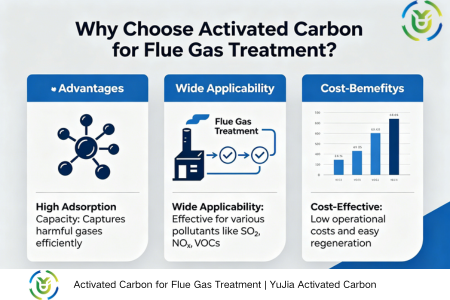
Activated carbon is a kind of porous carbon material, internal pore structure is developed, specific surface area can reach hundreds or even thousands of square metres per gram, the large specific surface area gives it a strong adsorption capacity, can quickly adsorb a large number of gaseous, trace pollutants, purification efficiency is far more than ordinary adsorbent materials, and it can effectively deal with the flue gas concentration of various types of impurities of varying heights.
Conventional flue gas treatment technology has a good effect on removing dust and conventional acid gases, but has limited effect on mercury and its compounds, dioxins, which are trace, highly toxic and difficult to degrade pollutants. Activated carbon can accurately adsorb such trace pollutants, firmly lock the harmful substances to avoid their escape and discharge, especially in the waste incineration, hazardous waste disposal and other industries, is the first choice for the removal of mercury, dioxins.
Activated carbon has stable performance, is resistant to high and low temperatures, acids and alkalis, and is suitable for flue gas working conditions in different industries, regardless of whether it is high temperature flue gas, high humidity flue gas, or mixed flue gas with complex composition, it can play a stable role. At the same time, activated carbon can be adjusted according to the working conditions of the form and formula, and can be flexibly adapted to various types of treatment equipment without significant modification of the original system, so it is widely applicable to a wide range of scenarios.
Compared with alternative materials such as molecular sieve, silica gel and organic adsorbent, activated carbon has a wider adsorption range, which can adsorb polar pollutants and non-polar pollutants, and the cost is more controllable; compared with catalytic materials, activated carbon does not require harsh reaction temperature and pressure conditions, and the operation and maintenance is more convenient; compared with the washing method, activated carbon does not produce waste water and waste residue, and the solid wastes can be recycled and disposed of, which is more environmentally friendly and safe. It is more environmentally friendly and safer.
Powdered activated carbon is activated carbon powder with high fineness, small particle size and sufficiently exposed pores, which can instantly occur adsorption reaction after contacting the flue gas, with short contact time and fast effect. This type of activated carbon is mainly used in the activated carbon injection system (ACI), which is directly sprayed into the flue gas pipeline and fully mixed with the flue gas to adsorb the pollutants. It is mostly used in the emergency and deep purification scenarios such as waste incineration and power plants, and is collected along with the dust after use without the need for regeneration, so it is used in a flexible way.
Granular activated carbon is granular, with high mechanical strength, good wear resistance and longer service life, and is mainly used in fixed-bed adsorption devices. The flue gas passes through the fixed bed filled with granular activated carbon at a uniform speed, and the pollutants are adsorbed layer by layer, with stable and long-lasting purification effect, which is suitable for continuous operation and stable flue gas quantity. Although the adsorption speed is slightly slower than that of powdered activated carbon, it can be repeatedly regenerated and used, with lower long-term operating costs, and is mostly used for the treatment of VOCs and acid gases in the chemical industry and iron and steel industry.
Impregnated modified activated carbon is based on ordinary activated carbon, through loading sulfur, halogens, metals and other modifiers, to enhance the targeted adsorption of specific pollutants, to solve the problem of poor adsorption selectivity of ordinary activated carbon. For example, sulfur-impregnated activated carbon can greatly improve the mercury adsorption efficiency; halogen-impregnated activated carbon has a better effect on the removal of dioxins and VOCs; metal-impregnated activated carbon can efficiently remove hydrogen sulfide, sulfur dioxide, and other acid gases, and is targeted to solve the governance of special working conditions.
The first step of selection is to clarify the core pollutants to be removed from the flue gas, and the types of activated carbon suitable for different pollutants are completely different. For mercury and heavy metal pollutants, halogen and sulfur impregnated activated carbon are preferred; for volatile organic compounds (VOCs), coal or wood activated carbon with large specific surface area and developed microporous is preferred; for dioxins, special impregnated activated carbon is preferred; for mixed pollutants, broad-spectrum activated carbon is preferred to fit the characteristics of the pollutants in order to ensure the purification efficiency.
The pores of activated carbon are divided into micropores, mesopores and macropores, and different pores are suitable for different pollutants. Microporous pores are small in diameter and large in number, and are responsible for adsorbing small molecule pollutants, such as mercury and VOCs; mesopores are responsible for adsorbing large molecule pollutants, such as dioxins and organic vapours; and macropores mainly play the role of channels to facilitate the diffusion of flue gas. The larger the specific surface area, the higher the proportion of micropores, the larger the adsorption capacity, but also to match the pore structure with the particle size of the pollutants, not blindly pursuing a high specific surface area.
Activated carbon particle size directly affects the adsorption efficiency and equipment operation resistance. The smaller the particle size, the larger the contact area and the faster the adsorption speed, but it will increase the flue gas flow resistance, leading to higher pressure drop of the equipment, and it is also easy to have dust leakage and clogging of the filter; the larger the particle size, the smaller the pressure drop, and it is easy to transport and deal with it, but the adsorption speed will become slower, and the purification efficiency will be reduced. When selecting the type, it is necessary to balance the efficiency and the difficulty of operation and maintenance, and fine particle size powder carbon is selected for the spraying process, and moderate particle size granular carbon is selected for the fixed bed.
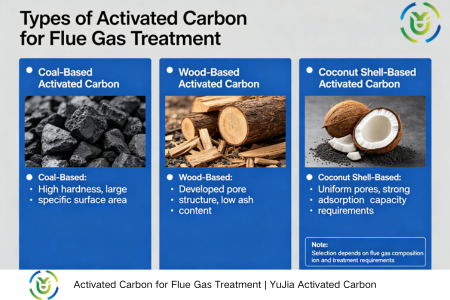
Common raw materials of activated carbon include coconut shell, coal and wood, with obvious performance differences. Coconut shell activated carbon with developed pores and strong adsorption is suitable for high-precision purification, but the cost is high; coal-based activated carbon with high mechanical strength, large adsorption capacity and high cost-effectiveness is the mainstream choice for industrial flue gas treatment; wood-based activated carbon with uniform pore structure is good for organic pollutant adsorption and suitable for VOCs treatment. Activated carbon of different raw materials has different stability under high temperature and high humidity working conditions, and should be selected in combination with the site conditions.
For specific pollutants, the corresponding impregnation type of activated carbon must be selected. To remove mercury from waste incineration flue gas, brominated impregnated activated carbon is preferred; to remove hydrogen sulfide and acidic gas, acid-base impregnated activated carbon is preferred; to remove dioxin, compound impregnated activated carbon is preferred. Ordinary activated carbon without targeted impregnation has very poor removal effect on heavy metals and highly toxic organic compounds, and cannot meet the emission standards, so do not blindly use it.
Flue gas temperature, humidity, composition, flow rate, will affect the adsorption effect of activated carbon. High temperature will reduce the adsorption capacity of activated carbon, and even lead to the desorption of pollutants; high humidity, water will block the pores, reducing the adsorption efficiency; flue gas with high dust content will cover the activated carbon pores in advance, shortening the service life. When selecting the type, we should fully consider the site temperature, humidity, contact time, system design, and if necessary, do pretreatment in advance to ensure that the activated carbon plays the best performance.
The dosage of activated carbon is directly related to the treatment cost and purification effect. If the dosage is insufficient, the removal of pollutants will not reach the standard; if the dosage is too high, it will cause waste of materials, increase the operation and maintenance cost, and increase the burden of dust removal equipment. Need to combine the amount of flue gas, pollutant concentration, emission standards, scientific calculation of the dosage, balancing the cost and the effect of treatment, through the small test, pilot test to determine the optimal dosage ratio, to achieve the maximum cost-effective.
Activated carbon flue gas treatment system, the rationality of the design directly affects the operating effect. Activated carbon injection system (ACI), to ensure uniform injection, so that the activated carbon and flue gas fully mixed to extend the residence time; equipment to be compatible with bag filter, electrostatic precipitator, to avoid the activated carbon dust clogging equipment, affecting the effect of dust removal; to ensure that sufficient residence time, so that the activated carbon to fully adsorb the pollutants to enhance the purification efficiency; and at the same time, we should take into account the wear and tear of the activated carbon on the downstream equipment, the impact of plugging, and do a good job of protection design to reduce the equipment failure rate. At the same time, we should consider the influence of activated carbon on the wear and clogging of downstream equipment and do a good job in protection design to reduce the failure rate of equipment.
In the actual selection process, many enterprises are prone to fall into the misunderstanding, resulting in poor governance effect and cost waste. Firstly, they only look at the price and choose low-priced low-quality activated carbon, with insufficient adsorption capacity and high impurity content, which can’t meet the emission standards; secondly, they ignore the composition of the flue gas and blindly choose general-purpose activated carbon, which is poor in pertinence and ineffective for special pollutants; thirdly, they ignore the need for impregnation and use ordinary activated carbon instead of special impregnated carbon, which makes it difficult to remove pollutants such as mercury, dioxins, etc.; fourthly, they choose the wrong particle size, and the pressure drop is too high, or purification is not Fifth, the lack of pilot test, directly purchased in large quantities, which does not match with the working conditions on site.
Before selecting activated carbon, performance test must be done, which is divided into laboratory test and on-site pilot test. Laboratory tests can detect the specific surface area, pore structure, adsorption capacity and other basic indicators of activated carbon; field pilot test can simulate real working conditions, verify the purification efficiency, service life, dosage, and the results are more in line with the actual. The core assessment indicators are pollutant removal efficiency, penetration time, the longer the penetration time, the more stable the performance of activated carbon. At the same time, we should pay attention to the technical support of the supplier, professional manufacturers can provide testing, commissioning, operation and maintenance of one-stop services to protect the governance effect.
Flue gas treatment can not only look at the unit price of activated carbon procurement, to account for the full life cycle costs, including procurement, transport, dosing, replacement, disposal and other costs. Balance the purification efficiency, dosage and replacement frequency, choose stable performance and renewable granular carbon to reduce the frequency of replacement; optimise the spraying and adsorption system to enhance the utilisation rate of activated carbon and avoid wastage. In the long run, although the unit price of high-quality activated carbon is on the high side, its long service life and high purification efficiency can reduce the trouble of operation and maintenance, lower the risk of compliance, and realise long-term operating cost savings.
The selection of suppliers directly determines the quality of activated carbon and follow-up services. First of all, we should look at the quality qualification, with relevant environmental protection certification, quality inspection reports, stable product quality, small batch differences; secondly, we should have the ability to customise, according to the site conditions, pollutant types, customised exclusive activated carbon; furthermore, we should have the experience of the flue gas treatment industry, be familiar with the conditions of major industries, and be able to provide professional advice on the selection of models; and finally, we should have perfect technical support and after-sales service, including testing, commissioning, operation and maintenance guidance, emergency treatment and other services, to solve the problem of using activated carbon. Finally, there should be perfect technical support and after-sales service, including testing, debugging, operation and maintenance guidance, emergency treatment and other services to solve all kinds of problems in the process of use.
Activated carbon is the core material for deep flue gas treatment, and whether the selection and use are reasonable is directly related to whether the flue gas can meet the emission standards. There is no uniform standard of activated carbon for flue gas treatment, so it is necessary to combine the target pollutants, working conditions, system design, select the appropriate type and specification, avoid the selection of misunderstanding, and do a good job in performance testing and cost optimisation. To achieve efficient, economical and stable flue gas purification, customised solutions is the key, enterprises should not blindly select the type, it is recommended to consult the professional and technical team, combined with the actual situation on the site, to develop the optimal treatment plan, not only to meet the environmental requirements, but also to control the operating costs.
For flue gas mercury removal, bromine impregnated or sulphur impregnated modified activated carbon is preferred. This kind of activated carbon has undergone special modification treatment, which can greatly improve the adsorption affinity for mercury, and the target removal effect is much better than that of ordinary activated carbon, and it is the special material used for waste incineration and power plants to remove mercury.
The smaller the particle size, the larger the contact area between the activated carbon and the flue gas, the faster the adsorption speed, the higher the purification efficiency, but it will increase the pressure drop of the equipment, easy to block the filter; the larger the particle size, the smaller the operational resistance, easy to operate and maintain, but the adsorption speed becomes slower, the purification efficiency will be reduced, and the need to balance the selection according to the type of process.
High-quality activated carbon can remove a variety of mixed pollutants at the same time, not only adsorption of dust, heavy metals, but also adsorption of VOCs, dioxins, acid gases, broad-spectrum activated carbon suitable for the composition of complex flue gas. For special pollutants, with the impregnation modification process, multi-pollutant synergistic treatment can be realised.
The dosage of activated carbon needs to be calculated in combination with the flue gas emission, initial concentration of pollutants, emission standards, and adsorption capacity of activated carbon. Usually, the basic dosage is measured through a small test in the laboratory, and then adjusted through a pilot test in the field to determine the optimal dosage, which can also be calculated by the assistance of a professional supplier.