Air purification, as a key means to improve air quality, has been widely used in many scenarios, such as household, industry, vehicles, etc. Among the many purification materials, activated carbon, with its unique advantages, has become the core choice to deal with gaseous pollutants, odours and volatile organic compounds (VOCs), and has been used to form a complementary system with traditional filters, such as HEPA, to build a more comprehensive air purification system. In this article, we will analyse the characteristics, working principle, application scenarios and selection methods of activated carbon to help you fully understand the important role of activated carbon in air purification.
With the advancement of industrialisation and urbanisation, the problem of air pollution is becoming increasingly serious. Outdoor industrial exhaust, car exhaust, haze and other pollution; indoor furniture, paints and other harmful gases such as VOCs, formaldehyde and other harmful gases will be released, and oil smoke, odours will also exacerbate the pollution. People spend 80%-90% of their time indoors every day, indoor pollution is even more harmful, efficient air purification has become a necessity.
Prolonged exposure to polluted air can be harmful to human health, short-term headache, sore throat and other discomforts, long-term may increase the risk of respiratory and cardiovascular diseases and even cancer. Especially for the elderly, children, pregnant women and other susceptible people more obvious harm, which also prompted families and businesses to pay attention to air purification, choose a highly efficient programme.
Traditional air filters can only deal with particulate matter, and are powerless to deal with gaseous pollutants and odours. Activated carbon makes up for this shortcoming by adsorbing VOCs, harmful gases and odours efficiently with its unique porous structure. It does not require complex chemical reactions, is simple to operate, safe and environmentally friendly, widely applicable, and is a core component of the air purification system.
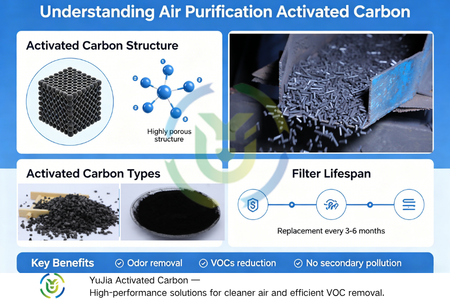


Activated carbon is a kind of carbon material with a highly porous structure, which forms a large number of tiny pores inside the carbon molecules through a special activation process. These pores are connected to each other, constituting a huge specific surface area – the surface area of each gram of activated carbon can be up to hundreds or even thousands of square metres, and this unique structure is precisely the key to its strong adsorption ability. This unique structure is the key to its strong adsorption capacity. Unlike ordinary carbon materials, the porous structure of activated carbon provides sufficient adsorption sites for gaseous molecules, thus realising efficient capture of pollutants without the need for complex chemical reagents, which is extremely safe.
Coconut shell activated carbon: one of the most widely used raw materials, with developed pore structure, strong adsorption capacity, environmental protection and renewable advantages, and natural materials, suitable for home, office and other scenes that require high security.
Coal-based activated carbon: made of coal as raw material, with lower cost and large adsorption capacity, mainly used in industrial scenarios, such as factory exhaust gas treatment, sewage treatment, and so on.
Wooden activated carbon: made of wood, wood chips, etc. It is affordable, widely available and has moderate adsorption performance, which is suitable for ordinary scenes with low purification requirements, such as simple air purifier and odour adsorption.
|
Types |
characteristics |
Scenarios |
|
Granular activated carbon |
Granular, uniform pore space, fast adsorption speed |
Home air purifiers, offices, etc., to remove indoor VOCs and odours |
|
Columnar activated carbon |
Columnar, high mechanical strength, not easy to be pulverised, high adsorption capacity. |
Industrial scenarios such as factory exhaust treatment, large-scale industrial air purification equipment, etc. |
|
Powdered Activated Carbon |
Powdery, large specific surface area, high adsorption efficiency, not easy to recycle |
Large-scale scenarios such as large-scale industrial exhaust treatment and odour control in wastewater treatment plants. |
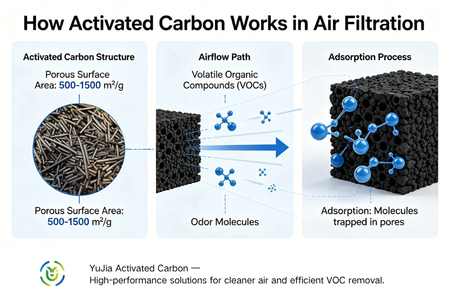
The core principle of industrial adsorption of activated carbon is to make use of its highly porous structure to efficiently capture gaseous pollutants, harmful gases and odours in industrial waste gas. When the industrial exhaust gas passes through the activated carbon adsorption layer, the pollutant molecules are firmly adsorbed in the pores of the activated carbon with the help of intermolecular van der Waals gravity, so as to realise the purification of the exhaust gas to meet the standard. Unlike the domestic scene, industrial exhaust gas has a high concentration, complex composition and large air volume, so the pores of industrial activated carbon (mostly columnar and powdered) are more developed and have a larger adsorption capacity. The adsorption process is a physical reaction without secondary pollution, which can effectively reduce the cost of industrial waste gas treatment and environmental risks.
Industrial production of exhaust gas composition is complex, including a variety of volatile organic compounds, harmful gases and odours, such gaseous pollutants are difficult to remove through simple physical interception, and activated carbon is just the right solution to this problem. Its strong adsorption capacity can cover most of the gaseous pollutants in industrial waste gas, and according to the composition of the waste gas, different types of activated carbon with different modification processes (e.g., impregnated activated carbon) can be selected to achieve accurate adsorption of specific harmful gases. Activated carbon can be flexibly adapted to the high air volume and high pollution scenarios of the industrial exhaust gas treatment system, and with the corresponding adsorption equipment, it can realise continuous and highly efficient exhaust gas purification, and help the enterprise to meet the requirements of environmental protection emissions.
Activated carbon air filter: the most common type, mainly used in family air purifiers, HVAC air conditioning systems, office air purification equipment, simple structure, easy to replace, can effectively improve indoor air quality.
Honeycomb activated carbon filter: with honeycomb structure, good air permeability, low wind resistance and large adsorption capacity, mainly used in industrial air treatment, such as factory exhaust purification, workshop air filtration, etc. It can adapt to high air volume and high pollution scenarios.
Impregnated activated carbon filter: special chemical reagents are impregnated on the surface of activated carbon, which can target the removal of specific harmful gases, such as ammonia, hydrogen sulphide, etc. It is mainly used in sewage treatment plants, rubbish disposal stations, chemical factories and other scenarios where the concentration of odour and harmful gases is high.
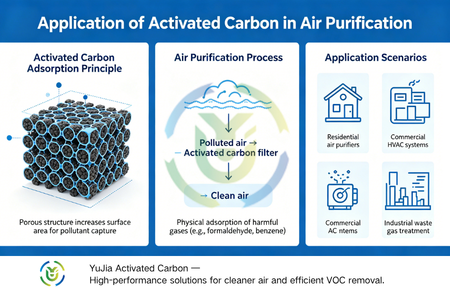
In household scenarios, activated carbon is widely used in air purifiers, deodorant boxes, refrigerator deodorants and other products to effectively remove formaldehyde, benzene and other VOCs remaining after renovation, as well as kitchen fumes, pet odours, second-hand smoke and so on, so as to create a healthy indoor environment for family members. In the office, activated carbon air purification equipment can improve air quality in the office, reduce fatigue and lack of concentration caused by air pollution, and enhance employee productivity.
The industrial production process produces a large number of harmful gases and odours, such as exhaust gases from chemical plants and volatile organic compounds (VOCs) from the manufacturing industry, etc. These pollutants, if discharged directly, will seriously pollute the environment. With its strong adsorption capacity, activated carbon is widely used in the exhaust gas treatment system of chemical, manufacturing, metallurgy and other industries, which can effectively adsorb the harmful gases in the exhaust gas, reduce the emission of pollutants, and help the enterprises to meet the environmental protection standard and realise green production.
Activated carbon can play an important role in odour control in some scenarios with high odour concentration, such as sewage treatment plants, waste treatment stations, farms, etc. By adsorbing odour molecules, it reduces the spread of odours, improves the quality of the surrounding environment, protects the health of the staff and reduces the impact on the surrounding residents.
The interior space of the car is small, and the air conditioning system and interior materials will release harmful gases such as VOCs and formaldehyde, plus the infiltration of external exhaust, so the air quality inside the car is often poor. Activated carbon car cabin air filter can effectively adsorb harmful gases and odours in the car, improve the air quality inside the car, and provide a healthier environment for car owners and passengers.
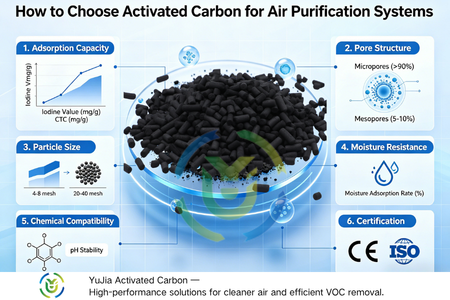
According to the application scenarios, choose the appropriate mesh size. For family scenarios, it is suitable to choose granular activated carbon with finer mesh for higher adsorption efficiency; for industrial scenarios, it is possible to choose columnar or granular activated carbon with coarser mesh, which can take into account both the adsorption capacity and the air volume, and is suitable for the industrial high air volume processing needs.
Iodine value is an important index to measure the adsorption capacity of activated carbon, the higher the iodine value, the larger the adsorption capacity and the better the purification effect. Household and industrial scenes can choose activated carbon with appropriate iodine value according to the degree of pollution, of which industrial high-pollution scenes need to prioritise the use of products with high iodine value.
Family scenarios give priority to granular activated carbon (GAC), which is easy to replace and has good purification effect; industrial scenarios can choose columnar activated carbon, which has high mechanical strength and long service life, and is suitable for long-term continuous operation; large-scale industrial treatment can choose powder activated carbon, which has high adsorption efficiency and is suitable for batch exhaust gas treatment.
Priority should be given to activated carbon with high-quality raw materials, such as coconut shell activated carbon, with better adsorption performance and more environmentally friendly; coal and wood activated carbon can be selected according to the budget and demand, in which coal activated carbon is commonly used in industrial scenes, and attention should be paid to its purity and adsorption performance to ensure that it meets the exhaust gas treatment standards.
Activated carbon has a unique highly porous structure, which can efficiently adsorb VOCs, harmful gases, odours and other pollutants in industrial exhaust gases and various scenarios, and it is especially suitable for industrial high-concentration pollution scenarios, with stable and significant purification effects.
It is made of natural raw materials such as coconut shell, coal, wood, etc. The adsorption process is a physical reaction without complex chemical reagents, which will not produce secondary pollution; and part of the industrial activated carbon can be recovered and regenerated, which is in line with the enterprise’s concept of green production and reduces the cost of environmental protection treatment.
Taking into account the family, office, industry, automotive and other types of scenes, especially in the industrial field, can be flexibly adapted to the chemical industry, manufacturing, metallurgy and other industries of the exhaust gas treatment, as well as sewage treatment plants, rubbish treatment stations, odour control, to meet the purification needs of different scenarios.
Under the premise of reasonable design and proper maintenance, activated carbon and activated carbon filters have a long service life, especially industrial columnar activated carbon, with high mechanical strength and low loss, which can run stably for a long time and reduce the cost of late replacement for enterprises and families, with an outstanding cost-effectiveness.
There is a clear upper limit to the adsorption capacity of activated carbon, which cannot infinitely adsorb industrial waste gas and pollutants in various scenarios. When the pores inside the activated carbon are completely filled with gaseous pollutants and odour molecules and reach the adsorption saturation state, its purification capacity will drop sharply, or even completely lose its purification effect. Normally, the replacement cycle of activated carbon is 3-6 months, and the specific replacement time needs to be flexibly adjusted in combination with the pollution level of the use scene. If the saturated activated carbon is not replaced in time, it will not only fail to purify the air effectively, but also may lead to the desorption of the adsorbed pollutants and re-release them into the air to cause secondary pollution, therefore, regular checking and replacing is the key to guaranteeing the effectiveness of activated carbon.
The adsorption performance of activated carbon is sensitive to environmental humidity, and high humidity will seriously affect its adsorption efficiency. This is because water molecules will preferentially occupy the pore space of activated carbon and compete with gaseous pollutant molecules to form adsorption, resulting in a significant decrease in the adsorption capacity of activated carbon for harmful gases and odours. When using activated carbon in humid environments, it is necessary to control the environmental humidity with dehumidification equipment or choose special industrial activated carbon with moisture-proof treatment to avoid affecting the adsorption effect due to humidity and to ensure that the purification work advances stably.
Activated carbon is not an all-purpose purification material, and its adsorption capacity has certain limitations, and its adsorption effect on some inorganic gases (e.g., carbon monoxide, carbon dioxide) is poor, which can’t be effectively removed by ordinary activated carbon. Exhaust gases in industrial scenarios are complex in composition and often contain a variety of gases that are difficult to adsorb, so it is necessary to use activated carbon that has been impregnated and modified to enhance the adsorption capacity of the target gases by loading specific chemical reagents on the surface of the activated carbon to achieve targeted purification. When choosing activated carbon, enterprises need to test the composition of the exhaust gas in advance, combine the types and concentrations of pollutants, and reasonably choose ordinary or modified activated carbon, so as to avoid blindly using activated carbon, which may lead to substandard purification and increase the risk of environmental compliance.
In the future, modified activated carbon will become the core direction of research and development, through chemical modification, physical modification and other refined processes, targeted optimisation of the pore structure and surface activity of activated carbon, to enhance its adsorption capacity for specific pollutants. We will focus on the research and development of special modified activated carbon for formaldehyde, ammonia, hydrogen sulphide and other harmful gases commonly used in industry to solve the problem of poor adsorption effect of ordinary activated carbon on some pollutants, and to further expand the application scope of activated carbon in industrial scenarios.
In the future, activated carbon air purification technology will break the single adsorption mode, and deeply integrate with advanced purification technologies such as photocatalyst, anion, plasma, etc., to build a dual purification system of ‘adsorption+decomposition’, and to improve the efficiency of industrial waste gas treatment. Through the integration of technology, activated carbon is responsible for adsorption of gaseous pollutants and odours in the waste gas, and advanced technology is responsible for decomposition of adsorbed pollutants into harmless substances, which not only enhances the purification efficiency, but also prolongs the service life of activated carbon, and reduces the comprehensive cost of waste gas treatment for enterprises.
As global environmental protection policies continue to tighten and the standards for industrial exhaust gas emissions in various countries become increasingly stringent, the demand for activated carbon in the industrial sector will continue to climb, becoming the core market and growth driver for the application of activated carbon. Especially in the chemical, manufacturing, metallurgy, sewage treatment and other industries, the demand for waste gas treatment and odour control is urgent. With the advantages of high efficiency, environmental protection and low cost, activated carbon will play a more important role in industrial waste gas purification, and the market scale will continue to expand.
Q1: Why can activated carbon effectively purify air?
A: Activated carbon has a highly porous structure with a huge specific surface area, which can firmly adsorb gaseous pollutants and odour molecules in the air inside the pores through physical adsorption to achieve air purification without chemical reaction, which is safe and efficient.
Q2: What pollutants can activated carbon remove from the air?
A: It can mainly remove VOCs (e.g. formaldehyde, benzene, toluene), harmful gases (e.g. ammonia, hydrogen sulphide), odours (e.g. grease, pet odour, rubbish odour), etc. It has no obvious purification effect on particles (e.g. dust, PM2.5), and it needs to be paired with HEPA filter.
Q3: How long is the service life of activated carbon filter?
A: The service life mainly depends on the pollution degree and air volume of the use scene, generally 3-6 months. The more serious the pollution, the shorter the service life, when the purification effect is found to be significantly reduced, the odour can not be effectively removed, need to be replaced in time.
Q4: Which type of activated carbon is most suitable for removing VOCs?
A: Granular activated carbon (GAC) and impregnated activated carbon are the most suitable for removing VOCs. granular activated carbon has a fast adsorption speed, which is suitable for home and office scenarios; impregnated activated carbon has been modified to have a more prominent adsorption effect on specific VOCs.
Q5: Can activated carbon remove odour from industrial waste gas?
A: Yes. With its strong adsorption capacity, activated carbon can effectively adsorb odour molecules in industrial waste gas, which is especially suitable for odour control in scenarios such as wastewater treatment plants, rubbish treatment stations, chemical plants, etc. It is a commonly used material for industrial odour treatment.
In today’s increasingly important air purification, activated carbon, with its efficient adsorption capacity, a wide range of applicable scenes, environmental protection and safety advantages, has become the core material in the air purification system, whether it’s home, office or industrial scenes, can play an important role. Through the analysis of this article, I believe you have a comprehensive understanding of the characteristics, working principle, and selection method of activated carbon. Choose high-quality activated carbon, with a reasonable purification system, in order to effectively improve air quality, guard your own and your family’s health, and at the same time help enterprises green production, promote the development of environmental protection.