As a core material in the field of adsorption, activated carbon is widely used in water treatment, air purification, chemical production and other industrial scenarios. Its adsorption efficiency, service life and system operating costs are not only affected by the specific surface area and pore size, but also by the mesh size, which is a very easy to be ignored but crucial factor. Many enterprises in the selection, often only focus on the specific surface area of activated carbon, but ignored the mesh size of the overall performance of the decisive role – choose the right mesh size, in order to maximise the adsorption value of the activated carbon, while reducing equipment loss and operation and maintenance costs. In this article, we will analyse the definition and classification of mesh size, as well as its core impact on the performance of activated carbon, to help you accurately select and avoid misunderstandings.
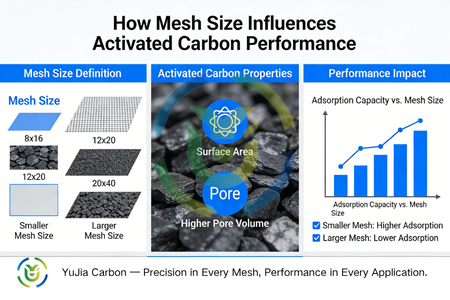
The mesh size (mesh number) is the core index for measuring the size of activated carbon particles, which is measured by the U.S. mesh standard (U.S. mesh standard), and refers to the number of holes in the screen mesh per inch (25.4 mm) of length. Simply put, the higher the mesh number, the smaller the pore size of the sieve mesh, and the finer the activated carbon particles that pass through the mesh; conversely, the lower the mesh number, the coarser the particles. For example, 4 x 8 mesh activated carbon means that the particles can pass through a 4 mesh sieve, but not an 8 mesh sieve, and the particle size is in the corresponding interval.
The mesh size directly determines the approximate diameter of the activated carbon particles, and there is a negative correlation between the two: the higher the mesh number, the smaller the diameter of the particles; the lower the mesh number, the larger the diameter of the particles. In order to understand more intuitively, here are some examples of conversion between common mesh size and micron (μm): 4×8 mesh corresponds to a particle diameter of about 2.36-4.75mm, 8×30 mesh to 0.595-2.36mm, 12×40 mesh to 0.38-1.68mm, 80-300 mesh to 1.68mm, 12×40 mesh to 0.38-1.68mm, and 80-300 mesh to 1.68mm. 1.68mm, 80-325 mesh (powdered activated carbon) is less than 0.18mm, these values are the most commonly used reference standards in industrial selection.
|
mesh specification |
Core Characteristics |
Core Application Scenarios |
|
4×8mesh |
Coarse particles, good air permeability, stable structure |
Gas adsorption, solvent recovery |
|
8×30 mesh |
Strong versatility with both adsorption speed and resistance. |
Water treatment, air purification |
|
12×40 mesh |
Fine particles, fast adsorption speed |
VOCs removal, chlorine adsorption |
|
20×50 mesh |
Finer particles, high efficiency, high resistance |
Small equipment, short-term emergency adsorption |
|
80-325 mesh (PAC) |
Extremely fine particles, high specific surface area, fastest adsorption speed |
Water treatment decolourisation, emergency adsorption |
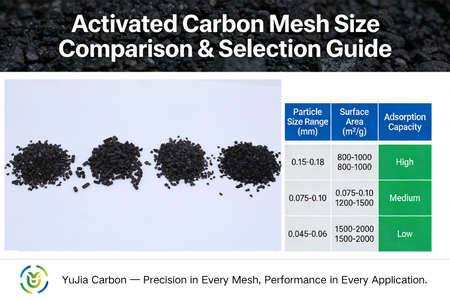
Fine-grained activated carbon has a larger external specific surface area, and pollutants can come into contact with the surface of activated carbon and be adsorbed faster, with fast adsorption speed, which is especially suitable for removing pollutants such as VOCs, chlorine and heavy metals. However, the disadvantage is obvious, the adsorption saturation speed is fast, and it is easy to appear the phenomenon of ‘ditch flow’ (the fluid preferentially passes through the gap of the particles quickly, and does not fully contact the activated carbon), resulting in a decline in the adsorption efficiency.
Coarse particles of activated carbon have a smaller external surface area, so the adsorption speed is slower, but the structure is more stable, and the saturation speed of adsorption is relatively slower, which is suitable for scenarios that do not require a high adsorption speed, but require long-term operation.
In formaldehyde gas-phase adsorption, the initial adsorption speed of 12×40 mesh activated carbon is much faster than that of 8×30 mesh, but because of the finer particles, it is easy to be blocked and worn out, and the replacement frequency is about 30% higher than that of 8×30 mesh.
Empty bed contact time (EBCT) is a key parameter to measure the adsorption efficiency, referring to the time the fluid stays in the activated carbon bed. mesh size directly affects the EBCT and the system pressure drop, and the two need to be dynamically balanced.
Fine-grained activated carbon will increase the bed resistance, resulting in slower fluid flow, longer EBCT, and higher adsorption efficiency, but higher system pressure drop – too high a pressure drop will increase the load on the pump, reduce the system capacity, and even increase equipment losses.
The bed resistance of coarse granular activated carbon is small, the fluid flow rate is fast, and the pressure is lowered, which can ensure the high treatment capacity of the system, but the EBCT is shortened, and the adsorption efficiency will be reduced.
When selecting industrial systems (such as water treatment columns, air scrubbing towers, gas adsorption towers), the contact time and pressure drop must be balanced: for example, in water treatment systems, 8×30 mesh or 12×40 mesh activated carbon can take into account the fast adsorption and controllable pressure drop, and is the most commonly used choice.
Coarse granular activated carbon has a more complete particle structure and higher mechanical strength, which can better resist the collision during handling and loading, as well as the scouring of fluids during operation, and is less prone to breaking and generating dust, which makes it suitable for industrial scenarios of continuous operation.
Fine-grained activated carbon is brittle and easy to break, and the dust generated will block the bed layer, affect fluid distribution, and even damage downstream equipment and increase maintenance costs, so it is only suitable for short-term emergency adsorption scenarios.
For industrial scenes with continuous operation (such as continuous water treatment and gas purification systems), coarse-grained activated carbon is preferred to reduce dust generation and particle loss and prolong the service life of the bed layer; while for short-term emergency adsorption scenes (such as sudden water pollution control), fine-grained activated carbon can be used, sacrificing part of the mechanical strength in exchange for higher adsorption efficiency.
The diffusion path of fine-grained activated carbon is short, and pollutants can be desorbed more easily from the inside of the particles, and the regeneration speed is faster and more complete, but during the regeneration process, the fine particles are easy to be depleted due to high temperature and chemical reaction, and the rate of physical loss is high, and the volume of the bed layer will be obviously reduced after long-term regeneration, so it is necessary to frequently replenish the new charcoal.
Coarse particles of activated carbon have a long diffusion path, slow regeneration, and need a longer regeneration cycle, but the particles are tough, and the physical loss during regeneration is low, so the service life is longer.
In the VOCs recovery system, enterprises mostly use 4×8 mesh or 6×12 mesh coarse granular activated carbon, which can reduce the carbon loss during regeneration and lower the long-term operation cost, although the regeneration cycle is long.
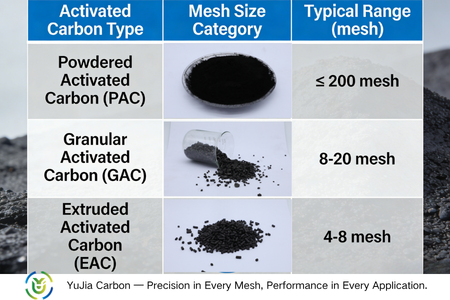
The mesh size is 80-325 mesh and the particle diameter is less than 0.18mm, which belongs to powdered activated carbon with extremely fine particles and good dispersion. The particle size of this type of activated carbon is much smaller than that of other types, which can be quickly dispersed in the fluid and fully contacted with the pollutants, laying the foundation for efficient adsorption. Its fine particle size also determines its adsorption rate and the specificity of application scenarios.
It has the largest specific surface area and the fastest adsorption speed; the advantage is that it has high adsorption efficiency and can quickly capture trace pollutants in the fluid, which is suitable for short-term high-efficiency adsorption needs. The disadvantage is that it is difficult to recover, not easy to separate after use, need to be replaced frequently, and in large-scale industrial applications, it is difficult to store, put and handle, and the operation and maintenance cost is relatively high.
Water treatment decolourisation, emergency adsorption, food and beverage polishing, etc. It is especially suitable for short-time operation with high requirements on adsorption speed. In water treatment, it can quickly remove water pigment and odour, in emergency adsorption, it can quickly deal with sudden pollution, and in the food and beverage industry, it is used for product purification, removing impurities in production and improving product quality.
The mesh size ranges from 20 x 50 mesh to 4 x 8 mesh, with particle diameters ranging from 0.2 to 5 mm. The particle size is moderate, between powdered activated carbon and extruded activated carbon. This size of particles can ensure a certain adsorption surface area and avoid excessive bed resistance caused by too fine particles, which is the most widely used specification range in the industry.
Better balance between adsorption performance and fluid mobility, repeatable regeneration, able to restore adsorption capacity through thermal regeneration, chemical regeneration and other ways to reduce long-term operating costs.
Advantage is strong versatility, suitable for a variety of industrial scenarios. Disadvantage is that the adsorption speed is slightly lower than that of PAC, but its comprehensive performance is balanced, and it is the most widely used type of activated carbon in the industry.
Water treatment, air purification, industrial wastewater treatment and other scenes, suitable for most of the conventional adsorption needs. Whether it is the purification of drinking water, industrial wastewater treatment, or air purification in workshops, it can play a stable adsorption role, taking into account the processing efficiency and operational stability, and is the mainstream choice in the field of industrial adsorption.
The mesh size corresponds to particles with a diameter of 1 mm or more, mostly columnar particles with regular morphology and high hardness. This larger particle size makes it mechanically stronger than other types, able to withstand long-term fluid washout and handling collisions, and less prone to breakage and dust generation.
The highest mechanical strength and extremely low dust content can effectively avoid dust blocking pipelines and damaging downstream equipment during operation; the advantages are long service life, low maintenance costs, and long-term continuous operation.
The disadvantage is that the specific surface area is relatively low, and the adsorption efficiency is slightly inferior to that of PAC and GAC, which is more suitable for scenarios requiring high durability.
Gas phase adsorption, solvent recovery, high-end air purification and other scenes, especially suitable for long-term continuous operation of the system. In solvent recovery, it can withstand repeated thermal regeneration; in high-end air purification, it can avoid dust pollution; and in gas phase adsorption, it can ensure stable airflow, which is suitable for harsh operation requirements.
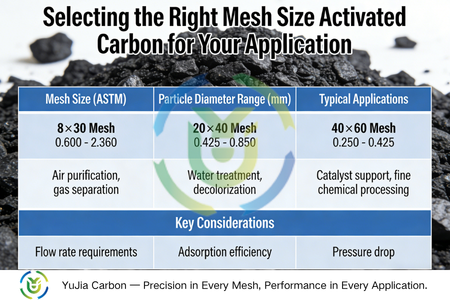
Priority is given to 8×30 mesh and 12×40 mesh activated carbon, these two specifications can well balance the pollutant removal rate and system pressure drop, which is suitable for the long-term continuous operation of water treatment and wastewater treatment. Whether treating domestic sewage or industrial wastewater, it can quickly adsorb organic matter, heavy metals and other pollutants in the water to ensure that the effluent meets the standard. At the same time, the reasonable particle size can avoid bed clogging, reduce the frequency of equipment operation and maintenance, taking into account the processing efficiency and operational stability.
Choose 4×8 mesh, 6×12 mesh, 8×16 mesh coarse particles of activated carbon, this type of specification particles of good permeability, can ensure the stability of the airflow in the air purification system, and effectively avoid the generation of fine particles of dust to prevent pipeline clogging and equipment damage. In VOCs removal scenarios, the structural stability of coarse particles can meet the long-term operational requirements of gas phase adsorption, which can efficiently adsorb volatile organic compounds while reducing the pressure drop of the system and energy consumption. It is suitable for indoor air purification, industrial workshop waste gas treatment and other gas phase adsorption scenarios.
Choose 4×8 mesh and 6×12 mesh coarse granular activated carbon, which has high mechanical strength and strong abrasion resistance, and can withstand repeated thermal regeneration in the solvent recovery process, which effectively reduces the physical loss of activated carbon and extends its service life. In the solvent recovery system, the bed resistance of coarse particles is small, which can ensure the smooth flow of solvent vapour and improve the recovery efficiency. At the same time, the adsorption capacity of this type of specification activated carbon is stable, and it can adsorb solvent molecules continuously and efficiently, reducing the operating cost and carbon consumption of the enterprise.
Choose 100-325 mesh powdered activated carbon (PAC), which has extremely fine particles, large specific surface area and fast adsorption speed, can quickly adsorb pigments, odours and trace impurities in the production process of food and beverages, and achieve product polishing and purification. It is suitable for decolourisation of fruit juice, removal of impurities from wine, purification of drinking water and other food and beverage related scenes, which can effectively improve the quality of the products and meet the hygiene standards of the industry.
At the same time, the rapid adsorption characteristics of powdered activated carbon can be adapted to the continuous operation of the production line without affecting the production efficiency.
Choose 6×12 mesh and 8×30 mesh activated carbon, these specifications can take into account the fluid flow rate and adsorption efficiency, suitable for the complex pollutant treatment needs of the chemical industry. The pollutants generated in chemical production have complex composition and variable concentration, and this type of activated carbon can not only ensure the smooth flow of chemical fluids to avoid system blockage, but also efficiently adsorb various organic pollutants, harmful gases and heavy metal ions. Meanwhile, its moderate mechanical strength can adapt to the harsh operating environment of chemical production and reduce maintenance costs.
Choose 6×12 mesh activated carbon, its high hardness of coarse particles can effectively avoid the abrasion and crushing in the process of gold recovery, reduce the loss of gold adsorption process, and improve the gold recovery rate. In the gold adsorption scenario, the moderate particle size of this specification can ensure the smooth flow of gold cyanide solution and provide sufficient adsorption sites to efficiently adsorb the gold ions in the solution. Meanwhile, its strong wear resistance can adapt to the long-term operation of the recovery system and reduce the operating costs of enterprises.
|
Type |
Core Advantages |
Core disadvantages |
|
Fine mesh activated carbon (high mesh) |
Fast adsorption and high efficiency for rapid removal of contaminants |
High pressure drop, low mechanical strength, easy to produce dust, fast wear and tear, and frequent replacement. |
|
Coarse mesh activated carbon (low mesh) |
Good fluidity, low pressure, high strength, wear-resistant, long life, low maintenance costs |
Slow adsorption speed, slightly lower initial adsorption efficiency. |
Many enterprises in the selection of activated carbon mesh size, easy to fall into the following misunderstandings, resulting in low adsorption efficiency, increased equipment loss, rising operating costs, must be avoided:
1.Blindly choose fine mesh activated carbon
It is believed that the higher the mesh number, the better the adsorption effect, not knowing that the fine particles will lead to too high a pressure drop, clogging equipment, especially not suitable for fixed-bed filters.
2.Ignore the pressure drop limit
Selection is only concerned about the adsorption efficiency, not considering the pressure capacity of the equipment, resulting in excessive load on the pump when the system is running, or even can not run normally.
3.Not combined with the type of pollutants selection
For example, when dealing with large molecule pollutants (such as dyes), selecting too fine mesh activated carbon, on the contrary, will affect the adsorption effect due to insufficient matching of pore size.
4.The mesh size does not match with the filtration equipment
For example, the selection of coarse granular activated carbon for small filtration equipment will lead to excessive fluid flow rate and insufficient adsorption; the selection of fine granular for large equipment will lead to excessive pressure drop.
Purchasing must be clearly marked mesh range (such as 12 × 40 mesh), to avoid vague specifications lead to receive the product does not meet the equipment requirements.
Require the supplier to provide a particle size distribution report to ensure that the activated carbon particles are uniform in size to avoid excessive fine powder or large particles.
Especially for continuous operation scenarios, suppliers should be required to provide hardness and wear resistance test reports, and choose products with low wastage rates.
Technical data sheet will be marked in detail mesh size, specific surface area, pore size distribution and other key parameters, which is an important reference for selection, and at the same time, you can ask the supplier to provide third-party test reports to ensure product quality.
Q: The higher the mesh number, the better the performance of activated carbon?
A: Not necessarily, the higher the mesh number, the faster the adsorption speed, but the higher the pressure drop and carbon loss, need to be balanced with the application scenario, there is no ‘the higher the better’, only ‘the more appropriate the better’.
Q: What is the difference between mesh size and pore size?
A: They are two different indicators: mesh size measures the size of the activated carbon particles, and pore size measures the diameter of the pores inside the activated carbon, the former affects the fluid flow and adsorption speed, and the latter affects the type of pollutants adsorbed (small molecules/macromolecules).
Q: Can the same mesh size activated carbon be used for both liquid phase and gas phase adsorption?
A: Not recommended. Liquid-phase adsorption (e.g., water treatment) requires a balance between adsorption speed and pressure drop, while gas-phase adsorption (e.g., VOCs removal) requires a balance between gas flow stability and abrasion resistance, and even if the mesh sizes are the same, it is necessary to choose a product that is optimised for the purpose.
Q: Does mesh size affect the replacement cycle of activated carbon?
A: Yes. Fine mesh activated carbon adsorption fast, fast loss, replacement cycle is shorter; coarse mesh activated carbon adsorption slow, low loss, replacement cycle is longer, usually coarse mesh replacement cycle is 1.5-2 times of fine mesh.
As the core parameter of activated carbon selection, mesh size directly affects the adsorption efficiency, system pressure drop, mechanical strength and service life, and even determines the operating cost of the whole adsorption system. When selecting activated carbon, do not blindly pursue a high mesh number, nor can you just look at the price and ignore the specifications, you need to combine your own application scenarios (water treatment/air purification/solvent recovery, etc.), pollutant types, equipment specifications, and balance the adsorption speed, pressure drop, and maintenance costs, in order to let the activated carbon to play the maximum value.
If you are still unsure of the appropriate mesh size, we recommend that you consult a professional activated carbon supplier, provide detailed application requirements and equipment parameters, obtain targeted selection advice, and if necessary, request samples for a small test to ensure accurate selection and avoid losses due to specification discrepancies.