Volatile organic compounds (VOCs) are a class of organic chemical substances with high vapour pressure and easy to evaporate at room temperature, which are widely present in various industrial production processes and are one of the main pollutants in industrial waste gas. Activated carbon, as an efficient adsorption material, plays an irreplaceable role in VOCs treatment, which not only effectively removes VOCs from exhaust gases and helps enterprises to meet the requirements of environmental regulations, but also reduces treatment costs and environmental and health risks. This article will focus on the basic knowledge of VOCs, the advantages of activated carbon in treating VOCs, and how to select high-quality activated carbon and other core content, to provide a comprehensive and practical reference guide for relevant enterprises and practitioners.
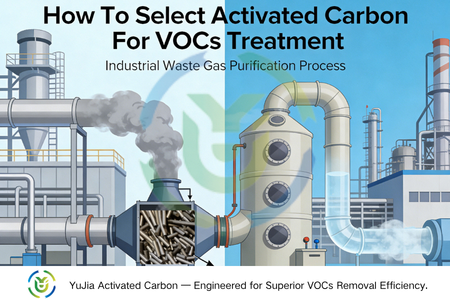
VOCs are Volatile Organic Compounds, the core definition of which is: organic chemical substances with high vapour pressure that volatilise easily into the air at room temperature and pressure. The distinctive feature of these substances is that they are highly volatile and can evaporate quickly from liquid or solid state at room temperature. They are widely found in many scenarios, such as industrial production and daily life, and their emissions can cause multiple impacts on the environment and human health.
There are a wide variety of common VOCs pollutants in industrial production, the most representative of which include: benzene, toluene, xylene, ethyl acetate, formaldehyde and so on. These substances are widely sourced from chemical production, paint coating, printing and packaging industries, which is one of the main culprits of air pollution, and is also the focus of activated carbon treatment.
The emission of VOCs will bring double harm, on the one hand, it will have a serious impact on the environment: as a precursor of ozone and PM2.5, VOCs will participate in photochemical reactions, exacerbate hazy weather and air pollution, and destroy the ecological balance; on the other hand, VOCs are toxic, and some of the substances (e.g., benzene, formaldehyde) are also carcinogenic, and long-term exposure or inhalation will cause damage to the human respiratory system and nervous system, seriously threatening human health. On the other hand, VOCs are toxic and some substances (such as benzene and formaldehyde) are carcinogenic, which will cause damage to the human respiratory system and nervous system through long-term exposure or inhalation, and seriously threaten human health. In addition, with increasingly stringent environmental regulations, companies must meet national and local standards for VOCs emissions or face penalties, so compliance with VOCs treatment is critical.
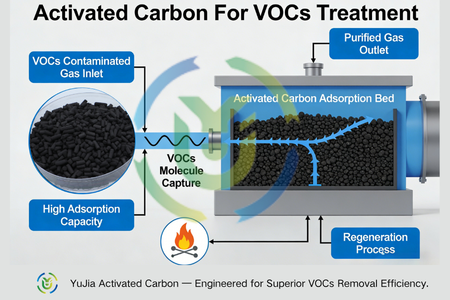
There are a wide range of industrial emission sources of VOCs, of which the key industries include: chemical manufacturing (e.g. organic synthesis, fine chemicals), coating and painting industry (e.g. furniture painting, automotive spray painting), printing and packaging industry (e.g. ink volatilisation), petroleum refining industry (e.g. oil and gas volatilisation), etc. The production process of these industries will continuously emit a large amount of VOCs, which, if not effectively treated, will seriously pollute the neighbouring environment and at the same time affect the compliant production of the enterprises.
Currently, VOCs treatment technologies mainly include adsorption, combustion, condensation, etc., of which activated carbon adsorption has become one of the most widely used and effective treatment technologies due to its unique advantages. Compared with other technologies, activated carbon adsorption method is simple to operate, low cost of treatment, wide range of application, can deal with a variety of types and different concentrations of VOCs, and can achieve regeneration and reuse of activated carbon, taking into account the effectiveness of the treatment and the economy, and therefore has become the preferred choice for VOCs treatment in most enterprises.
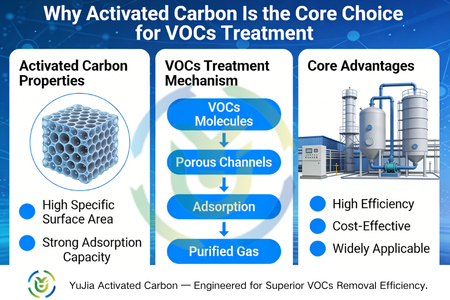
The core of activated carbon’s ability to adsorb VOCs efficiently lies in its unique physical structure: it has a very high specific surface area (usually up to 800-1500 square metres/g) and is filled with tiny pores. These microporous structures provide sufficient adsorption sites for VOCs molecules. When the exhaust gas containing VOCs passes through the activated carbon, the VOCs molecules are adsorbed and retained by the micropores, thus realising the purification of the exhaust gas. This mechanism of action based on physical adsorption can quickly and efficiently capture all types of organic gas molecules.
The adsorption of VOCs by activated carbon is mainly divided into two types: physical adsorption and chemical adsorption. Physical adsorption is based on the van der Waals force between molecules, the adsorption process is reversible, when the activated carbon adsorption is saturated, it can be regenerated through heating, blowing, etc. to restore the adsorption capacity; chemical adsorption is through the functional groups on the surface of the activated carbon and VOCs molecules to have a chemical reaction, the formation of stable chemical bonds, the adsorption process is not reversible, but the adsorption selectivity is stronger. In actual VOCs treatment, physical adsorption is more widely used and can meet the treatment needs of most scenarios.
Compared with other VOCs treatment technologies such as combustion method and condensation method, activated carbon adsorption method has three core advantages: first, high removal efficiency, which can effectively remove low concentration VOCs, and the removal rate can reach more than 90%; second, good cost economy, low investment in equipment, low operating costs, and activated carbon can be regenerated and reused, which significantly reduces the long-term treatment costs; third, wide range of applicability, which can deal with a wide range of VOCs, whether it is high concentration VOCs, such as benzene, toluene, formaldehyde and so on. Third, the scope of application is wide, can deal with benzene, toluene, formaldehyde, etc. A variety of VOCs, whether high concentration or low concentration of exhaust gas, can achieve effective treatment, to match the treatment needs of different industries.
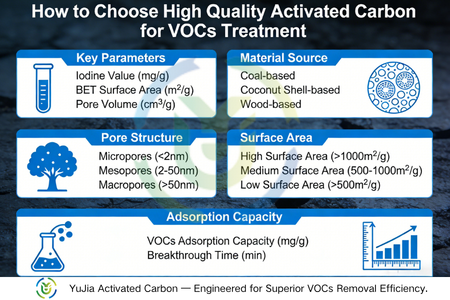
The raw material type of activated carbon directly determines its pore structure and adsorption performance, and activated carbon produced by different raw materials is applicable to different scenarios: coal-based activated carbon has a strong microporous structure and large adsorption capacity, which is applicable to the treatment of most of the VOCs and is cost-effective; coconut shell activated carbon has a higher hardness and a larger volume of micropores, which has a better adsorption performance, and is applicable to scenarios that require high adsorption efficiency; wood-based activated carbon has a more reasonable mesopore distribution, and wood-based activated carbon has a more reasonable mesopore distribution. Wooden activated carbon has a more reasonable mesopore distribution and is more suitable for adsorption of VOCs with larger molecular volume (e.g., macromolecular solvents). Enterprises can choose the appropriate raw material according to the type of VOCs they are dealing with.
Pore size distribution is one of the key indicators for selecting activated carbon, and the core principle is ‘matching the pore size with the molecular size of VOCs’. The pores of activated carbon are mainly divided into micropores (pore size less than 2 nm), mesopores (pore size 2-50 nm) and macropores (pore size more than 50 nm): micropores are mainly used for adsorption of small molecules of VOCs (e.g., formaldehyde, benzene), and mesopores are suitable for adsorption of macromolecules of VOCs (e.g., ethyl acetate, polycyclic aromatic hydrocarbons (PAHs)), and the balanced distribution of pore sizes can take into consideration the different molecular sizes of VOCs, and enhance the overall adsorption capacity and efficiency. efficiency. Therefore, the pore size distribution should be matched according to the molecular size of VOCs to be treated.
Specific surface area (usually measured by BET method) is the core index for measuring the adsorption capacity of activated carbon. Generally speaking, the larger the specific surface area is, the more adsorption sites the activated carbon has and the stronger the adsorption capacity is. The specific surface area of activated carbon used for VOCs treatment is usually between 800-1500 square metres/g. Too low a specific surface area will lead to insufficient adsorption efficiency, while too high a specific surface area may increase the cost, so it is necessary to choose activated carbon with a suitable specific surface area according to the actual treatment needs.
Adsorption capacity is a direct index for evaluating the adsorption performance of activated carbon, and commonly used evaluation parameters include butane working capacity, carbon tetrachloride (CTC) activity, and VOCs penetration time. Butane working capacity reflects the adsorption capacity of activated carbon for small molecule VOCs, CTC activity is used to measure the overall adsorption performance of activated carbon, and the longer the VOCs penetration time is, the greater the adsorption capacity and the longer the service life of the activated carbon. These key indicators should be paid attention to when selecting to ensure that the activated carbon can meet the capacity requirements of actual treatment.
There are three common particle forms of activated carbon used for VOCs treatment: granular activated carbon (GAC), columnar activated carbon, and powdered activated carbon (PAC). Among them, columnar activated carbon is the preferred form for gas-phase VOCs adsorption due to lower pressure drop, better airflow distribution and longer service life; granular activated carbon is suitable for fixed-bed adsorption devices, and powder activated carbon is mainly used for emergency treatment or adsorption of low concentration VOCs, which enterprises can choose according to the type of treatment equipment and scenario needs.
The mechanical strength and hardness of activated carbon are crucial in industrial VOCs treatment systems. If the mechanical strength is insufficient, the activated carbon is prone to abrasion and crushing during use, generating dust, which not only reduces the adsorption efficiency, but also may block the equipment pipeline, increase the system pressure drop and affect the stable operation of the treatment system. Therefore, it is necessary to ensure that the activated carbon has sufficient mechanical strength to avoid the reduction of the treatment effect caused by abrasion.
The moisture content of the activated carbon directly affects its adsorption efficiency, as moisture will occupy the adsorption sites of the activated carbon and reduce the adsorption capacity of VOCs, especially in high humidity environments, and this effect is more obvious. Therefore, activated carbon used for VOCs treatment should be selected with lower moisture content to ensure the stable play of its adsorption performance.
VOCs concentration is the basic factor affecting the selection of activated carbon: for high concentration of VOCs exhaust gas, activated carbon with large adsorption capacity and excellent regeneration performance should be preferred to ensure that a large number of VOCs molecules can be efficiently accommodated and processed; for low concentration of VOCs exhaust gas, more cost-effective activated carbon can be selected to reduce the operation cost under the premise of ensuring the treatment effect.
Temperature has a significant effect on the adsorption capacity of activated carbon, and high temperature will significantly reduce the adsorption performance of activated carbon. Therefore, if dealing with high temperature waste gas, it is necessary to specially select high temperature resistant activated carbon to avoid adsorption efficiency decline due to high temperature and ensure stable treatment effect.
Gas humidity will interfere with the adsorption effect of activated carbon, moisture will occupy the adsorption sites of activated carbon, weakening its adsorption capacity of VOCs, especially in high humidity environment, this effect is more prominent. Therefore, under high humidity environment, it is necessary to choose the activated carbon with strong anti-humidity interference ability and low moisture content to guarantee the adsorption performance.
Excessive airflow speed and insufficient contact time between the activated carbon and the exhaust gas will cause the VOCs molecules to be discharged before they are fully adsorbed, thus affecting the treatment effect. Therefore, according to the actual airflow speed, we need to select the appropriate particle form and bed design of the activated carbon to ensure that the waste gas and activated carbon have sufficient contact time to enhance the adsorption efficiency.
The core advantages of this type of activated carbon are developed microporous structure, large adsorption capacity and outstanding cost performance, which is one of the most widely used types in industrial VOCs treatment. With its strong adaptability, it is widely used in the treatment of VOCs in the chemical and petroleum refining industries, and can effectively treat various types of common VOCs exhaust gases, taking into account the treatment effect and operating costs.
Compared with other types, coconut shell granular activated carbon has higher hardness, larger microporous volume, and more excellent adsorption performance.
It is suitable for scenarios requiring high adsorption efficiency, such as the electronics and pharmaceutical industries, and can accurately capture low concentrations of VOCs to ensure that exhaust emissions meet stringent standards.
The core feature of this type of activated carbon is that it is highly targeted. By loading specific chemical reagents on the surface of the activated carbon, it can realise targeted adsorption of certain special VOCs (e.g. sulphur-containing and nitrogen-containing VOCs). It is suitable for specific industries with individualised treatment needs, and can solve special VOCs treatment problems that are difficult to be handled by conventional activated carbon.
Typical application scenarios of the above three types of activated carbon cover industrial exhaust gas purification, solvent recovery systems, air purification equipment, etc. According to the industry attributes of the enterprise and the type of VOCs, the type of activated carbon can be flexibly selected to achieve efficient treatment.
The core is to confirm that the activated carbon products comply with the relevant national and industry standards, and the supplier must be required to provide test reports issued by authoritative organisations, focusing on verifying the authenticity of key performance indicators such as specific surface area, adsorption capacity, pore size distribution, and so on, so as to avoid purchasing unqualified products and affecting the governance effect.
Focus on the supplier’s production control system to ensure that it can stably produce activated carbon with uniform pore structure and consistent performance. Stable quality is the guarantee for long-term VOCs treatment, which can avoid unstable adsorption efficiency and equipment failure due to product quality fluctuations.
There are differences in the types of VOCs, emission concentrations and treatment equipment of different enterprises, so it is necessary to select a supplier with customisation capability, so that it can tailor-make suitable activated carbon products according to the specific treatment needs of the enterprise and improve the targeting and efficiency of treatment.
High-quality suppliers should be able to provide a full range of technical support, including adsorption system design, activated carbon regeneration guidance, daily maintenance of equipment and other services, to help enterprises optimise the governance scheme, solve all kinds of problems in the process of use, and reduce operating costs and governance risks.
Mainly used in organic synthesis, fine chemicals and other production processes, for the production process of all kinds of VOCs volatile exhaust gas adsorption purification. It can effectively remove benzene, toluene, xylene and other common pollutants in chemical waste gas and accurately capture organic volatiles leaked during the production process, thus ensuring that the enterprise’s waste gas emissions meet the relevant national and local environmental protection standards and helping the enterprise to achieve compliant production.
Suitable for furniture, automobile, hardware and other industries, focusing on adsorption of paint, thinner and other VOCs volatilised during the spraying process, whether it is oil-based paint exhaust from furniture spraying or water-based paint volatiles from automobile spraying, it can be adsorbed efficiently, solving the problem of exhaust pollution in the painting process without affecting the production schedule, taking into account both the treatment effect and the production efficiency.
Mainly used in the drug synthesis process of organic solvent volatilisation treatment, adsorption of VOCs pollutants generated in drug production. After the volatilisation of methanol, ethanol and other organic solvents commonly used in the pharmaceutical industry, they can be efficiently adsorbed by activated carbon, avoiding the pollution of the environment caused by the leakage of organic solvents and protecting the health of the frontline operators at the same time, which is in full compliance with the stringent environmental standards of the pharmaceutical industry.
The treatment of VOCs emissions during the production of electronic components adsorbs all kinds of organic solvents volatilised in the production process. The VOCs generated in the welding and encapsulation processes of electronic factories can be effectively purified by activated carbon adsorption to ensure that the production environment of electronic factories meets the standards, and at the same time, reduce the corrosion of VOCs on the production equipment and the adverse impact on product quality, and help improve the quality of electronic products.
It can be used as the pretreatment or deep purification of various types of industrial exhaust gases to meet the exhaust gas treatment needs of different industries, further remove the residual VOCs in the exhaust gases, ensure that the exhaust gas emission meets the relevant national and local standards, and provide reliable environmental protection guarantee.
When choosing, enterprises need to combine their own VOCs type, emission concentration, operating conditions and other actual needs, focusing on the type of raw material, pore size distribution, specific surface area, adsorption capacity and other key indicators of activated carbon, and at the same time, choose a supplier with high-quality products and perfect technical support. The scientific selection of activated carbon can not only effectively control the emission of VOCs and reduce environmental and health risks, but also help enterprises to reduce the cost of treatment and achieve green and sustainable development. If you need to further optimise your treatment plan, consult a professional VOCs treatment expert for personalised advice on selecting activated carbon.