In edible oil refining, decolorization is the key to determine the appearance, quality and safety of the oil, activated carbon, with its unique structural advantages, has become a core consumable in the decolorization process, which can effectively solve the problems of oil pigmentation, impurities, odor and other issues, and help enterprises to produce high-quality edible oils up to standard. In this article, we will comprehensively analyze the role, principle, type and application of activated carbon in the decolorization of edible oil to provide practical reference for practitioners.
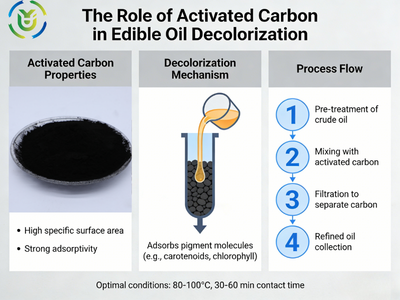
Natural oils and fats generally contain chlorophyll, carotenoids, cotton phenol and other pigments, most of the pigments are harmless, but will affect the appearance of the oil, reduce market acceptance, and will accelerate the oxidation of fats and oil deterioration, shorten the shelf life of cotton phenol and other toxic pigments will also be a direct threat to human health, does not meet food safety standards.
Therefore, decolorization is indispensable in edible oil refining, which can not only remove all kinds of pigments and improve the color of oil, but also provide qualified raw materials for the subsequent deodorization process to further enhance the purity, stability and safety of edible oil, and to meet the industry norms and consumer demand.
Not all activated carbon is suitable for decolorization of edible oil, activated carbon for edible oil processing must have unique adsorption performance, pore structure and surface characteristics to efficiently remove pigments and impurities, while not polluting the oil and fat, and not destroying the nutrients of oil and fat. Its core characteristics are mainly reflected in the following three points:
The core advantage of activated carbon is its adsorption ability, which can firmly adsorb pigments, impurities and harmful substances in fats and oils like a “magnet”. This adsorption ability comes from its special molecular structure, which can selectively adsorb tiny pigment molecules and harmful impurities in fats and oils, and the adsorption speed is fast, the adsorption capacity is large, and will not have chemical reaction with fats and oils, to ensure that the original properties of fats and oils will not be damaged.
activated carbon for decolorization of edible oil has dense honeycomb microporous structure, these tiny pores are like countless “traps”, which can accurately capture the pigment molecules, heavy metal ions and other non-oil components in the oil and grease. The size of the micropores is highly matched with the pigment molecules and impurity molecules, which can adsorb efficiently and avoid adsorbing the oil itself, realizing “precise purification” and making the oil purer.
Specific surface area is the key index to determine the adsorption efficiency of activated carbon – the larger the specific surface area, the more adsorption sites, the more pigments and impurities can be adsorbed. The specific surface area of activated carbon for edible oil processing is usually up to 1000 square meters/g or more, and the large surface area allows it to quickly and efficiently complete the decolorization of oil and grease, improve processing efficiency, and reduce the amount of consumables to save production costs.
In the process of edible oil production, activated carbon is mainly used in the decolorization step of the refining process, and its role is much more than “removing pigment”, but to improve the quality and safety of edible oil in all aspects, which can be divided into the following four points:
This is the most central role of activated carbon. This is the core function of activated carbon. Activated carbon can selectively adsorb chlorophyll, carotenoids, cotton phenol and other types of natural pigments in oils and fats, no matter dark green, yellow or other miscellaneous colors, can be effectively removed, so that the edible oil shows pure, transparent color (such as yellowish, colorless), in line with the market’s requirements for the appearance of edible oils, and to enhance product competitiveness.
In addition to color pigments, activated carbon can also efficiently adsorb non-oil components in fats and oils, including phospholipids, waxes, heavy metal ions (e.g., lead, mercury) and other impurities. These impurities are important causes of oxidative rancidity of fats and oils and shortening of shelf life. Removal of these impurities significantly slows down the rancidity of fats and oils, improves the stability of fats and oils, extends the shelf life, and at the same time reduces the content of harmful substances in fats and oils, and improves the safety of consumption.
Cooking oils often contain aldehydes, ketones and other volatile organic compounds, which will make the oils and fats have an odor (such as bad smell, fishy smell), affecting the taste of consumption. Activated carbon can adsorb these volatile odor substances, effectively removing miscellaneous odors and fishy smells from oils and fats, making the flavor of edible oils purer and more refreshing, and enhancing the eating experience.
Compared with the traditional alkali refining and white earth decolorization process, activated carbon adsorption and decolorization is gentler, and while efficiently removing pigments and impurities, it can maximize the retention of unsaturated fatty acids, vitamins, and other nutrients in edible oils, and reduce the loss of nutrients. At the same time, the high adsorption efficiency of activated carbon can reduce the loss of oil and grease in the process, helping enterprises to save production costs.
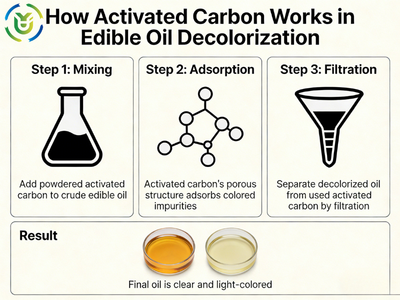
The role of activated carbon in the decolorization of edible oil mainly relies on physical adsorption to achieve. Its honeycomb microporous structure and large surface area can form a strong intermolecular gravitational force, the pigment molecules in the oil, impurity molecules firmly adsorbed on their own surfaces, so as to achieve the separation of oil and pigment, impurities, to achieve the purpose of decolorization and purification.
This physical adsorption process does not require the addition of chemical reagents, will not produce harmful substances, and will not change the chemical properties of edible oil, which can ensure the safety and quality stability of the decolorized fats and oils.
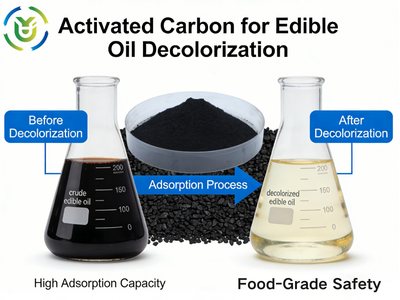
At present, edible oil processing, activated carbon decolorization mainly has two common processes, which can be selected according to the production scale and demand of enterprises:
The decolorization efficiency of activated carbon is not fixed, and will be affected by a variety of key factors, which directly determine the decolorization effect, processing efficiency and production cost control. The following will explain the key factors one by one:
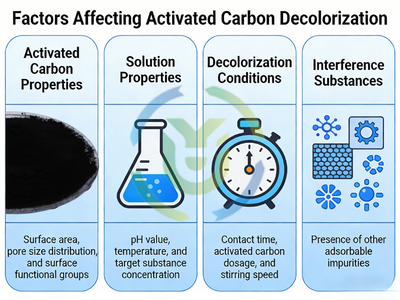
The pH value of oils and fats directly affects the adsorption activity of activated carbon, and there are obvious differences in the pH value of different types of edible oils, such as olive oil, which is more acidic, and palm oil, which is neutral. Acidic or alkaline environment will reduce the adsorption selectivity of activated carbon on pigment, resulting in incomplete removal of pigment, affecting the final decolorization effect, so it is necessary to adjust the appropriate pH according to the type of oil and grease.
Processing temperature should be strictly controlled in a reasonable range, too low a temperature will slow down the adsorption reaction rate between activated carbon and pigment and impurity, prolong the production and processing cycle, and reduce the production efficiency; too high a temperature may destroy the honeycomb pore structure of the activated carbon, reduce its adsorption capacity, and accelerate the oxidative deterioration of fats and oils, which affects the quality of edible oils, which is more than worth the loss.
The contact time between the activated carbon and the oil is very important, if the contact time is not enough, the pigments and impurities can not be fully adsorbed, resulting in the decolorization does not meet the standard; contact time is too long, it will increase the production of energy consumption, slow down the progress of the production, reduce the overall production efficiency. In actual production, we need to combine our own capacity to reasonably control the contact time, to achieve a balance between adsorption effect and efficiency.
The type and dosage of activated carbon need to be accurately matched with the edible oil processing demand. Different types of activated carbon (such as wood, coal powder activated carbon) have different adsorption performance and pore structure, and are suitable for different types of edible oil. In terms of dosage, too little will lead to poor decolorization effect, while too much will increase the cost of consumables, and may also cause activated carbon residue, affecting the purity of oil and grease.
The initial concentration of pigment and impurity in oil and grease is also an important factor affecting the decolorization efficiency. If the initial concentration is too high, it is difficult to reach the decolorization standard only relying on the conventional process. At this time, it is necessary to appropriately increase the dosage of activated carbon or prolong the contact time between activated carbon and grease, and adjust the process parameters to ensure that the decolorization reaches the standard.
Therefore, in the actual production, we can not blindly apply the fixed process, we need to combine the specific types of edible oil (such as palm oil, fish oil, etc.), the quality of raw materials (such as the purity of crude oil) and the production requirements of the enterprise (such as production capacity, finished product standards), scientifically optimize the above parameters, to achieve the effect of decolorization, processing efficiency and the triple balance of the cost of production, and ultimately produce high quality edible oils in line with the industry standards and market demand. The final production of high quality edible oil meets the industry standard and market demand.
Activated carbon used for decolorization of edible oil is mainly powdered activated carbon, which is characterized by fast adsorption speed, high decolorization efficiency, flexible use, and synergistic effect with activated white clay to enhance decolorization effect.
Powdered activated carbon can be made from various carbon-containing raw materials such as coal, wood and fruit shells, etc. After high-temperature treatment, it is then activated by chemical activators such as phosphoric acid, zinc oxide, etc., or activated by air or steam to further increase the specific surface area and adsorption activity.
Powdered activated carbon used for decolorization of edible oil must comply with food grade standards and have the following core features:
Non-toxic and harmless: no irritating gas, will not contaminate the oil and grease, to ensure the safety of consumption;
Low ash content: to avoid ash mixing into the oil and grease, affecting the quality of the oil;
High iodine value: the higher the iodine value, the stronger the adsorption capacity and the higher the decolorization efficiency;
High mechanical strength and easy to regenerate: it can be reused to reduce production cost.
In the decolorization of edible oil, food grade wood powder activated carbon is the most commonly used and recommended type. This type of activated carbon is made of wood, with stronger adsorption performance, lower ash content, non-toxic and harmless, which is better suited to the decoloration needs of edible oils and will not destroy the nutrients of oils and fats. Enterprises can choose the appropriate specification of wood powder activated carbon according to the type of edible oil (such as palm oil, olive oil) and the requirements of the production process, in order to achieve the best decolorization effect.
The decolorization effect of activated carbon is applicable to the refining of many kinds of edible oils, and the focus of its application is slightly different for different types of edible oils, as follows:
In the process of palm oil refining, palm oil is faced with the contamination problems of 3-MCPD and glycidyl ester (GE) – – These two substances are the major causes of high temperature refining. -These two substances are harmful pollutants produced during the high temperature refining process and do not meet food safety standards. Although activated carbon cannot directly remove all contaminant precursors, it can ensure the safety of palm oil by efficiently removing pigments and impurities and reducing the temperature and time of the subsequent deodorization process, thus reducing the generation of 3-MCPD and GE.
Good quality virgin olive oil focuses on natural flavors and is usually not refined, but lower grades (e.g., Lampante olive oil) must be refined for consumption. Activated charcoal is used in the refining of olive oils to remove heavy defects and coloration without excessively stripping the oil of its natural flavors, and to “polish” the oil so that lower grades of olive oils can be blended with virgin olive oils to produce regular olive oils that meet the required standards.
Fish oil and Omega-3 oils are very sensitive to oxidation and have a strong fishy odor, which affects the consumption and application of the products (e.g., health care products, functional foods). Activated carbon can effectively remove persistent organic pollutants (POPs) and volatile compounds in fish oils that lead to fishy odor, and at the same time inhibit the oxidation of fats and oils, making the flavor of fish oils neutral, ensuring the safety and palatability of the final product, and meeting the stringent requirements for the production of nutraceuticals.
Choosing a high-quality activated carbon supplier is the key to ensuring the decolorization effect of edible oil and product safety. Enterprises can focus on the following 4 points when choosing a supplier:
Qualification compliance: suppliers need to provide food-grade activated carbon related certifications to ensure that the product is non-toxic, harmless and in line with food safety norms.
Stable quality: The pore structure, specific surface area, iodine value and other key indicators of the product are stable to ensure that the decolorization effect is uniform and consistent.
Technical support: the supplier can provide personalized technical guidance to help enterprises optimize decolorization parameters, improve efficiency and reduce losses.
Perfect after-sales service: We have comprehensive after-sales service, provide test report, regeneration program, and deal with all kinds of problems in use in time.
Q1: Will activated carbon decolorization affect the nutritional content of cooking oil?
No. Activated carbon is a physical adsorption method. Activated carbon adopts physical adsorption method, which only adsorbs pigments, impurities and harmful substances in oils and fats, and does not react with unsaturated fatty acids, vitamins and other nutrients in oils and fats, so that the nutrition of oils and fats can be retained to the maximum extent.
Q2: Can activated carbon be reused to decolorize cooking oil?
Yes, it can. After adsorption saturation, activated carbon can be regenerated through professional regeneration treatment (e.g. high temperature activation) to restore its adsorption performance and be reused, which can not only reduce the production cost, but also reduce the pressure of environmental protection.
Q3: Can activated carbon and activated white clay be used together?
Yes, and it is recommended to use them together. Activated white clay is good at adsorbing gums and some pigments in oils and fats, while activated carbon is good at adsorbing large polycyclic aromatic hydrocarbons and residual pigments that activated white clay can not adsorb, and the two are used synergistically, which can improve the decolorization efficiency and purity of oils and fats.
Q4: Is it safe to use activated carbon in edible oil processing?
Yes, it is safe. Activated carbon used in edible oil processing must meet the food grade standard, and is non-toxic, non-harmful, non-irritating gas, and will not contaminate the oil and grease. It removes pigments and impurities through physical adsorption, does not react chemically with fats and oils, and does not produce harmful substances, which ensures the safety of edible oils after decolorization and meets food safety standards.
Activated carbon, as the core adsorbent material in the decolorization process of edible oil, can not only efficiently remove all kinds of pigments in oils and fats and improve the color and lustre of oils and fats, but also adsorb impurities, remove odors, and reduce the loss of nutrients by virtue of its strong adsorption performance, unique pore structure and large specific surface area, so as to improve the quality and safety of edible oils and fats in an all-round way. Whether it is palm oil, olive oil or fish oil refining, activated carbon can play an irreplaceable role, and compared with the traditional decolorization process, it is gentler, more efficient and more environmentally friendly.