In the production, processing and application of liquid chemicals, purity is the core factor determining product quality, safety and market competitiveness. Whether it is an API in the pharmaceutical field, an additive in the food industry, or a solvent in the petrochemical industry, the presence of impurities can cause a series of problems, and activated carbon, as a highly efficient purification material, has long been an indispensable core link in the process of liquid chemical purification. This article will analyze the characteristics of activated carbon, its role in the purification of liquid chemicals, the core advantages and application scenarios, while answering common questions in the industry to help practitioners fully understand the importance of activated carbon for liquid chemicals – this is also the “Activated Carbon for Liquid Chemicals This is also the key solution to the core needs of “activated carbon for liquid chemicals” and “purification of liquid chemicals”.
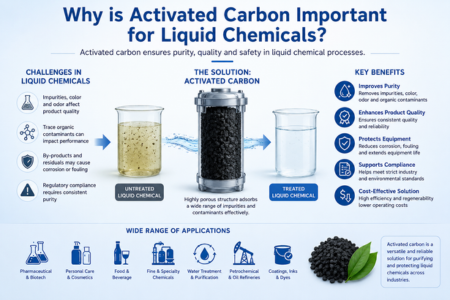
Activated carbon is a kind of porous material made of organic raw materials (such as coconut shell, coal, wood, etc.) through activation treatment, and its most notable features are extremely high specific surface area and developed pore network – the surface area of each gram of activated carbon can reach hundreds or even thousands of square meters, which lays the foundation of its adsorption performance and enables it to This unique structure lays the foundation for its adsorption performance, enabling it to efficiently capture various types of impurity molecules in liquids.
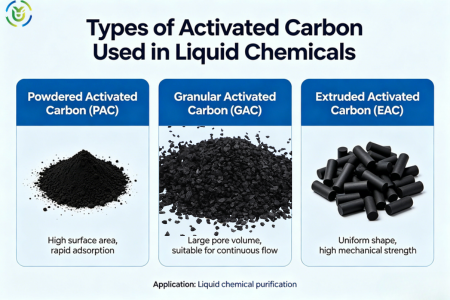
Fine particles, good dispersion, fast and full contact with the liquid, high adsorption efficiency, suitable for rapid purification of batch liquids, especially suitable for dealing with scenarios containing a large number of suspended impurities or requiring rapid decolorization, such as emergency purification of food additive solutions.
Large particles, high mechanical strength, not easy to lose, suitable for fixed-bed filtration system, long-term continuous operation, commonly used in the deep purification of solvents, wastewater treatment chemicals purification and other scenes that require continuous operation, and the subsequent filtration and separation is more convenient.
It refers to the total amount of impurities that can be adsorbed by activated carbon. The higher the capacity, the more durable the purification effect is, and the frequency of replacement of activated carbon can be reduced, thus lowering the operation cost.
The pores of activated carbon are divided into micropores, mesopores and macropores, and different pore sizes correspond to the adsorption of different sizes of impurity molecules – micropores can capture small molecules of organic pollutants, mesopores are suitable for medium-sized pigments and intermediates, and macropores can adsorb suspended impurities, and a reasonable pore size distribution is the key to achieving efficient purification.
The functional groups on the surface of activated carbon (e.g. hydroxyl group, carboxyl group, etc.) will affect its adsorption capacity for specific impurities. Through modification treatment, it can enhance the targeted adsorption of polar or nonpolar impurities, which can be adapted to meet the purification needs of different types of liquid chemicals.
That is, affect the product appearance of colored substances, mostly by-products of the production process, such as brown impurities in organic acids, solvents in the yellow pigment, which will reduce the visual pass rate of the product.
Including trace organic intermediates, reaction by-products, raw materials that have not been fully reacted, etc. Such impurities may affect the chemical stability of the product or even produce toxic and harmful substances.
Volatile organic substances, which can lead to abnormal odor of liquid chemicals, especially affecting the quality of products in food, medicine and other industries that have strict requirements on odor.
The solvents used in the production process are not completely removed, and the residual amount exceeding the standard will violate the industry standard, and at the same time, it may react with the product and reduce the performance of the product.
Impurities can lead to a reduction in the purity, concentration and stability of liquid chemicals, such as impurities in pharmaceutical raw materials may reduce the efficacy of the drug, or even trigger side effects; impurities in the solvent will affect its dissolution properties, which in turn affects the subsequent production process.
Countries have strict purity standards for liquid chemicals in different industries, such as GMP standards in the pharmaceutical industry, food safety standards in the food industry, unpurified products will not be able to pass the test due to impurities exceeding the standard, resulting in product stagnation, penalties and other consequences.
Impurities will block the pipes and filters of the production equipment, increase the cost of equipment cleaning and maintenance, and at the same time may prolong the production cycle, reduce the production capacity, and increase the operational burden of the enterprise.
Using the van der Waals force between the surface of the activated carbon and the impurity molecules, the impurity molecules are adsorbed into the pores of the activated carbon. This adsorption process does not require a chemical reaction, is reversible and fast, and is suitable for the removal of most organic impurities and pigments.
The functional groups on the surface of activated carbon react with the impurity molecules to form a stable chemical bond, which fixes the impurity molecules on the surface of activated carbon. This kind of adsorption is irreversible, and it is suitable for the removal of some polar impurities or poisonous and harmful substances which are difficult to be removed by physical adsorption.
Different types of impurity molecules have different sizes, and the micropores, mesopores and macropores of activated carbon can correspond to the adsorption of small molecules, medium size and large molecules of impurities, for example, micropores can efficiently adsorb micro-organic pollutants, mesopores can capture pigment molecules, and macropores can filter suspended impurities to achieve “precise capture”.
Through modification treatment (e.g. oxidation, reduction), more functional groups can be introduced on the surface of activated carbon to enhance its adsorption capacity for specific impurities, e.g. the introduction of carboxyl groups can improve the adsorption efficiency for polar impurities, and the introduction of hydrophobic groups is more suitable for the adsorption of non-polar organic pollutants.
Compared with other purification methods (such as distillation, filtration, ion exchange, etc.), activated carbon has irreplaceable advantages in the purification of liquid chemicals, which are mainly reflected in the following five aspects:
Activated carbon can efficiently remove all kinds of pigment impurities in liquid chemicals, whether it is natural pigment or synthetic pigment, it can quickly decolorize the products to meet the appearance standard required by the industry, especially suitable for organic acids, solvents, syrups and other products that require high transparency.
It has strong adsorption ability for trace organic pollutants, reaction by-products and residual intermediates in the liquid, which can reduce the content of impurities to a very low level, guarantee the purity of the product and avoid the influence of impurities on the performance of the product.
It can adsorb the volatile odor compounds in the liquid, completely eliminate the abnormal odor of the product, meet the strict requirements of food, medicine, cosmetics and other industries on the odor of the product, and enhance the market competitiveness of the product.
By removing impurities that lead to product degradation (such as oxidizing impurities and catalytic impurities), the shelf life of liquid chemicals can be extended, preventing deterioration, discoloration, and failure of products during storage and use.
The purification process of activated carbon is mature, safe and free of secondary pollution, which can help liquid chemicals meet the strict purity standards in the fields of medicine, food and industry, avoid compliance risks and help enterprises successfully pass testing and certification.
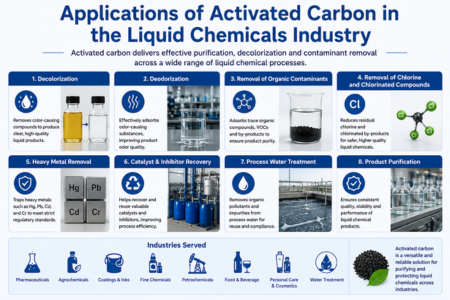
Mainly used in the purification of API, removing intermediates, by-products and trace impurities in the synthesis process, to ensure the purity and safety of API; meanwhile, it is used in the purification of pharmaceutical excipients (e.g., solvents, buffers) to meet the requirements of GMP standards.
Used for the purification of syrups, food additives (such as citric acid, lactic acid), edible flavors and other products, to remove color, odor and organic impurities, to ensure that the product meets the food safety standards, and at the same time to enhance the taste and appearance of the product.
Used for the deep purification of solvents (such as ethanol, acetone, toluene), to remove the sulfur compounds, organic impurities and water, to enhance the purity of solvents and the use of performance; at the same time, used for lubricants, diesel fuel and other products decolorization and purification.
It is used for the purification of water treatment chemicals such as coagulants, disinfectants, acid and alkali reagents, removing impurities and harmful components, ensuring the effect of water treatment, avoiding secondary pollution, and safeguarding the safety of drinking water and industrial water.
|
Industry Classification |
Activated Carbon Application |
|
Pharmaceutical Industry |
API purification, pharmaceutical excipients purification, to meet GMP standards |
|
Purification of syrup, food additives, etc., to remove pigment, odor and meet food safety standards. |
|
|
Petrochemical industry |
Deep purification of solvents, decolorization and purification of lubricating oil and diesel fuel. |
|
Water Treatment Chemicals |
Coagulants, disinfectants and other purification, to avoid secondary pollution of water treatment |
The raw materials of activated carbon are mainly categorized into three types: coconut shell, coal and wood. Among them, coconut shell activated carbon has a more developed pore structure and higher adsorption capacity, which is suitable for high-precision purification (e.g., pharmaceuticals and food industry); coal activated carbon has a lower cost, which is suitable for conventional purification of industrial-grade liquid chemicals; and wood activated carbon is suitable for scenarios that require higher adsorption speed.
According to the molecular size of the impurities in the liquid chemicals, the corresponding pore size distribution can be selected. For example, activated carbon with well-developed micropores can be selected for removing small molecule organic impurities, and activated carbon with a high proportion of mesopores can be selected for removing medium-sized impurities such as pigments.
Powdered activated carbon (PAC) is suitable for batch rapid purification, and granular activated carbon (GAC) is suitable for continuous filtration systems, and the appropriate particle size should be selected according to the production process (batch treatment or continuous production).
Iodine value is an important index to measure the adsorption capacity of activated carbon, the higher the iodine value is, the higher the adsorption capacity is, which is suitable for liquid chemicals with high impurity content; it is necessary to choose activated carbon with suitable iodine value according to the impurity content and purification requirements.
The lower the ash content of activated carbon, the higher the purity, avoiding the secondary pollution of liquid chemicals caused by ash residue, especially suitable for pharmaceutical, food and other industries with very high purity requirements, and need to choose products with ash content lower than the industry standard.
After using for some time, the pores of activated carbon will be blocked by impurities, the adsorption capacity decreases, and the purification effect deteriorates.
Solution: Reasonably determine the dosage and replacement cycle of activated carbon according to the impurity content of liquid chemicals; choose activated carbon with reasonable pore size distribution to reduce clogging; regularly regenerate the activated carbon (e.g., activate at high temperature) to extend its service life.
Powdered activated carbon has good dispersion, but subsequent filtration and separation is difficult and easy to cause product contamination; granular activated carbon may have high water flow resistance and slow filtration speed.
Solution: Powder activated carbon can be matched with special filtration equipment (such as plate and frame filters) to improve the separation efficiency; granular activated carbon can be used to select the appropriate particle size according to the filtration demand and optimize the flow rate and pressure of the filtration system.
When activated carbon is saturated, whether to choose regeneration or direct replacement needs to be balanced between cost and effectiveness.
Solution: For scenes with high value and high purity requirements (such as the pharmaceutical industry), regeneration can be chosen to reduce costs; for scenes with high impurity content and high regeneration difficulty, the activated carbon can be directly replaced to ensure purification effect.
The most fundamental solution is to choose the appropriate grade, pore size and dosage of activated carbon according to the characteristics of liquid chemicals and purification requirements, avoiding the above problems at the source and establishing a perfect use and maintenance process.
The purity and environmental protection requirements for liquid chemicals are increasing in various countries, especially the more stringent standards for the limitation of harmful impurities, which will further promote the application of activated carbon in the field of purification and force enterprises to improve purification technology.
With the rapid development of specialty chemicals and fine chemicals market, higher requirements have been put forward for the adsorption performance, relevance and stability of activated carbon, and high-performance modified activated carbon (e.g., special decolorized activated carbon, high-efficiency decontamination activated carbon) will become the mainstream of the market.
Environmental protection and renewable have become the core direction of industry development. Activated carbon made of renewable raw materials such as coconut shell and bamboo, as well as recyclable activated carbon products, will be favored by more enterprises to realize the green cycle of “purification-regeneration-reuse”.
A1: The choice should be made according to specific scenarios – powdered activated carbon (PAC) for batch rapid decolorization and decontamination; granular activated carbon (GAC) for continuous filtration and in-depth purification; coconut shell activated carbon for high-precision scenarios, such as pharmaceuticals and food, and coal activated carbon for industrial-grade conventional purification.
A2: Mainly through physical adsorption, the developed pore network of activated carbon can capture pigment molecules, while its surface chemical properties can enhance the adsorption capacity of pigments, especially its mesoporous structure, which can accurately adsorb pigment molecules of medium size to achieve efficient decolorization.
A3: It can be reused. After activated carbon is saturated, through high-temperature activation, chemical washing and other regeneration treatments, its adsorption performance can be restored and reused for liquid chemical purification; but the regeneration times are limited (generally 3-5 times), and the adsorption capacity after regeneration will be slightly reduced, so it is necessary to judge whether to continue to use it according to the requirements of purification.
A4: There is no fixed standard for the dosage, which should be determined according to the impurity content, volume, purification requirements of the liquid chemicals and the adsorption capacity of activated carbon. Generally, it is recommended that the dosage should be 0.1%-5% of the mass of the liquid; in actual application, the optimal dosage can be determined through a small trial, so as to avoid increasing the cost of too much dosage or affecting the purification effect of insufficient dosage.
A5: The first step is to define the type of impurities (pigment, organic impurities, etc.) and molecular size of the liquid chemical; the second step is to select the activated carbon with suitable pore size distribution and surface chemistry according to the characteristics of the impurities; the third step is to select the size of the particles in combination with the production process (batch/continuous); and finally, the optimal model and dosage are determined through a small test to prove the adsorption effect.
With its unique porous structure, efficient adsorption performance and extensive adaptability, activated carbon plays an irreplaceable role in the purification of liquid chemicals – it can not only effectively remove impurities, decolorise and deodorise, improve product purity and stability, but also help enterprises meet industry compliance requirements and reduce production and operation costs. From medicine and food to petrochemical and water treatment, activated carbon has become an important support for the high-quality development of the liquid chemical industry.