Adsorption technology plays a crucial role in the oil refining industry, directly related to the improvement of oil quality, optimisation of production efficiency and product safety, which are also the core concerns of industry practitioners. Acidic clay (activated bleaching earth) and activated carbon as the key adsorbent in the refinery purification process, each playing a unique role, and the synergistic effect generated by the combination of the two, but also break through the performance limitations of a single adsorbent, to achieve the purification effect of 1 + 1 > 2. In this article, we will analyse in detail the characteristics of acidic clay and activated carbon, the principle of synergy, application advantages and industry practice points, for the refining industry process optimization to provide reference.
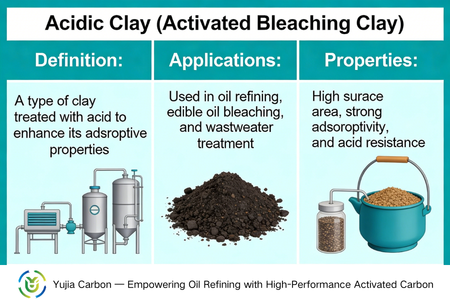
Acidic clay, also known as activated bleaching earth, is a natural mineral clay by acid activation treatment of the adsorbent, specifically used in the oil refining industry oil purification process. The core of the preparation process is the acid activation of natural clay minerals – through a specific concentration of acid immersion, reaction, changing the internal structure of the clay, thereby significantly enhancing its adsorption properties, so that it can be better adapted to the removal of impurities in the oil products.
Acidic clay can become one of the core adsorbents in the oil refining industry, thanks to its three key characteristics: first, it has a high specific surface area, which provides sufficient space for the adsorption of macromolecule impurities and ensures that the adsorption process is carried out efficiently; secondly, it has a strong adsorption capacity of pigments, which is also the key to play a core role in the decolouration process of oil; thirdly, it contains a large number of acidic sites on its surface, which can effectively promote the removal of phospholipids, saponins, soaps and other impurities in oil. promote the removal of polar impurities such as phospholipids, soaps, metals, etc., and further enhance the purity of oil products.
In the oil refining process, the application scene of acidic clay is relatively concentrated, in which the most important use is the decolouring treatment of vegetable oil, including the refining process of common vegetable oils such as soybean oil, palm oil and sunflower oil. In addition, it also undertakes the task of removing impurities such as phospholipids, soaps and heavy metals from oils, while effectively reducing the colour depth of oils and laying the foundation for subsequent fine purification.
Activated carbon is a kind of adsorption material with unique microporous structure, and its most remarkable feature is that it has a great specific surface area, far exceeding that of common adsorbents, which gives it a very strong adsorption capacity and can efficiently capture trace impurities in the oil. Unlike acidic clay, the adsorption of activated carbon mainly relies on the physical adsorption mechanism, and the adsorption of impurities is achieved through the van der Waals force between molecules. This non-chemical combination makes it widely adaptable to various types of impurities, and it is especially good at capturing small molecules.
In the process of oil purification, the core role of activated carbon is reflected in three aspects: firstly, to remove polycyclic aromatic hydrocarbons (PAHs), which are harmful to human health and are the indexes that must be strictly controlled in food-grade oils, and activated carbon can effectively adsorb and remove them to ensure that the oil products comply with the food safety standards; secondly, to adsorb trace pollutants and odourous substances, to improve the organoleptic qualities of the oil products to avoid the influence of the products’ competitiveness due to odours; thirdly, to enhance the stability of the oil products; it can improve the stability of oil products, reduce the rancidity of oil products by adsorbing the impurities that lead to the oxidation of oil products, and extend the shelf life of oil products.
|
Role of activated carbon |
|
|
Type of action |
Specific effects |
|
Removal of harmful substances |
Adsorption of polycyclic aromatic hydrocarbons (PAHs) to ensure food safety. |
|
Improvement of organoleptic quality |
Adsorption of trace contaminants and odours |
|
Improve stability |
Reduces oil rancidity and extends shelf life |
In refinery adsorption systems, synergism refers to the fact that when acidic clay is used in combination with activated carbon, the purification effect is much greater than the sum of the effects of the two when used alone. The central reason for this synergy is the obvious performance limitations of a single adsorbent: acidic clay is weak in adsorption of non-polar contaminants, while activated carbon is far less effective than acidic clay in pigment removal. The combination of the two can make up for each other’s shortcomings and achieve comprehensive and efficient oil purification.
The synergistic effect of acidic clay and activated carbon is essentially due to the complementary adsorption mechanism of the two. The core advantage of acidic clay lies in the adsorption of polar impurities, pigments and macromolecules, which can be accurately captured by virtue of the acidic sites on its surface and large pore size; while activated carbon is good at adsorption of non-polar molecules, trace pollutants and polycyclic aromatic hydrocarbons, and achieves the in-depth removal of small molecule impurities by relying on its microporous structure and large specific surface area. In addition, the pore size structure of the two forms a perfect complement – the larger pore size of acidic clay is responsible for the initial adsorption, while the micropores of activated carbon are responsible for the fine capture, thus realising a comprehensive coverage of all kinds of impurities in the oil products.
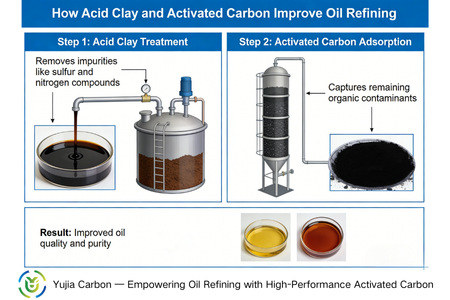
The synergistic adsorption of acidic clay and activated carbon follows the step-by-step principle of ‘coarse first and then fine’ to ensure the high efficiency and comprehensiveness of purification effect. The first step is the pretreatment stage, in which the acidic clay is responsible for the preliminary removal of pigments and polar impurities in the oil, separating the main pollutants in the oil first, so as to reduce the burden of subsequent fine purification; the second step is the fine purification stage, in which the activated carbon takes over the subsequent treatment, and carries out in-depth adsorption for the residual trace pollutants that are not completely removed by the acidic clay, so as to realize the purification of the oil in a high degree of purity in the end.
The synergistic effect of the two is also reflected in the interplay of surface chemistry: the interaction between the acidic sites on the surface of the acidic clay and the microporous structure of the activated carbon enhances the binding capacity of impurities and improves the adsorption stability. At the same time, this interaction can also effectively improve the removal effect of oxidation by-products in the oil, reduce the oil quality degradation caused by oxidation, and further improve the purity and stability of oil.
The synergistic use of the two adsorbents can effectively reduce adsorption competition – as they target different types of impurities, there will be no ‘multiple impurities competing for adsorption sites’ in a single adsorbent, thus optimising the overall adsorption efficiency. In addition, the two complementary pore size structure can also accelerate the mass transfer rate, so that impurities are captured by the adsorbent faster, shorten the adsorption time, improve the overall production efficiency of the refining process.
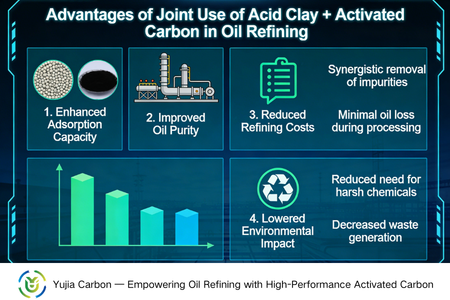
Compared with a single adsorbent, the oil decolorization effect under the synergistic effect of the two is better, which can meet the higher standard oil colour requirements and improve the product appearance quality. Acidic clay is responsible for preliminary adsorption of most of the pigments in the oil, while activated carbon captures the residual trace pigments in depth, which can effectively reduce the colour value of the oil under the dual action. This advantage has irreplaceable practical value for high-end edible oil, special industrial oil and other products with strict requirements on appearance.
It can effectively solve the problem of incomplete removal of specific pollutants by a single adsorbent to ensure that the oil products comply with food safety and industry standards. Single acidic clays are weak at adsorbing non-polar PAHs, while activated carbon excels at capturing trace amounts of these harmful contaminants, and the two work in tandem to achieve complete contaminant coverage. This synergistic effect ensures the safety and compliance of food-grade oils and the purity of industrial oils.
Significantly reduces oil oxidation, extends the shelf life of the oil and reduces losses due to product deterioration. Acidic clay can remove the polar impurities in oil products that are easy to trigger oxidation, while activated carbon can adsorb the by-products produced in the oxidation process, and the two together can effectively inhibit the rancidity and deterioration of oil products. This not only reduces the loss of finished oil products, but also enhances the stability of the product in market circulation and reduces the storage and loss costs of the enterprise.
The synergistic effect enables the dosage of both adsorbents to be reduced, thereby reducing the operating costs of the refinery process. When one adsorbent is used alone, a larger amount of adsorbent is required to achieve the desired effect, while the synergy between the two can complement each other’s shortcomings and improve efficiency. This not only reduces the amount of acidic clay and activated carbon purchased, but also reduces the costs associated with subsequent adsorbent disposal, filtration, etc., which reduces costs and increases efficiency for the enterprise.
Comprehensively removing all kinds of impurities ensures the safety and quality of oil products and enhances the competitiveness of products in the market. Acidic clay removes polar impurities and colour pigments, while activated carbon focuses on trace harmful pollutants and odour substances, and the dual purification can achieve an all-round improvement of oil quality. High oil quality not only meets the stringent industry standards, but also enhances the product’s reputation, which helps enterprises to take advantage of the fierce competition in the market.
Mainly used in soybean oil, palm oil, sunflower oil, rapeseed oil and other types of vegetable oil refining process, is the key link to ensure the quality of edible vegetable oil, can effectively remove the pigment, polar impurities in vegetable oil, enhance the purity and appearance of oil.
For all kinds of oils that need to meet food-grade standards, through the synergistic adsorption of acidic clay and activated carbon, harmful impurities (such as polycyclic aromatic hydrocarbons) and off-flavour substances are completely removed to ensure the safety and organoleptic qualities of the oils and comply with the relevant standards for food safety.
It is applicable to the purification treatment of industrial oils such as lubricating oil and biodiesel, which can remove all kinds of pollutants in industrial oils, improve the performance of industrial oils, prolong their service life, and guarantee the stable operation of industrial production.
From the actual case, a refinery introduced acidic clay and activated carbon synergistic adsorption system, oil decolourisation efficiency increased by more than 30%, PAH removal rate of more than 95%, while the adsorbent dosage was reduced by 20%, significantly reducing the operating costs, which verified the synergistic system of the practical application of value.
The optimal dosage ratio of the two adsorbents is not a fixed value, but is mainly affected by the type of oil, impurity content and target quality standard. For example, for vegetable oils with a high colour content, the amount of acidic clay may be increased, while for oils with a high level of trace contaminants, the proportion of activated carbon may be increased. In industrial practice, it is usually necessary to carry out a small trial test according to the specific working conditions to determine the most appropriate dosage ratio, in order to achieve a balance between purification effect and cost.
Temperature and contact time are the key parameters affecting the effect of co-adsorption. Generally speaking, the optimal temperature range of co-adsorption is 60-80℃, under which the activity of adsorbent is optimal and the adsorption efficiency can be effectively enhanced; the contact time should be adjusted according to the flow rate of the oil and the content of impurities, and it is usually controlled in 30-60 minutes to ensure that the impurities can be fully captured by the adsorbent and to avoid incomplete purification due to the insufficiency of the contact time.
Mixing uniformity directly affects the adsorption effect, industrial applications can use mechanical mixing and other ways to ensure that the acidic clay, activated carbon and oil are fully mixed, so that the adsorbent can uniformly contact the impurities in the oil. Filtration links need to choose the appropriate filter media and filtration speed, not only to ensure that the adsorbent residue can be completely separated, to avoid contamination of finished oil products, but also to take into account the filtration efficiency, to avoid affecting the overall production progress.
In the process of industrial oil refining, the synergistic adsorption system should be reasonably integrated with the existing refining process to avoid large changes to the existing process and reduce the transformation cost. At the same time, the efficiency of the co-adsorption can be further improved by optimising the adsorption process parameters and improving the mixing and filtration links, so as to achieve the dual goals of cost saving and quality improvement.
The initial investment of dual adsorbent system is higher than that of single adsorbent, so it is necessary to balance the initial investment and long-term operating costs, and reduce the comprehensive cost by optimising the dosage ratio.
The mixed use of two adsorbents may increase the difficulty of filtration, and it is easy to have problems such as clogging of the filter cloth, etc. It is necessary to choose appropriate filtration technology and media to ensure smooth filtration.
Disposal of adsorbent after adsorption saturation will bring environmental pressure, while the regeneration process of adsorbent needs to invest additional costs, and it is necessary to choose suitable disposal or regeneration methods according to the actual situation of the enterprise.
The raw material quality of acid clay and activated carbon will directly affect the adsorption effect, and it is necessary to strictly control the quality of raw materials to ensure their stable performance and avoid the purification effect decline due to the fluctuation of raw materials.
The integration of acidic clay and activated carbon characteristics into a single adsorbent material can simplify the refining process, while further improving the adsorption efficiency, suitable for industrial scale production needs.
The specific surface area and adsorption specificity of activated carbon can be improved through technological improvement, so that it can be better adapted to the purification needs of complex oil products and enhance the removal ability of trace pollutants.
Responding to the trend of green environmental protection industry, develop recyclable and sustainable adsorbent materials, which can not only reduce the environmental pressure caused by the disposal of adsorbents, but also reduce the long-term operating costs of enterprises.
As food safety-related standards continue to become more stringent, the iterative upgrading of refinery adsorption and purification technologies will be further promoted to ensure that the safety of oil products meets higher industry standards.
The synergistic effect of acidic clay and activated carbon in oil refining, through the complementary adsorption mechanism, step-by-step adsorption process, and the mutual cooperation of surface chemistry, achieves a significant improvement in the purification effect of the oil products, and at the same time brings multiple advantages, such as cost savings, quality enhancement, and compliance, which is an important means to optimise the process and enhance the competitiveness of products in the modern oil refining industry. For oil refineries, the synergistic effect of two adsorbents and the optimisation of process parameters in combination with best practices can effectively solve the performance limitations of a single adsorbent, and realise efficient, environmentally friendly and high-quality development of oil refining processes.