Reverse osmosis (RO) system is the core equipment for deep purification in the field of water treatment, which is widely used in municipal water supply, industrial production, seawater desalination and other scenarios. Pretreatment link is the RO system stable operation of the “first line of defense”, directly determines the efficiency and life of the RO membrane. This article focuses on RO pretreatment system activated carbon selection, to provide practitioners with a scientific guide to help avoid misunderstandings and realize the efficient operation of the system.
Composite film (TFC) RO membrane is extremely sensitive to chlorine, chloramines and other oxidizing agents, these substances will quickly destroy the membrane structure, resulting in membrane performance degradation and shortened service life. Through adsorption, activated carbon can effectively remove such oxidizing agents before the water enters the RO membrane, and at the same time reduce the load of organic matter in the water to provide all-round protection for the RO membrane. In addition, activated carbon can also improve the taste and smell of the water, remove disinfection by-products, and in some cases can also be used as a terminal filtration material after the RO water tank, the water for “fine treatment”, to further improve water quality. The specific role can be divided into the following points:
Chlorine is a commonly used disinfectant in water treatment, but the TFC RO membrane has a strong destructive, will quickly erode the surface structure of the membrane, resulting in a decline in the desalination rate of the membrane, water production decreased. Activated carbon can completely remove chlorine through physical adsorption before the water reaches the RO membrane, avoiding oxidative damage to the membrane. For chloramines such as stronger stability of the oxidant, it is necessary to use a special catalytic activated carbon, in order to achieve efficient removal, to ensure the safe operation of the RO membrane.
Organic matter in the water will not only cause organic pollution of RO membrane, but also affect the filtration efficiency of the membrane and water quality. Activated carbon, with its developed pore structure, can effectively adsorb organic matter in the water, reduce the organic load of the water body, thereby reducing the risk of contamination of the RO membrane, maintaining the long-term stability of the membrane performance, prolonging the service life of the membrane.
Volatile organic compounds (VOCs) in the water, some pesticide residues and odor substances generated in the disinfection process will seriously affect the taste and smell of the water. Activated carbon can remove these harmful substances through adsorption, making the water cleaner and fresher, especially for drinking water RO system.
During the disinfection of drinking water, chlorine reacts with organic matter in the water to produce disinfection by-products such as trihalomethanes (THMs), which are potential health risks. High-quality activated carbon can effectively adsorb such disinfection by-products, reduce the health risks of the water, and ensure that the water meets drinking water standards.
After the RO water tank, you can set up a terminal activated carbon filter, RO water for further “fine treatment”, to remove residual trace odors in the water, organic matter, etc., to further improve the quality of the water, to meet the water needs of different scenarios.
Coal-based activated carbon is cost-effective, with a developed pore structure and large adsorption capacity, and is suitable for industrial wastewater, municipal sewage and other RO pretreatment scenarios with a high content of organic matter, but it has a relatively high content of impurities, so it is necessary to pay attention to purity control.
Coconut shell activated carbon has uniform pore structure, large specific surface area, fast adsorption speed, and low impurity content, high strength, suitable for drinking water RO system, industrial scenarios with high water quality requirements, but its cost is relatively high.
Wooden activated carbon has mild adsorption performance and large pore size, which is suitable for treating macromolecule organic matter, but its mechanical strength is low and it is easy to produce powder, which needs to be carefully selected for high pressure RO pretreatment system.
In addition, the pore structure of activated carbon (microporous and mesoporous) should also be paid attention to: microporous is mainly used for the adsorption of small molecules (e.g. chlorine, VOCs), while mesoporous is more suitable for the adsorption of macromolecule organics, and the ratio of microporous and mesoporous activated carbon should be reasonable according to the type of pollutants of the influent water in RO pretreatment.
|
Activated Carbon Types |
Core Advantages |
Applicable Scenarios |
|
Coal-Based Activated Carbon |
High cost-effectiveness, highly developed pore structure, large adsorption capacity |
RO pretreatment for high organic load wastewater such as industrial effluents and municipal sewage |
|
Coconut Shell Activated Carbon |
Uniform pore distribution, rapid adsorption, low impurity content, high mechanical strength |
Drinking water RO systems and industrial applications with stringent water quality requirements |
|
Wood-Based Activated Carbon |
Large pore size, suitable for treating macromolecular organic compounds |
Scenarios requiring treatment of large-molecule organic compounds |
Iodine value is the core indicator to measure the adsorption performance of activated carbon. It represents the adsorption capacity of activated carbon to iodine, and indirectly reflects the development and adsorption capacity of its pore structure. The higher the iodine value, usually means the larger the specific surface area of activated carbon and the stronger the adsorption capacity.
The unit of iodine value is mg/g, which refers to the number of milligrams of iodine that can be adsorbed per gram of activated carbon. It is a common indicator for evaluating the adsorption performance of activated carbon, and is especially suitable for measuring the adsorption capacity of small molecular substances.
Recommended iodine value range for RO pretreatment: combined with the operation needs of RO system, activated carbon used for RO pretreatment, the iodine value is recommended to be between 800-1200mg/g. If the content of organic matter in the inlet water is high, activated carbon with high iodine value can be selected; if the water quality is relatively clean, the iodine value requirement can be appropriately reduced to balance the cost and performance.
Relationship between iodine value and organic matter removal: the iodine value is positively correlated with the removal efficiency of activated carbon on organic matter, the higher the iodine value, the better the adsorption effect of activated carbon on small molecules of organic matter in water, chlorine, disinfection by-products, etc., and the better it reduces the risk of contamination of RO membrane.
For hard-to-remove oxidants such as chloramine, the adsorption effect of ordinary activated carbon is limited, and it is necessary to choose catalytic activated carbon with high catalytic activity, so that chloramine can be decomposed into harmless substances through catalytic reaction, and efficient dechlorination can be realized.
Refers to the time needed from the beginning of the use of activated carbon to the chlorine content of the water exceeds the standard, the longer the penetration time, indicating that the activated carbon’s dechlorination capacity is greater, the longer the service life. When selecting the type, it is necessary to combine the water production of the RO system and the chlorine content of the influent water, and select the activated carbon with a penetration time that meets the operational requirements of the system.
Activated carbon’s ability to remove chlorine will decay with the use of time, we need to assess its service life through the test data provided by the manufacturer, the actual operating experience, and reasonably formulate the replacement cycle to avoid damage to the RO membrane due to the failure of activated carbon.
The particle size and uniformity of activated carbon will affect its filtration efficiency, pressure loss and contact efficiency with water, which in turn will affect the pretreatment effect, and should be emphasized when selecting the type:
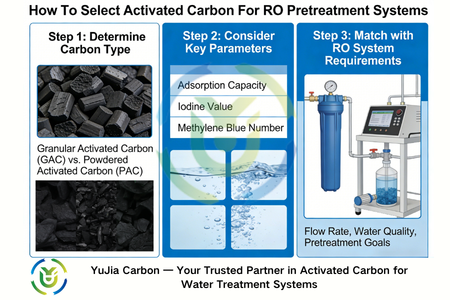
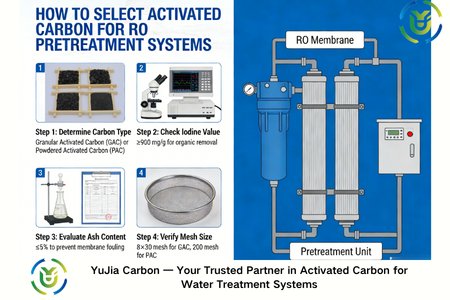
Granular activated carbon (GAC) vs powdered activated carbon (PAC): In RO pretreatment, granular activated carbon (GAC) is preferred because of its high mechanical strength, not easy to produce powder, and it can avoid clogging caused by powder entering the RO membrane; powdered activated carbon (PAC) is fast in adsorption, but it is easy to be lost and difficult to be recycled, and it is only suitable for temporary emergency treatment (e.g. sudden increase in chlorine content of incoming water). It is only suitable for temporary emergency treatment (such as a sudden increase in chlorine content in the feed water).
Recommended particle size: activated carbon used for RO pretreatment pressure vessel, particle size is recommended to be 8-30 mesh, particle size is too large is small contact area, low adsorption efficiency, particle size is too small will lead to system pressure loss is too large, affecting the normal operation of RO system.
Uniformity of particle size: activated carbon with uniform particle size can ensure the uniform distribution of water in the activated carbon bed, avoid the phenomenon of “ditch flow”, ensure that each part of the activated carbon can give full play to the adsorption effect, and at the same time, reduce the pressure loss of the system to maintain stable operation of the system.
|
Activated Carbon Forms |
Core Advantages |
RO Pre-Treatment Applications |
|
Granular Activated Carbon (GAC) |
High mechanical strength, minimal powder generation |
Preferred choice for routine pre-treatment |
|
Powdered Activated Carbon (PAC) |
Rapid adsorption rate |
Only suitable for temporary emergency treatment (e.g., sudden increase in chlorine content in incoming water) |
Activated carbon needs to have good abrasion resistance to avoid crushing and producing fine carbon powder during backwashing and water impact.
If the mechanical strength of activated carbon is insufficient, the carbon powder generated after crushing will enter the RO membrane, causing the membrane to be clogged and affecting the water yield and desalination rate of the RO system, so it is necessary to choose activated carbon with high mechanical strength and not easy to break.
Activated carbon with high mechanical strength has a longer service life, reduces the frequency of replacement, lowers the operation and maintenance cost, and avoids the system failure caused by activated carbon crushing, and maintains the long-term stable operation of the RO pretreatment system.
Ash content and purity of activated carbon will affect the water quality, especially for drinking water RO system, need to strictly control the ash and impurity content:
Impact of ash on water quality: ash is an inorganic impurity in activated carbon, if the ash content is too high, it may be dissolved into the water in the process of using, resulting in the increase of conductivity of the effluent water, the deterioration of water quality, and affecting the operation efficiency of RO membrane.
Avoid heavy metal dissolution: some poor quality activated carbon may contain heavy metal impurities, heavy metal dissolution will occur during the use of the water, contamination of the water, endangering human health (drinking water scenario) or affecting the quality of industrial products (industrial scenario), so you need to choose the activated carbon with heavy metal content in line with the standard.
Compliance with drinking water standards: For drinking water RO pretreatment system, activated carbon should comply with national drinking water health standards to ensure that its ash, heavy metals, microorganisms and other indicators meet the standards to ensure the safety of water.
Empty bed contact time (EBCT) refers to the time that water stays in the bed layer of activated carbon, which directly affects the adsorption efficiency of activated carbon, especially the effect of chlorine removal and organic matter removal:
Recommended EBCT: In order to achieve effective dechlorination and organic removal, the empty bed contact time (EBCT) of activated carbon in RO pretreatment is recommended to be no less than 5 minutes, and if the content of pollutants in the feed water is higher, the EBCT can be extended appropriately to ensure adequate adsorption.
Design differences between industrial and municipal systems: industrial RO system influent organic matter, oxidant content may be higher, need to design thicker activated carbon bed, longer EBCT; municipal drinking water RO system influent water quality is relatively stable, according to the actual quality of water to adjust the depth of the bed and the EBCT, balancing the treatment effect and cost.
The pressure loss of the activated carbon bed will affect the overall hydraulic performance of the RO system, and it is necessary to reasonably control the pressure loss under the premise of ensuring the adsorption efficiency:
Balance filtration efficiency and hydraulic performance: too small a particle size, the bed is too thick will lead to pressure loss is too large, increase the energy consumption of RO system; particle size is too large, the bed is too thin will affect the adsorption efficiency. Therefore, it is necessary to reasonably select the activated carbon particle size and bed depth to balance the relationship between the two.
Optimization of pressure loss: by selecting activated carbon with uniform particle size, reasonable design of bed height, regular backwashing, etc., pressure loss can be effectively controlled to maintain stable operation of the system.
Backwashing is the key operation to maintain the adsorption efficiency of the activated carbon bed, and a reasonable backwashing program should be formulated according to the characteristics of activated carbon.
Reasonable expansion rate: When backwashing, the expansion rate of the activated carbon bed is recommended to be controlled at 30%-50%, which can effectively flush out the impurities and pollutants in the bed, and also avoid the loss of activated carbon and protect the bed structure.
Preventing ditch flow: Uneven backwashing will lead to the phenomenon of “ditch flow” in the bed layer, and the activated carbon in some areas can not be effectively rinsed, and the adsorption efficiency will be reduced. Reasonable design of backwash pipeline and control of backwash flow rate are needed to ensure uniform backwash and avoid ditch flow.
Maintain adsorption efficiency: Regular and standardized backwashing can remove the pollutants on the surface of the activated carbon, restore its adsorption capacity, prolong the service life of the activated carbon, and ensure the stability of the pretreatment effect.
Some practitioners in order to reduce costs, choose low-priced low-quality activated carbon, such activated carbon adsorption performance is poor, short service life, high impurity content, not only can not effectively protect the RO membrane, but also due to carbon powder, heavy metal leaching and other issues, resulting in RO membrane clogging, damage, and instead increase the long-term operation and maintenance costs.
Chlorine penetration test can visually reflect the chlorine removal ability and service life of activated carbon, if you ignore this test, blindly select the activated carbon, may lead to early failure of activated carbon, chlorine into the RO membrane causing oxidative damage.
Particle size is too large, the adsorption efficiency is insufficient to effectively remove pollutants; particle size is too small, the pressure loss is too large, affecting the operation of the system, and even lead to carbon powder into the RO membrane. According to the system pressure, water production and other parameters, select the appropriate particle size of activated carbon.
Different RO system feed water quality varies greatly (such as organic content, oxidant concentration, hardness, etc.), if you do not analyze the water quality, blindly select the activated carbon, may lead to the adsorption performance of the activated carbon does not match the pollutants in the feed water, and can not achieve the desired pretreatment effect.
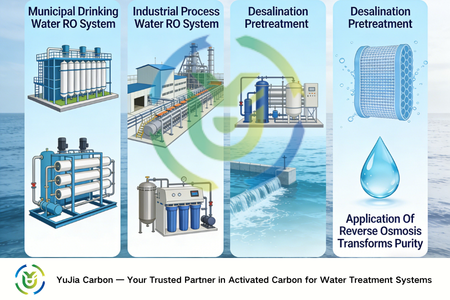
The core demand of municipal drinking water RO system is to ensure that the water is safe and tastes good, so the selection of activated carbon needs to be focused on:
1 Priority is given to the selection of catalytic activated carbon with strong dechlorination ability to ensure the effective removal of chlorine and chloramines in the water and protect the RO membrane.
2 Choose low ash, high purity, in line with drinking water standards of coconut shell or coal-based activated carbon, to avoid impurities, heavy metals leaching, while enhancing the taste of water.
3 Focus on the long-term stability of activated carbon, reduce the frequency of replacement, reduce operation and maintenance costs, to ensure that the water quality continues to meet the standards.
Industrial process water RO system feed water usually contains high organic matter, heavy metals, oxidizers and other pollutants, and the requirements of the water quality varies from industry to industry, the selection needs attention:
1 Select activated carbon with large adsorption capacity and high iodine value, which can effectively cope with high organic load and reduce the risk of contamination of RO membrane.
2Pay attention to the compatibility of activated carbon and chemical substances in industrial water, to avoid chemical reactions, affecting the performance of activated carbon or contamination of the effluent.
3 Select activated carbon with high mechanical strength and good abrasion resistance to adapt to the high pressure and high flow operating conditions of the industrial system and prolong the service life.
The feed water of seawater desalination RO system is characterized by high salinity, high microbial content, easy scaling, etc. Activated carbon selection needs to focus on these challenges:
1 Select activated carbon that is resistant to high salinity to ensure that it can still maintain good adsorption performance in a high-salt environment and effectively remove chlorine, organic matter and other pollutants in the water;
2 Focus on the biological pollution control ability of activated carbon, choose activated carbon that is not easy to harbor microorganisms, avoid the formation of biofilm, and reduce the biological pollution of RO membrane;
3 Select activated carbon with high mechanical strength and wear resistance to adapt to the high pressure and high flow rate operating conditions of the desalination system and avoid carbon powder generation.
Suppliers are required to provide test reports issued by authoritative third-party testing organizations, focusing on verifying the iodine value, dechlorination capacity, ash content, heavy metal content and other core indicators of activated carbon to ensure compliance with the selection requirements.
Require the supplier to provide the dechlorination test report of the activated carbon, focusing on the penetration time, dechlorination efficiency and other data, to ensure that its dechlorination capacity meets the operational requirements of the RO system.
Verify the iodine value of the activated carbon through on-site sample testing or commissioning third-party testing to avoid false data provided by the supplier and ensure that its adsorption performance meets the standard.
For large, complex RO systems (such as industrial high organic load systems, seawater desalination systems), it is recommended to carry out pilot test, the candidate activated carbon in the actual water intake conditions for trial operation, to assess its adsorption performance, service life, pressure loss and other indicators to ensure the accuracy of the selection.
The initial purchase cost of high-quality activated carbon is higher, but the service life is long and the replacement frequency is low; the initial cost of poor-quality activated carbon is low, but the service life is short and it needs to be replaced frequently, which increases the operation and maintenance cost in the long run. We need to calculate the purchase cost per unit of time by taking into account the service life of the activated carbon and choose a more cost-effective product.
High-quality activated carbon can effectively protect the RO membrane, reduce membrane contamination, oxidative damage, extend the service life of the membrane, and reduce the replacement cost of RO membrane (RO membrane is one of the most costly components in the RO system). Therefore, choosing activated carbon with good performance can realize long-term cost savings by reducing the number of membrane replacements.
Activated carbon with stable performance and long service life can reduce the number of replacements, reduce the cost of manual replacement and downtime loss; at the same time, reasonably selected activated carbon can reduce the pressure loss of the system, reduce energy consumption, and further reduce operation and maintenance costs.
Combined with the core requirements of RO pretreatment, the iodine value of 800-1200mg/g of activated carbon is most suitable. If the feed water has high organic matter and chlorine content, choose 1000-1200mg/g high iodine value activated carbon; if the feed water is cleaner, choose 800-1000mg/g activated carbon to balance the cost and performance.
The service life of activated carbon is affected by the influent water quality, water production, operating conditions and other factors, usually 6-12 months. If the influent water is high in pollutants and the water production is large, the service life may be shortened to 3-6 months; if the influent water quality is clean and the operation is standardized, the service life may be extended to more than 12 months. It is recommended to test the chlorine content and organic matter content of the effluent water on a regular basis, and replace the activated carbon in time when the indexes exceed the standard.
Ordinary coconut shell activated carbon has limited adsorption effect on chloramine and cannot realize efficient removal. If you need to remove chloramine from water, you need to choose the catalytically modified coconut shell catalytic activated carbon, which decomposes chloramine into harmless nitrogen and water through catalytic reaction, realizing highly efficient removal of chloramine and protection of RO membrane.
It is recommended to be replaced every 6-12 months, and the specific replacement cycle should be adjusted according to the actual operation: when the chlorine content of the water is detected to be more than 0.1mg/L, the content of organic matter rises significantly, or the pressure loss of the system exceeds 20% of the design value, it is necessary to replace the activated carbon in a timely manner; in addition, regular backwashing can prolong the service life of the activated carbon, but it can’t replace the replacement.
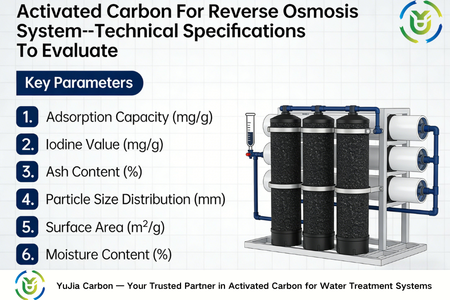
Activated carbon as the core material of reverse osmosis pretreatment system, its selection of science, rationality, directly determines the RO membrane operating efficiency, service life and water quality. When selecting activated carbon, it is necessary to comprehensively evaluate the performance and cost of activated carbon around the six core indexes of raw material type, iodine value, chlorine removal ability, particle size, mechanical strength, ash and purity, combined with the feed water quality of the RO system, operating conditions and application scenarios, to avoid common selection mistakes.
At the same time, strict quality testing is required before procurement to ensure that the activated carbon meets the selection requirements; regular maintenance and testing are required during operation, and the replacement cycle should be formulated reasonably to realize the best use of activated carbon. Through systematic and scientific selection and management, we can give full play to the pretreatment effect of activated carbon, protect RO membrane, reduce operation and maintenance costs, realize the long-term, efficient and stable operation of reverse osmosis system, and provide high-quality and safe water for different scenes.