In the pre-treatment of desalination system, activated carbon plays an indispensable role, and its selection is directly related to the service life of the reverse osmosis (RO) membrane, the quality of the effluent water, and the operating cost of the whole system. If the choice is not appropriate, it will not only lead to RO membrane damage due to oxidation, the water quality does not meet the standard, but also increase the equipment maintenance costs and downtime loss.
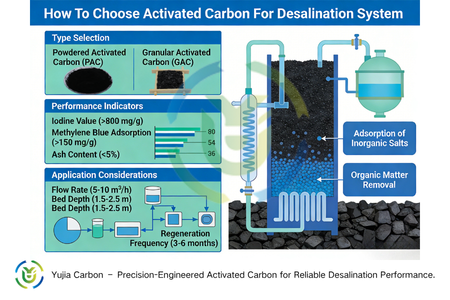
In this paper, we will comprehensively analyze the selection logic from the core role of activated carbon, type division, key selection parameters, raw material differences, filtration design points, common misunderstandings, supplier evaluation and future development trends in eight dimensions, to provide a grounded selection reference for desalination projects of different sizes and different needs.
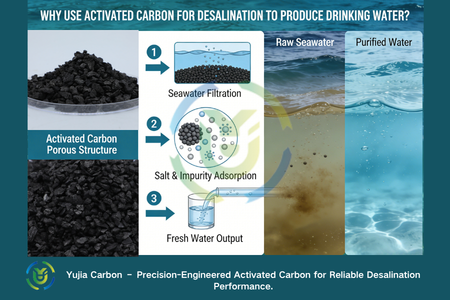
Chlorine and oxidant contained in seawater and water to be treated are “invisible killers” of RO membrane, and long-term contact will lead to oxidative degradation of the membrane and greatly shorten the service life of the membrane. Activated carbon can efficiently remove chlorine and all kinds of oxidants in water through adsorption, protecting RO membrane from the source and avoiding water quality decline and replacement cost increase due to membrane damage.
Seawater and raw water contain a large number of natural organic matter (NOM), volatile organic compounds (VOCs) and all kinds of residual chemicals, these pollutants will not only affect the taste of water and water quality, but also may form dirt on the surface of the RO membrane, reducing the filtration efficiency. Activated carbon with strong adsorption capacity, can effectively adsorb such organic pollutants, reduce the pressure of subsequent treatment.
In addition to removing pollutants, activated carbon can also effectively reduce the chromaticity of the raw water, odor, and remove trace pollutants in the water, so that the water quality into the RO membrane to achieve the optimal state, thus enhancing the filtration efficiency of the RO membrane, extending the membrane’s operating cycle, and to ensure that the final quality of the water meets the standards.
Granular activated carbon (GAC) is the preferred type for large-scale desalination plants, with uniform particles and well-developed pore structure, which is very suitable for filtration column filtration. Its core advantage is its large adsorption capacity and stable operation, which can meet the demand for continuous operation of large-scale systems and remove chlorine and organic pollutants efficiently over a long period of time. However, it should be noted that granular activated carbon has certain requirements on the installation space, and sufficient filter bed space should be reserved, which is suitable for large-scale and continuous desalination projects.
Powdered activated carbon is mainly used in specific pretreatment processes, such as batch treatment, temporary surge of raw water pollutants and other scenarios. Its advantage is that it is flexible in application, the dosage can be adjusted flexibly according to the concentration of pollutants, and the short-term cost is low, without the need for complex filter bed design. But at the same time there are limitations: powdered activated carbon treatment and disposal process is relatively cumbersome, and is not suitable for long-term continuous filtration, mostly used for temporary emergency or auxiliary pretreatment links.
This type of activated carbon is mainly used in specific industrial-grade seawater desalination systems, with uniform particles, high hardness, and good compression resistance, suitable for high-pressure operation environment. Its core feature is strong stability, not easy to produce powder shedding, can effectively avoid membrane contamination caused by activated carbon powder into the RO membrane, suitable for industrial seawater desalination projects with high requirements for operational stability.
|
Activated Carbon Types |
Core Advantages |
Applicable Scenarios |
|
Granular Activated Carbon (GAC) |
Large adsorption capacity, stable operation, long-term and efficient dechlorination and organic matter removal |
Large-scale desalination plants, large-scale, continuous operation projects |
|
Powdered Activated Carbon (PAC) |
Flexible application, low short-term cost, no need for complex filter bed design. |
Batch processing, temporary surge of pollutants, temporary emergency or auxiliary pretreatment |
|
Extruded/columnar activated carbon |
High hardness, strong stability, not easy to produce carbon powder, good pressure resistance. |
Industrial-scale desalination system with high requirements for operational stability. |
When choosing activated carbon, we can’t judge only by “type”, but need to focus on its core performance parameters, which directly determine the effect and service life of activated carbon in desalination pretreatment, and are the core basis for selection.
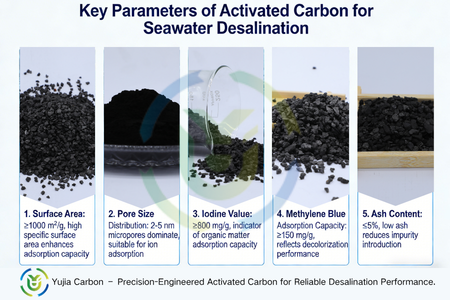
Iodine value is the core index to measure the adsorption capacity and adsorption strength of activated carbon, mainly reflecting the microporous volume of activated carbon – the higher the iodine value, the more developed the microporous of activated carbon, the stronger the adsorption ability of small molecules of organic matter, chlorine and other pollutants. For the pretreatment of seawater desalination, it is recommended to choose the activated carbon with iodine value in accordance with the industry standard. Generally speaking, the higher the iodine value is, the better it can meet the demand for efficient dechlorination and removal of small molecule pollutants in seawater desalination.
The adsorption capacity of activated carbon mainly depends on its specific surface area and pore structure, both of which need to be adapted to the needs of seawater desalination: microporous (small pore size) is mainly used for adsorption of chlorine and small molecule organic pollutants, which is the most critical pore type in the pretreatment of seawater desalination; mesoporous (medium pore size) is mainly used for adsorption of large molecule pollutants such as natural organic matter (NOM). Therefore, it is necessary to prioritize the activated carbon with balanced ratio of microporous and mesoporous pores in the selection, which can remove chlorine efficiently as well as all kinds of organic pollutants effectively.
Particle size and mesh size directly affect the filtration efficiency and system pressure loss of activated carbon: the smaller the particle size, the larger the specific surface area, the higher the adsorption efficiency, but at the same time, it will increase the pressure loss of the system, which will easily lead to the clogging of filtration beds; if the particle size is too large, it will be insufficient for adsorption efficiency, and will not be able to remove the pollutants adequately. Therefore, according to the filtration speed of the desalination system, the design of the filter bed, choose the appropriate particle size and mesh number, balance the adsorption efficiency and pressure loss, to avoid clogging or insufficient adsorption problems.
The filter bed of seawater desalination system is mostly in continuous operation for a long time, and the activated carbon is prone to abrasion and powder shedding (i.e., “carbon powder”) in the process of water impact and backwashing, etc. These carbon powders will enter the RO membrane, leading to membrane contamination and clogging, and affecting the service life of the membrane. Therefore, the hardness and abrasion resistance of activated carbon is crucial, and we need to choose products with high hardness and strong abrasion resistance to reduce carbon powder and ensure the long-term stable operation of the system.
Ash in activated carbon is an important reflection of its impurity content, high ash will lead to the release of impurities in the use of activated carbon, these impurities will enter the RO membrane, resulting in membrane contamination, fouling, affecting the quality of water. Therefore, activated carbon for seawater desalination should preferably choose products with low ash content and high purity, and it is generally recommended that the ash content meets the relevant standards of the industry, so as to avoid damage to the RO membrane due to impurity pollution.
Chlorine removal is one of the core functions of activated carbon in desalination pretreatment, and the chlorine removal rate is the key index to measure its performance and the core guarantee to protect RO membrane, which belongs to the parameter of “non-negotiable”. When selecting activated carbon, we need to pay attention to the dechlorination rate index to ensure that it can efficiently remove chlorine and oxidants in water, and generally recommend that the dechlorination rate reaches the industry standard or above, so as to avoid oxidative damage to the RO membrane due to incomplete dechlorination.
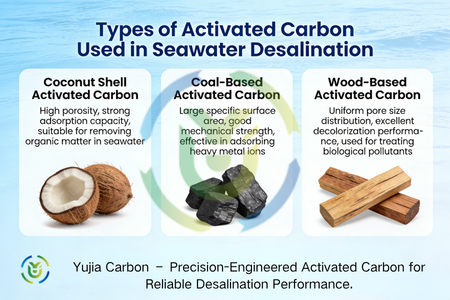
Coconut shell activated carbon is one of the preferred raw materials in desalination pretreatment, and its core advantages are developed microporous structure, large specific surface area, excellent dechlorination effect, and low ash content, high purity, and can effectively protect the RO membrane. At the same time, coconut shell activated carbon is more wear-resistant and has a longer service life, which is suitable for desalination projects with high requirements for chlorine removal and strict requirements for effluent water quality, especially for RO membrane pre-treatment (Keywords: coconut shell activated carbon for RO pre-treatment).
The core features of coal-based activated carbon are balanced pore structure (moderate ratio of microporous and mesoporous), relatively low cost, high hardness and wear resistance, which is suitable for large-scale use in large-scale seawater desalination plants. It can take into account the needs of dechlorination and removal of organic pollutants, with high cost performance, and is a more widely used type of activated carbon in large-scale seawater desalination projects, especially suitable for scenarios with requirements for cost control and high demand for continuous operation.
The outstanding advantage of wood-based activated carbon is its large mesopore volume, which is suitable for the adsorption of large molecule pollutants, such as natural organic matter (NOM), and therefore is more suitable for seawater desalination systems with a high content of organic pollutants in the raw water. However, it should be noted that the number of micropores of wood-based activated carbon is relatively small, and the effect of chlorine removal is slightly inferior to that of coconut shell and coal-based activated carbon, which is generally used in scenarios with a high content of organic pollutants and a relatively low demand for chlorine removal, or as an auxiliary pre-treatment material.
Empty bed contact time refers to the residence time of raw water in the activated carbon filter bed, which directly affects the adsorption effect of activated carbon – insufficient residence time, the pollutants can not be fully adsorbed; residence time is too long, it will increase the system pressure and operating costs. For seawater desalination pretreatment, according to the type of activated carbon, raw water pollutant concentration, the design of the optimal EBCT, to ensure that the pollutants are fully adsorbed, while taking into account the operational efficiency of the system.
The filtration speed should be matched with the activated carbon particle size and filter bed design to balance the adsorption efficiency and pressure loss. Too fast filtration speed will lead to insufficient contact between raw water and activated carbon, and the adsorption effect will be reduced; too slow filtration speed will increase the system energy consumption and operating costs. Generally speaking, the filtration speed of granular activated carbon should be controlled in a reasonable range, while powder activated carbon should be adjusted according to the dosage of mixing and filtration speed.
After long-term operation, the activated carbon filter bed will accumulate a large number of pollutants and impurities, leading to a decline in filtration efficiency and an increase in pressure loss, so it needs to be regularly backwashed. The frequency and intensity of backwashing should be adjusted according to the type of activated carbon and the concentration of pollutants in the raw water, in order to completely remove the impurities in the filter bed, but also to avoid excessive intensity of backwashing leading to wear and tear and loss of activated carbon, and to prolong the service life of activated carbon.
Bed depth should be combined with the activated carbon particle size, filtration speed and adsorption demand design, the bed is too shallow, the adsorption effect is insufficient; bed is too deep, it will increase the system pressure and floor space. At the same time, the system configuration needs to be adapted to the type of activated carbon, for example, granular activated carbon is suitable for filter column configuration, and powder activated carbon is suitable for stirring pretreatment configuration, to ensure that the activated carbon can give full play to the adsorption effect.
Myth 1: Selecting activated carbon only according to iodine value – Iodine value is an important indicator, but not the only indicator. If the pore structure, hardness, chlorine removal rate and other parameters are ignored, even if the iodine value is high, poor adsorption effect, membrane pollution and other problems may occur.
Myth 2: Neglect the particle size distribution – uneven particle size distribution will lead to unstable filtration efficiency, either clogging, or adsorption is not sufficient, according to the system design to choose a uniform particle size of activated carbon.
Myth 3: Neglect the hardness and abrasion resistance – some practitioners in order to control costs, choose low hardness of activated carbon, resulting in the use of a large number of carbon powder, pollution of the RO membrane, but increased maintenance and replacement costs.
Myth 4: Use of low-quality activated carbon – low-quality activated carbon is not only poor adsorption, but also may release impurities and harmful substances, contamination of water quality, damage to equipment, seemingly low-cost, but in fact, the loss is not worth the gain.
Choosing a high-quality activated carbon supplier is the key to guaranteeing the quality of activated carbon and the stable operation of the system. When evaluating suppliers, we need to focus on the following four aspects to avoid choosing “three nos” products or unreliable suppliers.
Require suppliers to provide relevant quality certification (such as industry standard certification) and product test reports, focusing on the verification of iodine value, dechlorination rate, ash and other key parameters, to ensure that the product meets the requirements of seawater desalination.
Priority is given to suppliers with rich experience in desalination project cooperation, such suppliers understand more about the needs of desalination, and can provide suitable products and technical support to avoid problems caused by product mismatch.
Ask the supplier about the source of raw materials to ensure that the quality of raw materials is stable and the batches are consistent, so as to avoid unstable performance of activated carbon due to fluctuation of raw materials, which may affect the operation of the system.
High-quality suppliers should be able to provide professional technical support, including activated carbon selection guidance, filter design recommendations, operation and maintenance skills, etc., to help practitioners better use of activated carbon and improve system operation efficiency.
New activated carbon materials (e.g. modified activated carbon, nano activated carbon) will be gradually promoted, the adsorption capacity and dechlorination efficiency of these materials are higher and their service life is longer, which can further enhance the effect of seawater desalination pre-treatment.
Catalytic activated carbon can realize the double function of “adsorption + catalytic degradation”, which can remove chlorine and organic pollutants faster, reduce the replacement frequency of activated carbon, and lower the operation cost, and it will become an important development direction of seawater desalination pretreatment. It will become an important development direction of seawater desalination pretreatment.
Activated carbon will be deeply integrated with ultrafiltration, microfiltration and other modern pretreatment technologies to form an integrated pretreatment system, improve the overall purification efficiency, and meet the large-scale and intelligent operation requirements of large-scale seawater desalination projects.
The core of selecting activated carbon for seawater desalination system is “fit” – fit system scale, fit pretreatment needs, fit RO membrane protection requirements, while taking into account the cost and service life. This article provides practitioners with a complete selection logic by sorting out the roles, types, key parameters, raw material differences, design points, misconceptions, and supplier evaluation methods of activated carbon.
In conclusion, when choosing activated carbon for seawater desalination, we should not blindly pursue “high iodine value” or “low cost”, but should comprehensively consider the key parameters, combine with the actual needs of the project, and choose high-quality products and reliable suppliers, so as to truly play the value of activated carbon for pretreatment, protect the RO membrane, and improve the effluent membrane. Protect RO membrane, improve water quality and reduce operating costs. If you need further selection guidance, you can consult professional activated carbon suppliers or industry experts to get targeted advice.