Activated carbon for gold extraction is critical to the efficiency and effectiveness of all types of mining operations, with its ability to adsorb gold from cyanide solutions by virtue of its microporous structure and chemisorption properties (specific surface area 500-1500 m2/g). The application scenarios vary slightly from small-scale mining, where simple column designs are used, to large-scale mining, where CIP and CIL systems are used.
Choosing high quality activated carbon for gold extraction can reduce consumption, improve efficiency and lower costs. This article centers on its selection criteria, supplier screening, raw material comparison and other core content to provide practitioners with practical guidance.
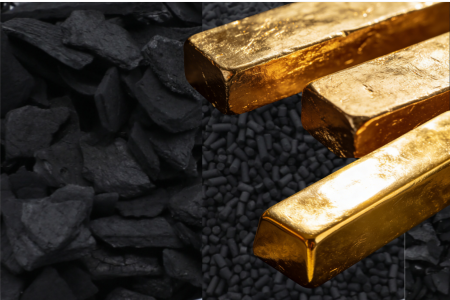
Activated carbon for gold extraction is a kind of functional material specially used for gold extraction, and its core working principle is based on its own microporous structure and chemical adsorption characteristics: the densely covered microporous inside the activated carbon can capture the gold-cyanide complex in cyanide solution, and fix the gold firmly on its own surface through chemical adsorption, and then realize the separation and purification of gold through desorption, electrolysis and other subsequent processes. In practice, the activated carbon needs to be in full contact with the gold-bearing slurry in order to maximize the adsorption effect.
Depending on the scale of mining, the application of activated carbon for gold extraction varies: small-scale artisanal mining mostly adopts column adsorption design, which is simple and easy to operate, and is suitable for low-cost operation; while large-scale industrial mining mainly adopts mature systems such as CIP, CIL, and CIC (Column-In-Carbon Method), which have higher requirements for the stability of the performance of activated carbon and the consistency of the batch, and are capable of realizing large-scale and high-efficiency gold extraction. The importance of activated carbon for gold extraction
Activated carbon for gold extraction is the core material for modern gold mining and beneficiation, and it plays a key role in the three mainstream gold extraction processes, namely, carbon in pulp (CIP), carbon in leach (CIL), and carbon in leach optimization (CIC), which directly determines the recovery rate of gold and the production efficiency. In these three processes, activated carbon assumes the core function of adsorbing gold ions in the slurry, and high-quality activated carbon can enhance the adsorption efficiency, shorten the process cycle, and reduce the loss of gold. Among them, the CIC process requires a higher adsorption rate and suitability of activated carbon, and high-efficiency activated carbon can accurately match the demand, and synergistically guarantee the profitability of gold extraction with the CIP and CIL.
From the cost and environmental protection point of view, activated carbon for gold extraction can be regenerated and utilized many times, which can reduce the input of mine consumables, and its good anti-abrasive properties can reduce the production of charcoal powder in each process link to avoid the loss of gold adsorption; at the same time, it is economical and environmentally friendly, with strong suitability, and it can adsorb the harmful impurities of slurry at the same time, which is in line with the demand for green mining, and the relevant research shows that its combination with electro-coagulation in the three major processes (especially the CIC) can recover up to 96% or more of the fine-grained gold ores. Relevant research shows that its combination with electro-coagulation in the three major processes (especially CIC) for fine-grained gold ore recovery can reach over 96%. The selection of activated carbon with high adsorption efficiency and strong mechanical strength is the core premise to ensure the continuous and efficient operation of the three processes.
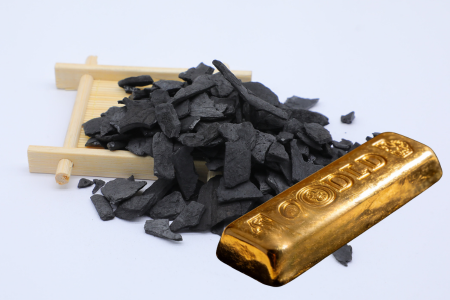
Raw material quality is the basis for determining the performance of activated carbon for gold extraction, among which coconut shell is the optimal raw material, and the thicker the coconut shell, the better. The thicker the coconut shell, the better. Choose the coconut shell with large thickness, low volatility, low moisture content and high fixed carbon content, the activated carbon will have higher strength, lower ash content, and better gold adsorption capacity and adsorption efficiency. This is because high-quality coconut shell raw materials can give the activated carbon more developed microporous structure and more stable chemical properties, providing a guarantee for efficient gold extraction.
The particle size of activated carbon for gold extraction needs to seek a balance between adsorption rate and screening efficiency: the smaller the particle size, the larger the specific surface area, the faster the rate of gold adsorption, but at the same time, the more difficult to screen out from the slurry, which can easily lead to the double loss of activated carbon and gold; the particle size is too large, it will reduce the adsorption rate, affecting the overall efficiency of the gold extraction.
At present, there are three commonly used activated carbon particle sizes in gold recovery: 6-12 mesh (1.68 mm ~ 3.36 mm), 8-16 mesh (1.19 mm ~ 2.38 mm), 6-16 mesh (1.19 mm ~ 3.36 mm). For CIP and CIL plants, it is necessary to select a particle size specification that can balance the screening efficiency and adsorption rate according to their own screening equipment and process design.
Adsorption capacity, also known as loading capacity, refers to the maximum amount of gold that can be adsorbed by activated carbon, the size of which is closely related to the physical and chemical properties of activated carbon, and is usually expressed by the K value. The higher the K value is, the stronger the gold adsorption capacity of activated carbon is, and the activated carbon per unit of mass can adsorb more gold, which can effectively increase the output of gold extraction and reduce the cost of activated carbon consumption per unit of gold extraction.
Adsorption rate refers to the speed of gold adsorption by activated carbon, which is also significantly affected by the physical and chemical properties of activated carbon, and is measured by R-value. The higher the R-value is, the faster the activated carbon can adsorb gold, which can shorten the overall cycle of gold extraction and improve the production efficiency, and it is especially suitable for the large-scale gold extraction operations that have requirements for processing speed.
Mechanical strength, abrasion resistance and hardness are indispensable and important indicators of activated carbon for gold extraction, which are no less important than the adsorption performance. In CIC, CIP, CIL and other gold extraction processes, activated carbon will experience intense friction and tumbling, if the strength is too low, it is very easy to wear into fine powder, which will not only cause the loss of the activated carbon itself, but also lead to the loss of gold adsorbed on the surface of the activated carbon, which will greatly reduce the effect of gold extraction and the economic benefits.
Therefore, high-quality activated carbon for gold extraction needs to strike a balance between hardness and adsorption performance – not only should it have enough mechanical strength to resist abrasion, but also should ensure good adsorption capacity and adsorption rate, and currently, coconut shell-based activated carbon performs the best in this balance.
Iodine value is an important index to measure the degree of pore development of activated carbon, the higher the iodine value, the more developed the microporous structure of activated carbon, the larger the specific surface area. Under specific working conditions, activated carbon with high iodine value can provide more adsorption sites, thus enhancing the gold bearing capacity and adsorption rate, which is one of the core indicators for judging the performance of activated carbon for gold extraction.
CTC value (carbon tetrachloride adsorption value) is similar to iodine value, and is also used to evaluate the degree of pore development of activated carbon.The higher the CTC value, the more perfect the microporous structure of activated carbon, and the gold bearing capacity and adsorption rate will be increased accordingly under specific working conditions, which can be used in conjunction with the iodine value to more comprehensively judge the adsorption performance of activated carbon.
The appearance morphology of activated carbon also affects the efficiency of gold extraction, and high-quality activated carbon for gold extraction should be characterized by uniform particle size and clean appearance. Uniform particle size can ensure the uniform distribution of activated carbon in the slurry, avoiding the local concentration is too high or too low, so as to improve the overall adsorption rate; clean appearance can reduce the interference of impurities on the adsorption process.
In addition, strict control of particle size can minimize the dust generated during the wear and regeneration of activated carbon, and high-quality activated carbon can be put into use directly after washing without grinding in advance, which can save the cost and time of pre-treatment.
Currently, there are two main activation processes in activated carbon plants: the Sleiphus process and the Rotary Furnace process, both of which produce activated carbon with different properties.
Sleiphus process controls the iodine adsorption value of activated carbon at 900-950 mg/g, which can improve the hardness index of activated carbon, but will sacrifice its gold adsorption capacity and adsorption speed, which is not suitable for the scenes with higher requirements on gold extraction efficiency; Rotary Furnace process can produce activated carbon with higher iodine value, and at the same time, the strength will be controlled at more than 98%, which can take into account gold adsorption performance under the prerequisite of guaranteeing mechanical strength. The rotary furnace process can produce activated carbon with higher iodine value and control the strength above 98%, which can ensure the mechanical strength and take into account the gold adsorption performance.
The type of raw material is an important prerequisite for the selection of gold-raising activated carbon, the mainstream gold-raising activated carbon is mainly coconut shell-based and coal-based two kinds of activated carbon, the two in the adsorption performance, mechanical strength, and other core indicators of the difference is significant, the specific comparison is as follows:
|
Activated Carbon Types |
Core Characteristics |
Suitability Evaluation |
|
Microporous developed, adsorption high efficiency, high mechanical strength, less abrasion, uniform particle size, renewable, environmental protection and economy. |
First choice for gold extraction, suitable for all kinds of scenarios, especially suitable for operations that require efficiency and loss. |
|
|
Uneven structure, poor adsorption, low mechanical strength, easy to wear, high ash content, interfere with gold extraction process. |
Poor applicability, can only be used in some scenarios, the overall performance is far less than the coconut shell-based activated carbon. |
At present, there are three mainstream gold extraction processes in the industry, each process has its own focus on the performance requirements of the activated carbon, which need to be precisely matched to achieve the best results.
CIP (carbon slurry method): the process is “crushing and grinding → leaching → adsorption → desorption and electrolysis → smelting”, the activated carbon is in direct contact with the slurry throughout the whole process, which has a high adsorption efficiency and is suitable for processing low-grade ores with a high gold recovery rate. This process has high requirements for the adsorption capacity, adsorption rate and mechanical strength of activated carbon, and it is necessary to choose specifications that take all three into account.
CIL (Carbon Infiltration Method): The process is “crushing and grinding → leaching and adsorption synchronization → desorption and electrolysis → smelting”, leaching and adsorption are carried out at the same time, which simplifies the process and shortens the processing time, and it is suitable for processing carbonaceous ores. In this process, the activated carbon needs to withstand more intense agitation and friction, so the requirements for mechanical strength and adsorption rate are more stringent.
CIC (column carbon method): the process is “crushing and grinding → leaching → column adsorption → desorption and electrolysis → smelting”, through the adsorption column to realize gold adsorption, suitable for processing low concentration of gold-containing solutions, especially for tailings treatment, high adsorption efficiency and simple process. This process has high requirements for the pore development and particle size uniformity of activated carbon, and it is necessary to choose products with perfect microporous structure and consistent particle size.
When choosing activated carbon, it is necessary to combine the characteristics of the ore (such as grade, carbon content), gold content, process design, economic cost and environmental protection requirements to make a comprehensive judgment: low-grade ore is preferred to the CIP process with high adsorption capacity of activated carbon; carbon-containing ore is suitable for the CIL process with high-intensity, high adsorption rate of activated carbon; tailings and other low-concentration gold-containing solution is suitable for the CIC process with a high porosity, particle size uniformity of activated carbon. The tailings and other low concentration gold-containing solutions are suitable for CIC process with activated carbon with high porosity and uniform particle size.
In the actual selection process, many practitioners are prone to fall into the following misconceptions, which lead to the decline in gold extraction efficiency and increase in cost, and need to be avoided:
A: Coconut shell-based activated carbon has high mechanical strength, well-developed microporous, excellent adsorption efficiency, low ash content, renewable, can reduce losses, reduce costs, and its comprehensive performance is far better than that of coal-based activated carbon.
A: High-quality coconut shell-based activated carbon for gold extraction can be regenerated after 3-5 times of acid washing and thermal regeneration, and it can be used for a long time under standardized operation, but the service life depends on the quality of the ore, process and carbon itself, and it needs to be monitored and replaced regularly.
A: Commonly used 6×12 mesh, 8×16 mesh, 6×16 mesh, preferably 6×12 mesh or 8×16 mesh (balanced screening and adsorption efficiency), need to match their own screening equipment and process.
A: Yes, CIP/CIL process is suitable for low grade ore, CIC process is suitable for low concentration solution and tailings, the key is to choose high quality activated carbon and ensure sufficient contact time.
A: Check ISO9001 and other certifications and batch test reports, verify the iodine value and other key indicators, third-party verification if necessary, and understand the supplier’s raw materials, processes and sample testing services.
When choosing suppliers, quality certification is the first checkpoint, and priority should be given to suppliers with international certifications such as ISO9001, NSF-61, KOSHER, HALAL, etc. These certifications are not a formality, but direct proof that the supplier’s products meet international quality standards, which can effectively guarantee the stability and consistency of the performance of activated carbon.
At the same time, batch-specific test reports should be requested from suppliers, focusing on the test data of key indicators such as iodine value, CTC value, ash content, mechanical strength, etc. High-quality suppliers will unreservedly provide relevant reports to prove that their product quality meets the standards.
Production capacity and delivery reliability are the key factors determining the success or failure of cooperation. Before cooperation, you need to confirm that the supplier can take their own orders, whether they have ready stock, or whether the production cycle meets their operational needs. In addition, you should also examine the supplier’s production facilities, to understand its typical delivery cycle – with automated production lines and perfect quality control system suppliers, can provide more stable product quality and faster delivery speed, to avoid supply delays affect the production schedule.
Quality suppliers not only provide qualified products, but also provide a full range of technical support. When choosing, you need to know whether the supplier can assist you in choosing the appropriate specifications of activated carbon, solving technical problems in the production process and optimizing the gold extraction process; at the same time, ask whether it has a professional technical team to meet the demand and whether it can provide customized products, as these value-added services can provide great convenience for the subsequent production.
The price system needs to be adapted to your own business needs, and you can’t simply pursue low prices. You should ask for quotations from multiple suppliers, and when comparing them, you should not only pay attention to the unit price, but also consider the transportation cost, minimum order quantity, payment terms and other factors. Sometimes a slightly higher unit price is often accompanied by better service, faster delivery or better performance, but in the long run can save costs. For specialty products, such as apricot shell activated carbon, it is important to ensure that comparisons are made to the same specifications to avoid the “wrong product”.
Supply chain stability has become increasingly important in recent years. When choosing suppliers, we need to confirm whether they have multiple raw material procurement channels and whether they can maintain a stable supply in case of emergencies; we give priority to suppliers with close relationship with raw material suppliers and perfect inventory management to ensure that they can still protect their own production in case of supply chain disruption.
Selecting high quality activated carbon for gold extraction is the key to improve efficiency and reduce cost and consumption, and it is necessary to prioritize the use of high quality thick coconut shell raw materials, combine with the gold extraction process to select the particle size, adsorption performance and other suitable indicators, and pay attention to the production process; suppliers need to consider the quality of the certification, production capacity, and other core factors, to avoid misunderstandings, and accurately match the process. To sum up, the selection of activated carbon for gold extraction needs to take into account the performance, process and economy, prioritize the coconut shell-based products, the products produced by the rotary furnace, and long-term cooperation with reliable suppliers to achieve high efficiency and low-cost gold extraction.