Wooden activated carbon is a kind of porous adsorbent material made of wood as raw material and processed by special technology, which is widely used in many fields by virtue of its excellent adsorption performance. If you want to master the production method of wood-based activated carbon, you first need to clarify its core definition, raw material advantages and complete production process. In this article, we will comprehensively dismantle the production details of wood-based activated carbon from the basic cognition, raw material selection, production process, operational steps, quality control, equipment selection and other dimensions, while answering common questions to help you systematically understand and master the relevant knowledge.
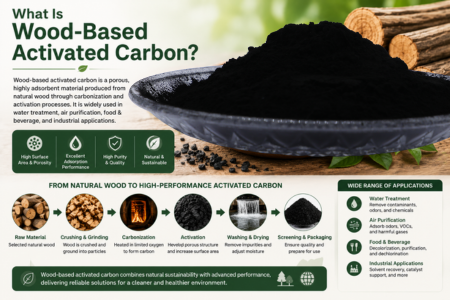
Wooden activated carbon is made from natural wood, through carbonization, activation and other processes to form adsorbent materials with a developed pore structure and a huge specific surface area, and its core characteristics are strong adsorption capacity, reasonable pore size distribution, and from natural sources, environmentally friendly and non-toxic.
|
Activated Carbon Types |
Core features |
Key parameters |
Applicable Scenario |
|
|
Wooden activated carbon |
Large mesopore volume, strong adsorption performance |
Specific surface area 800-1500m²/g, high percentage of mesopores |
Adsorption of large molecules such as dyes and COD |
|
|
Coconut shell activated carbon |
Predominantly microporous |
Specific surface area 1000-1800m²/g, high proportion of microporous |
Small molecule adsorption |
|
|
Coal-based activated carbon |
High hardness and wear resistance |
Specific surface area 700-1200m²/g, hardness ≥ 95 |
High strength, high wear scenes |
|
In practical applications, wood-based activated carbon is found in many scenarios such as water treatment, air purification, gold recovery, food decolorization and so on, and it is one of the most widely used types of activated carbon at present.
Wood is a rich and renewable resource, and forest resources are widely distributed around the world. Whether it is common hardwoods, softwoods, or sawdust, wood chips and other wastes generated from forestry processing, all of them can be used as raw materials, and the source is convenient and the cost is controllable.
Wood itself has a high mesopore volume, and after processing, it can form a pore structure more suitable for macromolecule adsorption, which is especially suitable for the removal of dyes, COD and other pollutants in wastewater treatment.
In some areas, the cost of obtaining wood raw materials is much lower than that of coconut shells and coal, so compared with other raw materials, the production of wood-based activated carbon is more competitive in terms of cost.
As a natural biomass material, the production and use of wood has less impact on the environment, which is in line with the current green development trend, and has both sustainability and environmental benefits.
The raw materials for making wood-based activated carbon are mainly based on wood, which can be divided into two categories according to the type of wood: hardwood has a higher density and compact fiber structure, and the hardness and adsorption performance of the activated carbon made from it are more stable; softwood is lighter in texture and looser in fiber, which makes it less difficult to be processed and is suitable for mass production.
In addition to intact wood, sawdust, wood chips, twigs, bark and other wastes generated during forestry processing can also be used as raw materials, which not only realizes the recycling of resources, but also further reduces production costs.
When choosing raw materials, we need to focus on three core indicators: density, ash content and moisture content. Moderate density of wood can ensure the uniformity of the carbonization and activation process, the lower the ash content, the higher the purity of the activated carbon, and the moisture content needs to be controlled in a reasonable range to avoid affecting the subsequent processing technology.
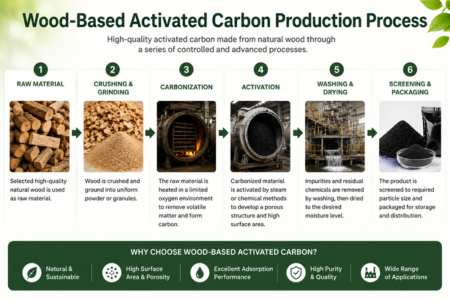
The production of wood-based activated carbon is a systematic process, the whole can be divided into four core links, namely, carbonization, activation, washing and drying as well as crushing and screening, the four links are interlocked, and the parameter control of each link will directly affect the quality of the final product.
Carbonization is the process of heating wood raw materials under anoxic environment, removing volatile substances and forming carbon blanks; activation is the core of the whole production process, forming a developed pore structure on carbon blanks through physical or chemical methods to enhance its adsorption performance; washing and drying is to remove the residual impurities and water after activation to ensure the purity and stability of the activated carbon; and finally, through crushing and sieving, activated carbon is processed into products with different particle sizes to meet the needs of different products. Finally, through crushing and sieving, the activated carbon is processed into products with different particle sizes to meet the needs of different application scenarios.
The core purpose of wood pretreatment is to remove the excess water in the raw material, adjust the size of the raw material, lay the foundation for the subsequent carbonization and activation process, and avoid the impact of raw material problems on the quality of the final product.
First of all, it is necessary to dry the wood raw material, through natural drying or mechanical drying, to reduce the moisture content of the wood to less than 15%, the moisture is too high will lead to difficult to control the temperature in the charring process, affecting the quality of the charcoal briquettes.
After drying, the wood needs to be reduced in size, according to the production demand, the wood will be processed into uniform wood chips or wood powder, to ensure that the subsequent charring and activation process is uniformly heated, to avoid the situation of insufficient local charring.
Carbonization, also known as pyrolysis, is the process of placing pre-treated wood raw materials into an oxygen-deficient environment for high-temperature heating, the heating temperature is usually controlled at 400-700℃, and the oxygen-deficient environment is the key to the success of carbonization.
In this process, the cellulose, hemicellulose and other organic substances in the wood will decompose, releasing moisture, tar, methane and other volatile compounds, ultimately leaving a solid substance with carbon as the main component, i.e. charcoal briquette.
The control of temperature is crucial, if the temperature is too low, the volatile substances can not be fully removed, and the pore structure of the charcoal briquette is not developed; if the temperature is too high, it will lead to charcoal briquettes burned and reduce the yield of the product. If there is too much oxygen, it will cause the wood to burn and the charcoal briquette will not be formed.
Activation is the core step to enhance the adsorption performance of wood-based activated carbon. A developed pore structure is formed on the charcoal briquette through a specific method, so as to greatly enhance its specific surface area and adsorption capacity, and physical or chemical activation can be selected according to the production requirements.
Physical activation adopts steam or carbon dioxide as the activator, and puts the billet into the high temperature environment of 800-1000℃, the activator will react with the carbon in the billet to remove the impurities inside the billet, and at the same time, form a large number of micropores and mesopores on the billet to improve the adsorption performance.
Chemical activation is to add chemical activators such as zinc chloride, phosphoric acid, potassium hydroxide, etc. before or during carbonization, and the activation temperature is relatively low, usually 400-700℃. Chemical activators can promote the formation of the pore structure of the carbon blanks. Compared with physical activation, the activated carbon produced has a larger specific surface area and a higher product yield, which is suitable for scenarios that require higher adsorption performance.
After activation, certain impurities and activators will remain on the surface of activated carbon (especially in the chemical activation process), and the core purpose of washing and neutralization is to remove these impurities and adjust the pH value of activated carbon to ensure that it meets the application requirements.
Firstly, the activated carbon is repeatedly rinsed with water to thoroughly remove the soluble impurities and residual chemical reagents on the surface, so as to avoid the impurities affecting the adsorption performance and purity of the activated carbon.
Then adjust the pH value of activated carbon to neutral by means of acid-base adjustment. For example, for wood activated carbon used for drinking water treatment, the pH value should be controlled between 6.5-8.5 to avoid affecting the water quality; for activated carbon used for industrial wastewater treatment, the pH value can be adjusted appropriately according to the acid and alkaline nature of the wastewater to enhance the adsorption effect.
The activated carbon after washing and neutralization contains a certain amount of moisture, which needs to be dried, and the moisture content should be reduced to a reasonable range through drying equipment, so as to ensure the stability and adsorption performance of the activated carbon, and avoid the moisture affecting the subsequent use.
After drying, according to the actual application requirements, the activated carbon is crushed and screened to be processed into products with different particle sizes, which are mainly divided into powdered activated carbon (PAC) and granular activated carbon (GAC).
Powdered activated carbon has a fine particle size and fast adsorption speed, which is suitable for liquid decolorization, wastewater treatment and other scenarios; granular activated carbon has a large particle size and high mechanical strength, which is suitable for air purification, water treatment and filtration and other scenarios.
Too high or too low activation temperature, too long or too short time will affect the formation of pore structure. Reasonable control of temperature and time is necessary to obtain optimal adsorption performance, which is one of the core parameters affecting the quality of activated carbon.
The selection of steam and carbon dioxide in physical activation and the proportion of different reagents in chemical activation will affect the pore distribution and specific surface area of activated carbon, and suitable activators should be selected according to product requirements.
Micropores are mainly used for adsorption of small molecules and mesopores are mainly used for adsorption of large molecules. Adjusting the pore size distribution according to the application scenarios can enhance the specificity of adsorption and make the activated carbon better adapted to the needs of use.
Iodine value and methylene blue value are the core standards for measuring the adsorption performance of activated carbon. The higher the iodine value, the stronger the adsorption ability of activated carbon for small molecules, and the higher the methylene blue value, the stronger the adsorption ability for large molecules.
According to the different scale of production, the production equipment of wood-based activated carbon varies, but the core equipment mainly includes four categories, namely, carbonization equipment, activation equipment, crushing and screening equipment, washing and drying equipment.
First, carbonization furnace/kiln, used for the carbonization of wood raw materials, small-scale production can use simple kiln, large-scale industrial production mostly use rotary kiln; second, activation furnace, used for the activation of charcoal billets, physical activation needs to be matched with a steam generator, chemical activation needs to be equipped with chemical reagent storage tanks and conveying equipment; third, crushing and screening equipment, used to process the dried activated carbon into products with different particle sizes, including Third, crushing and screening equipment for processing the dried activated carbon into products of different particle sizes, including crusher and sieving machine, etc. Fourth, washing and drying equipment for washing, neutralizing and drying the activated carbon to ensure the purity and stability of the products.
In addition, the industrial production needs to be equipped with waste gas treatment equipment, which is used to deal with the volatile gases generated in the process of carbonization and activation, in line with the environmental protection requirements and to avoid pollution to the environment.
Home-made mode equipment is simple, usually using simple kiln or metal drum as carbonization, activation equipment, less difficult to operate, suitable for personal or small-scale experimental use. However, due to the inability to accurately control the temperature, the amount of activator and other parameters, the quality of the activated carbon is unstable and the adsorption performance is limited, so it is only suitable for basic filtration scenarios, such as water filtration in fish tanks, simple air purification, and so on.
Industrial production mode adopts professional production equipment, such as rotary kiln, vertical activation furnace, etc., which can accurately control the parameters in the production process, and the pore structure of the activated carbon is uniform, the adsorption performance is stable, and the output is large and the purity is high, which is suitable for large-scale application in industrial scenarios, such as wastewater treatment, food processing, and purification of medicine.
|
Comparison Dimension |
Home-made (small-scale) |
Industrial production (large scale) |
|
Equipment Condition |
Simple equipment, using simple kilns, metal drums |
Specialized equipment, e.g. rotary kiln, vertical activation furnace |
|
Operating Difficulty |
Simple operation, low difficulty |
Specialized operation, precise control of parameters is required |
|
Product quality |
Unstable quality, limited adsorption performance |
Uniform pore space, stable adsorption, high purity |
|
Applicable scenes |
Basic filtration, such as fish tank filtration, simple air purification |
Industrial scenarios, such as waste water treatment, food processing |
The advantages of wood-based activated carbon are very prominent, firstly, its adsorption performance is excellent, especially in liquid phase adsorption, can quickly adsorb dyes, COD, heavy metals and other pollutants in the water, adsorption kinetics is fast, and the processing efficiency is high; secondly, the raw material is renewable wood resources, the source is wide and environmentally friendly, and the production and use of the process of environmental pollution is small, which is in line with the concept of sustainable development.
However, wood-based activated carbon also has certain limitations. Compared with coal-based activated carbon, its hardness is low, and it is easy to wear out and break during long-term use; at the same time, in some of the high-intensity, high-wear application scenarios, its loss rate is relatively high, and it needs to be replaced frequently, which increases the cost of use.
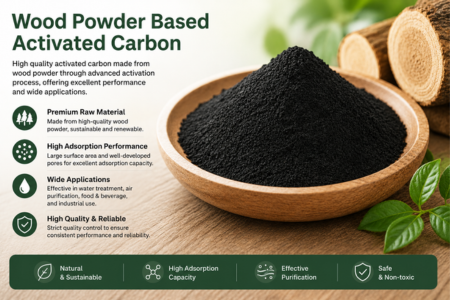
In wastewater treatment, wood activated carbon can be used to remove COD, dyes, heavy metal ions and other pollutants in wastewater, purify the water quality, and help enterprises to meet the emission standards, which is a commonly used material for industrial wastewater and domestic sewage treatment.
In the food and beverage industry, it can be used in the decolorization treatment of fruit juice, alcohol, sugar, removing impurities and off-flavors, improving the quality of the product and ensuring the taste and safety of food and beverage.
In the pharmaceutical industry, wood activated carbon can be used for the purification of drugs, removing impurities and harmful ingredients in drugs, ensuring drug safety and enhancing drug purity.
In the field of air purification, it can be used to remove VOC, formaldehyde, odor and other harmful substances in the air, improve indoor and outdoor air quality, and is suitable for home, office, factory and other scenes.
In addition, wood-based activated carbon can also be used in gold recovery, catalyst carriers and other special scenarios, giving full play to its excellent adsorption and catalytic effect, expanding its scope of application.
In the production process, the zinc chloride, phosphoric acid and other reagents used in the chemical activation process are corrosive, and safety protection measures need to be taken, and operators need to wear protective gloves, masks and other protective equipment to avoid direct contact; the carbonization and activation process will produce tar, volatile organic compounds and other exhaust gases, and need to be equipped with professional exhaust gas treatment equipment, and then discharged after treatment to meet the standards, to avoid polluting the air; the wastewater generated during the washing process needs to be treated before discharge, and to avoid polluting the air; the waste water generated during the washing process needs to be treated before discharge. Wastewater generated during the washing process should be treated and then discharged to prevent the residual chemical reagents from polluting the water body.
In the process of use, it is necessary to choose the appropriate type of wood activated carbon according to the application scene to avoid misuse; the discarded activated carbon should be reasonably disposed of, and it can be treated by incineration, landfill, etc., to avoid secondary pollution and practice the concept of green environmental protection.
The production of wood activated carbon is a process that takes both professionalism and practicality. From raw material selection and pretreatment to carbonisation and activation, each link needs to accurately control parameters in order to obtain high-quality products. Mastering its core principles and operation steps in industrial production can give full play to the adsorption advantages of wood activated carbon and be applied in various scenarios.